


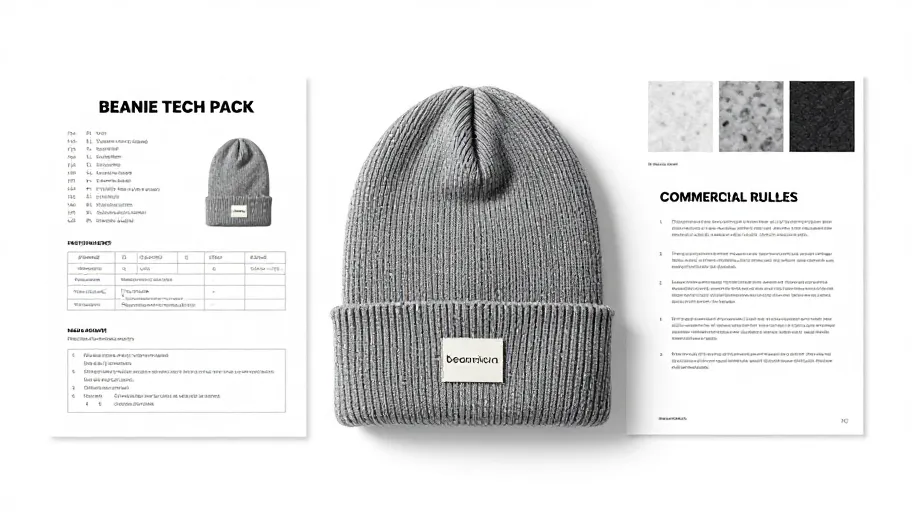
A beanie tech pack is the written specification you hand a supplier before requesting a quote: construction (knit style, gauge, cuff, crown), materials, label and branding method, artwork files, and the commercial rules you need confirmed. A complete one lets every supplier quote the same product, so you can compare offers line by line instead of decoding mismatched assumptions. This guide shows how to build it and turn it into a clear RFQ using the CLEAR RFQ Method.
Why a beanie tech pack belongs in your RFQ, not after it
Many buyers send a logo and a target price, receive quotes, then discover each supplier priced a different product: one quoted a fine-gauge merino blend, another a heavy acrylic rib knit; one included a woven label, another a heat transfer. The quotes look comparable but are not, and the buyer has no document to resolve the disagreement.
A beanie tech pack fixes this by moving specification ahead of pricing. When the supplier receives the same document, their quote becomes an answer to your questions rather than a guess at your intent. The document also becomes your reference for sample approval: if the sample deviates from the pack, you have a written basis for correction rather than a debate about what was "understood."
The CLEAR RFQ Method
CLEAR stands for Construction, Label, Embellishment, Artwork, Rules. Each letter is a block of your tech pack; together they cover what a supplier needs to quote a custom beanie accurately.
C — Construction. The physical beanie itself: knit structure (rib, cable, chunky, fine knit), cuff style (single-fold, double-fold, no cuff, brim), crown finish, yarn composition, weight or warmth target, and size range. Describe what the beanie must do — for example, whether it is positioned as a lightweight fashion piece or a cold-weather item — and let the supplier propose constructions that meet the brief, which you then document and approve.
L — Label. Branding inside and out: main label type (woven, printed, satin, heat transfer), content/care label requirements for your destination market, hangtag, and whether you supply labels or the supplier sources them. Ask the supplier to confirm which labelling documentation they can provide and what you must supply yourself.
E — Embellishment. How the logo appears on the product: embroidery (placement, stitch coverage), jacquard knit-in, woven patch, leather patch, print, or combinations. Each method changes how artwork must be prepared and how the supplier quotes, so specify it explicitly.
A — Artwork. Files, not descriptions: vector files where applicable, placement diagrams, colour references (for example Pantone codes), and maximum logo dimensions relative to the cuff or crown area. Ask the supplier which file formats they accept for each embellishment method and confirm size limitations before finalising the design.
Decision table: what to specify and what to approve
| CLEAR block | What you specify | Approval question for the supplier |
|---|---|---|
| Construction | Knit structure, cuff style, crown finish, yarn composition, size range, product positioning | "Which constructions can you produce in this yarn and gauge, and can you provide references to approve before sampling?" |
| Label | Main label type, content/care labelling, hangtag, who supplies | "Which label types can you produce in-house, what do you source externally, and what documentation do you provide for destination-market labelling?" |
| Embellishment | Logo method, placement, patch or print specifications | "Which embellishment methods do you recommend for this logo at this size, and what are the constraints of each?" |
| Artwork | Vector files, placement diagram, colour references | "Which file formats do you accept for each method, and what are the maximum dimensions for my logo on this construction?" |
| Rules | MOQ, sample policy, payment terms, lead time, certifications, inspection terms | "Please confirm in writing your current MOQ, sample policy, lead time, payment terms, available certifications with evidence, and inspection and defect terms for this specification." |
Turning the tech pack into a comparable RFQ
A tech pack becomes an RFQ when you attach your commercial questions and structure the response. Ask every supplier to quote in the same format — for example, broken into materials, embellishment, labels, packaging, and unit price at stated quantity breaks — so you can compare line by line rather than by headline number.
Two disciplines matter more than the template itself. First, document every answer: MOQ, sample policy, lead time and certifications exist only when confirmed in writing for your project; nothing a supplier says generically should enter your comparison sheet. Second, separate capability from preference: when a supplier proposes a different construction or label method than you specified, treat it as an option to evaluate and price, not a deviation to reject. The best-documented option set, not the fastest reply, is what you want on file.
When you receive quotes, verify rather than average. A quote far below others on the same specification deserves a question: which line differs? In many cases the difference is a substituted material, omitted labelling, or an assumption about packaging that the tech pack should have locked down — a sign to tighten the pack and re-request.
Pre-sample approval checklist
Before authorising any sample, work through this list and record each answer:
- Construction, cuff and crown documented and confirmed by supplier as producible
- Yarn composition and size range specified
- Label types, content labelling and supply responsibility confirmed
- Embellishment method, placement and size limits confirmed
- Artwork files accepted in the supplier's stated formats
- Written confirmation of lead time and payment terms for this specification
- Certifications and test documentation listed with evidence to verify
- Inspection, defect and rework terms documented
- All supplier answers attached to your comparison sheet
If any line is blank, the sample you approve will test an assumption rather than a specification.
FAQ
How detailed does a beanie tech pack need to be for a first RFQ? Detailed enough that two suppliers reading it would quote the same product: construction, yarn, label plan, embellishment method, artwork placement, and your commercial questions. Unknowns can stay as questions — but they must be written questions, not silences.
Should I specify yarn composition or let the supplier propose it? Both approaches work if documented. You can specify a composition and ask the supplier to confirm producibility, or describe the product's intended use and warmth positioning and ask for proposed options with quotes. Either way, the chosen composition enters the tech pack in writing before sampling.
What if suppliers quote different constructions despite the tech pack? Treat each variant as a priced option, ask which line drives the difference, and update the pack so the next quote round is tighter. Divergent quotes are information about assumptions, not reasons to abandon the document.
Do I need certifications in the tech pack? Include them as questions rather than claims: list the certifications or test documentation your market may require and ask the supplier to confirm, with evidence, what they can provide. Verify any evidence directly with the issuing body or through your own compliance review.
Can one tech pack cover multiple beanie styles? Yes — keep a shared Artwork and Rules section and a per-style Construction and Label section. This keeps quotes comparable across styles while avoiding duplicate commercial clarification.
Get the Beanie Brief
Turn this article into a working document. Get the Beanie Brief — a fill-in template that walks your team through the CLEAR RFQ Method block by block, with the approval questions built in, so your next RFQ goes out complete on the first send.
Prefer to start smaller?
Use the pre-sample approval checklist above as a one-page readiness test before your next supplier conversation. If every box is checked, you are ready to request quotes; if not, you know exactly which questions to send first.
#cap manufacturers china, #headwear manufacturers china, #cap factory








