

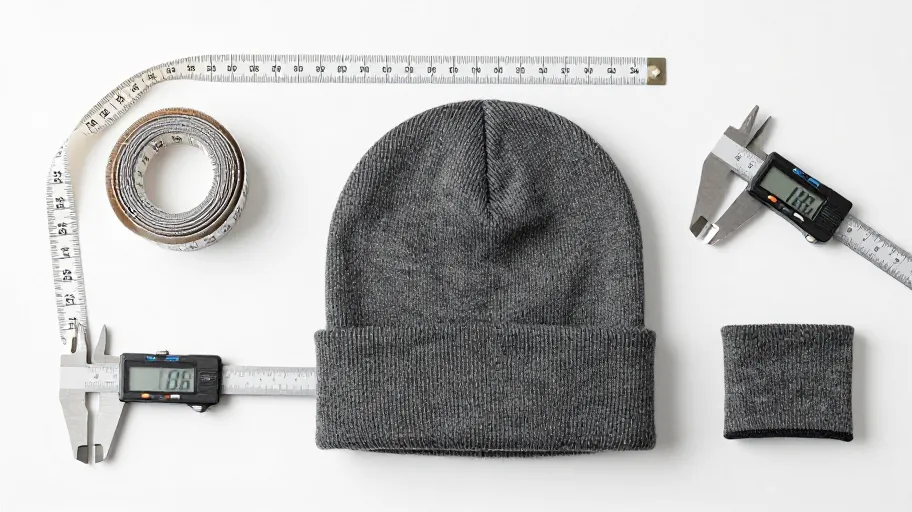
A complete beanie tech pack must document exact head circumference, crown radius, fold height, cuff thickness, and edge finish dimensions before contacting a supplier. Buyers omit these measurements because they rely on ambiguous references instead of strict dimensional drawings. This omission causes sampling delays and unexpected cost revisions. Documenting every measurement using a structured validation framework ensures accurate sampling and precise quotations.
The S.T.A.C.K. Measurement Validation Framework
When sourcing custom headwear, procurement teams focus heavily on yarn composition and label design. While these elements are vital, overlooking physical measurements in the initial beanie tech pack creates a cascade of project delays. To prevent this, apply the S.T.A.C.K. framework: Specify, Test, Align, Confirm, and Keep.
This framework forces buyers to move beyond basic length and width metrics, ensuring the supplier receives a complete dimensional blueprint.
Specify (S) Specify the exact head circumference target. Do not provide a single number. Provide a target size range and the specific measurement methodology. State whether the measurement is taken flat or on a circular last. Specify the crown radius explicitly. Does the crown feature a gathered top, a flat seam, or a pre-shaped mathematical curve? Document the curvature dimensions precisely.
Test (T) Test the fold and cuff dimensions. If the beanie features a fold-over cuff, document the folded height and the unfolded height separately. The cuff thickness impacts the total visible length of the beanie. State the exact width of the cuff band. Furthermore, document how the knit structure interacts with the fold. A ribbed knit stretches differently than a flat knit, altering the final folded dimensions.
Align (A) Align the edge finish with the measurement baseline. A raw edge, a hemmed edge, and a rolled edge require different dimensional allowances. Document the exact measurement from the top crown seam to the bottom edge. State whether the measurement includes the hem allowance or excludes it. Align the pom-pom or visor attachment dimensions with the crown radius to ensure structural integrity without distortion.
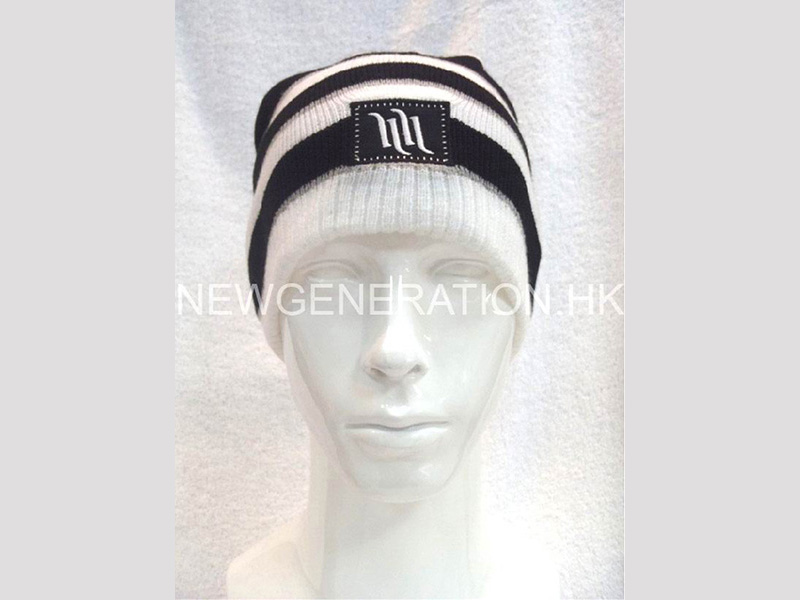
Confirm (C) Confirm the label placement coordinates. Provide exact vertical and horizontal distances from the bottom edge and the centre front seam. Do not use approximate terms like "centred." Provide the exact coordinate grid. Confirm the hanging tag loop placement and dimensions. Document the size of the loop, the attachment points, and how the attachment method affects the knit structure.
Keep (K) Keep a revision log within the tech pack. Every dimensional change must be dated, version-controlled, and annotated. When you alter the fold height, document how it impacts the total yarn consumption estimate. Maintain a record of all approved measurements to prevent the supplier from referencing outdated specifications during production.
Measurement Gap Impact Analysis
Review the decision table below to understand how missing dimensions impact the sampling phase. Use this to evaluate your current documentation before sending it to an OEM/ODM manufacturer.
| Measurement Gap | Sampling Risk | Documentation Action Required |
|---|---|---|
| Missing crown radius specification | Supplier defaults to a generic gathered top, altering the perceived fit and profile. | Provide a technical drawing detailing the crown seam or curve dimensions. |
| Ambiguous fold/cuff height | Finished length appears shorter or longer than expected after the customer folds the cuff. | Document both folded and unfolded dimensions, stating the exact fold line. |
| Undefined edge finish baseline | Hemmed edges curl or fray if the dimensional allowance is insufficient. | Specify the edge type (raw, hemmed, rolled) and confirm if the length measurement includes the hem. |
| Approximate label placement | Embroidery or woven labels distort the knit structure or sit off-centre. | Use a coordinate grid for exact vertical and horizontal placement from a defined baseline. |
| Omitted hanging loop dimensions | Loop attachment damages the knit structure or is too small for retail hanging tags. | Document loop length, width, and attachment coordinates. |
Critical Approval Questions for Your Tech Pack
Before you finalise your beanie tech pack and transmit it to a manufacturer, verify the following questions with your internal team. Ensure every question has a documented answer in your brief.
- Does the tech pack state the measurement methodology for head circumference (flat vs. on a last)?
- Have we provided exact coordinates for logo placement rather than approximate descriptions?
- Are the folded and unfolded cuff dimensions documented separately?
- Does the edge finish specification explicitly state whether the hem allowance is included in the total length measurement?
- Have we documented the exact dimensions of any附加 attachments (pom-poms, strings, patches) and their attachment coordinates?
- Is there a version control log detailing recent dimensional changes?
Frequently Asked Questions
What happens if the crown radius is not specified in the beanie tech pack? If the crown radius is absent, the manufacturer will select a default construction method. This may result in a gathered top instead of a flat seam, which alters the visual profile and the way the beanie sits on the head. Document the exact crown dimensions and seam type to control the final silhouette.
Should the total length measurement include the hem allowance? You must explicitly state your preference. If the measurement includes the hem allowance, the visible length of the beanie will be shorter once the hem is constructed. Specify whether the dimension represents the total cut length or the finished visible length to prevent sampling errors.
How do we document measurements for a slouchy beanie compared to a fitted beanie? A slouchy beanie requires additional documentation for the crown drop and the back panel dimensions. Do not rely on a single length measurement. Document the specific curvature and the extra material allowance required to achieve the slouch effect without distorting the head circumference.
Does the knit structure affect the final measurements? Yes. Different knit structures possess varying stretch and recovery properties. A ribbed knit stretches more than a flat knit. Document the intended knit structure alongside the measurements so the manufacturer can verify if the dimensions will yield the correct fit after the knitting process.
How specific must the label placement documentation be? Provide exact vertical and horizontal coordinates from a defined baseline, such as the bottom edge or the centre front seam. State "4 cm from the bottom edge, centred on the front panel" rather than "centred on the front." This prevents misalignment and ensures the label does not distort the knit structure.
Preparing a rigorous brief prevents unnecessary revisions and establishes a clear standard for the manufacturer to follow. To assist your team in standardising your initial documentation, 获取 Beanie Brief to align your internal measurement validation process.
Before you submit your documentation, download our low-friction pre-submission checklist. Verify your dimensional drawings, confirm your edge finishes, and validate your coordinate grids to ensure your tech pack is ready for review.
#cap manufacturers china, #headwear manufacturers china, #cap factory