


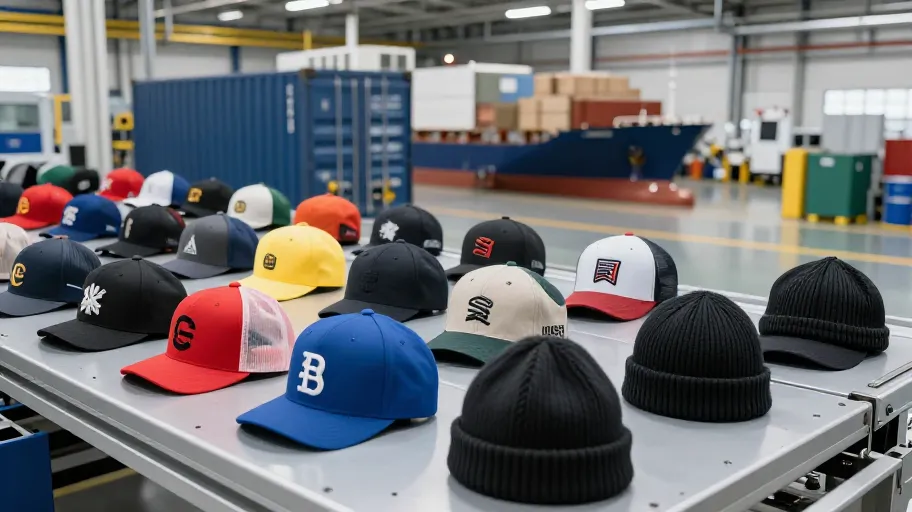
Why Your Hats Are Stuck Before They Even Ship
It’s not your factory that’s slow—it’s the system around it. A U.S. lifestyle brand missed its entire fall retail window not because hats took too long to make, but because their container sat seven days at Ningbo and nine more at Long Beach. That’s 16 days lost to avoidable delays.
A 2024 McKinsey analysis found 30–50% of total lead time in Asia-to-U.S. apparel shipping has nothing to do with production. Port congestion, inefficient yard management, and unreliable freight allocation eat weeks. The Port of Los Angeles and Long Beach handled 41% of trans-Pacific volume in 2025—yet average gate dwell times still stretch 3–7 days during peak seasons.
The real bottleneck? Synchronization. Leading B2B hat manufacturing partners now tie production schedules directly to freight contracts. That means no more finished goods sitting idle while teams scramble for container space. When production and shipping move as one, total cycle times drop below eight weeks—not by rushing, but by aligning.
Vietnam’s Micro-Factories Are Rewriting the Rules
Distributed production hubs in Vietnam are delivering headwear to North America 21 to 28 days faster than traditional China-based supply chains. For a Canadian outdoor brand, that meant landing at the Port of Seattle six weeks after design approval—beating competitors by a full month and capturing early-season margins.
Shorter sea transit helps, but the real advantage is operational architecture. Modular lines run stitching, labeling, and embroidery at the same time—not one after another—cutting manufacturing cycles by up to 40%. These Nearshore Micro-Factories support MOQs as low as 500 units, so brands can test demand without overstock risk. That means lower inventory costs and higher sell-through rates.
Modular production means you gain agility because small batches don’t require full-line shutdowns. That’s critical for seasonal lines or limited drops where timing is everything.
AI Booking Systems That Beat Freight Volatility
Trans-Pacific container availability swings 18–25% month over month. Without pre-negotiated space, brands face rollovers, surcharges, and unpredictable delays. The fix? Dynamic Freight Matching, an AI-driven system that books vessel space the moment a batch clears inspection.
This isn’t manual booking with fingers crossed—it’s automated bidding based on real-time capacity, port congestion data, and carrier performance. A 2024 Flexport benchmark showed this cuts port dwell time by 86% and lifts on-time-in-full delivery rates by 32%. That means fewer emergency air shipments and less firefighting during peak season.
Dynamic Freight Matching means predictable logistics because capacity is secured at the point of completion, not days later. For operations teams, that’s fewer late-night calls. For CFOs, it’s lower freight premiums and better forecast control.
Real-Time Tracking That Cuts Safety Stock by 28%
Visibility isn’t about watching a dot on a map—it’s about making decisions before problems hit. When a Midwest uniform supplier saw LA port congestion threatening 40% of their fall inventory, GPS tracking alerted them 72 hours before arrival. They rerouted through Tacoma and saved $180K in air freight—all without missing retail deadlines.
Their edge? An End-to-End Visibility Layer API-connecting factory output, vessel movements, and warehouse systems. Delays aren’t surprises—they’re triggers for action. Automated customs pre-clearance using digital twin documentation slashes border processing from 72 hours to under 12. Blockchain-verified records cut inquiry resolution from days to minutes, per a 2024 Gartner study.
Real-time tracking means lower carrying costs because you don’t need excess buffer stock. With 15-point gains in forecast accuracy, brands reduce safety stock by 28% on average. That’s cash freed up for growth, not warehousing.
Speed Isn’t a Bonus—It’s Your Margin Shield
In headwear, relevance expires fast. Every week saved in transit is a week of full-price sales captured, not discounted clearance. The fastest brands aren’t just efficient—they’re protected. By compressing lead times through synchronized production and freight, they turn speed into gross margin preservation.
For North American buyers, this changes the game. You no longer choose between cost and speed. The best cap manufacturers deliver both by designing supply chains that move as one unit—from fabric cut to store shelf.
Ready to close the gap on your next launch? See how aligned production and freight can cut 40% off your timeline—without sacrificing quality or scale.
#cap manufacturers china, #headwear manufacturers china, #hat tech pack








