


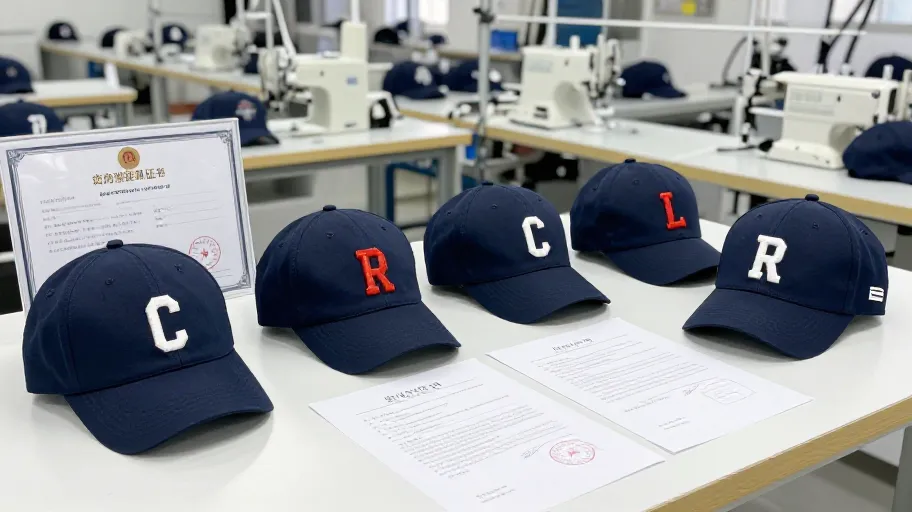
A documentation-first comparison of custom baseball caps factories means you judge suppliers by what they can prove — business registration, production site evidence, reference samples and written approval records — before you compare prices. The Evidence-Led Supplier Comparison (ELSC) approach below gives you a repeatable gate: no document, no shortlist slot, no deposit.
Why documentation comes before quotation
When overseas buyers evaluate a custom baseball caps factory, the hardest problem is not finding options — it is separating verifiable capability from unverifiable assertion. A supplier may present a polished catalogue, a wide product range and an enthusiastic sales chat. None of that tells you who cuts the panels, who controls embroidery placement, who answers for defects, or what happens when a bulk order differs from the approved sample.
The Evidence-Led Supplier Comparison (ELSC) framework corrects the order of operations:
- Verify identity. Confirm the legal entity behind the communication and whether it operates as a manufacturer, a trading company, or a hybrid. Each model can serve buyers well, but the model changes who you hold accountable and how you inspect.
- Verify capability claims. Ask for evidence tied to the specific cap constructions, decoration methods and materials your project requires — not a general capability list.
- Verify the approval trail. Establish, in writing, how the factory handles tech packs, pre-production samples, revisions and final sign-off before bulk production begins.
- Then compare quotations. Only once the evidence layer is in place does price comparison become meaningful, because you are comparing like against like.
Skipping steps one to three is how importers end up comparing numbers attached to entirely different risk profiles.
What to request before comparing quotations
Use this decision table as your first-pass filter. For every row, the question is not "did the supplier answer?" but "did the supplier provide something checkable?"
| Evidence item | What to ask for | What it helps you evaluate | Red flag |
|---|---|---|---|
| Business registration and exporter status | Company legal name, registration number, export credentials | Whether the entity exists and can export directly | Vague trading names, refusal to share entity details |
| Manufacturing role disclosure | Written statement of what the supplier makes in-house versus outsources | Accountability and consistency across repeat orders | "We make everything" with no supporting detail |
| Project-specific capability evidence | Photos, process descriptions or facility detail tied to your cap type and decoration method | Whether the factory matches your actual product | Generic portfolios unrelated to your construction |
| Reference samples | Physical samples of comparable work for your evaluation | Stitching quality, finishing, decoration precision | Refusal to discuss sample terms at all |
| Approval workflow | Written description of tech-pack, sample and revision handling | How disputes are prevented before production | "No problem" with no documented process |
| Communication record | Named contacts with defined responsibilities | Escalation path when issues arise | Single anonymous chat handle |
Note: sample policies, costs, shipping arrangements and whether any fees are credited toward orders vary by supplier and project. Confirm the current policy directly with each factory in writing before committing.
Concrete approval questions to send every factory
Send the same set to every shortlisted custom baseball caps factory so answers are comparable. Ask for written replies.
- Which legal entity will sign our contract, and does it match the entity that will ship and invoice us?
- For our specified construction and decoration method, what part of the process do you perform in-house?
- What information do you need in our tech pack to produce a pre-production sample, and how do you record revisions?
- What is your current sample policy — cost, shipping responsibility, and how sample approval is documented? (Confirm directly; do not rely on summaries.)
- What is your current minimum order quantity, unit pricing basis, and production timeline for a project of our specifications? (Project-specific; request a written quotation.)
- How do you want us to define acceptable quality — reference sample, written specification, or both — and how is that reference preserved?
- Which certifications or test reports relevant to our destination market can you currently provide evidence for, and which would we need to arrange independently?
- Who is the named contact responsible for our order, and what is the escalation path?
The exact answers matter less than the pattern. A supplier that answers precisely, in writing, with evidence attached is demonstrating how it will behave during production. A supplier that deflects these questions is demonstrating that too.
From evidence to decision: weighting your comparison
Once documentation is in hand, score each factory on three axes rather than one:
- Evidence completeness. How many rows of the decision table did the supplier satisfy with checkable material?
- Process clarity. Did the approval workflow questions produce a written, step-by-step answer you could hold both sides to?
- Communication quality. Were answers precise, consistent and traceable to a named person?
Price enters only after these axes are scored. A lower quotation from a supplier with a thinner evidence trail is not a saving; it is a transfer of risk onto your brand. Conversely, documentation does not guarantee outcomes — it simply lets you approve terms you can verify and enforce.
Finally, keep the evidence file. Repeat orders, audits and any future dispute resolution all benefit from a documented trail that starts before the first deposit.
FAQ
How can I tell whether a custom baseball caps factory is a manufacturer or a trading company? Ask directly and request supporting evidence such as registration documents and facility details, then verify the legal entity. Both models can work for importers, but the answer determines who is accountable for production — so document it before contracting.
What documents should a headwear supplier provide before I pay a deposit? At minimum: verified business registration and exporter status, a written statement of in-house versus outsourced processes, project-relevant capability evidence, a documented sample and approval workflow, and a named contact structure. Use the checklist below to run this consistently.
How do I compare quotations fairly between factories? Only after the evidence layer is complete. Ensure each quotation covers the same construction, materials, decoration method, packaging, incoterms and approval steps, then compare. Quotations with different assumptions are not comparable regardless of the numbers.
Should I approve a pre-production sample for custom caps? Establish a written approval step tied to a preserved reference sample before bulk production. Confirm each supplier's current sample policy, revision handling and approval recording directly — these terms vary and should be documented per project.
What quality standard should the contract reference? Define acceptability against a mutually preserved reference sample plus a written specification, and record how that reference is retained. Confirm with each factory how it handles this, and have your contract reflect the agreed method rather than an undefined standard.
Download the supplier evidence checklist
Run every shortlisted custom baseball caps factory through the same verification gate. 下载供应商证据清单 and score each supplier on evidence, process clarity and communication — before you compare a single price.
Not ready to shortlist yet? Work through the eight approval questions above in your next supplier email, and keep a written record of every reply. That alone upgrades your comparison from impression to evidence.
#cap manufacturers china, #headwear manufacturers china, #cap factory








