


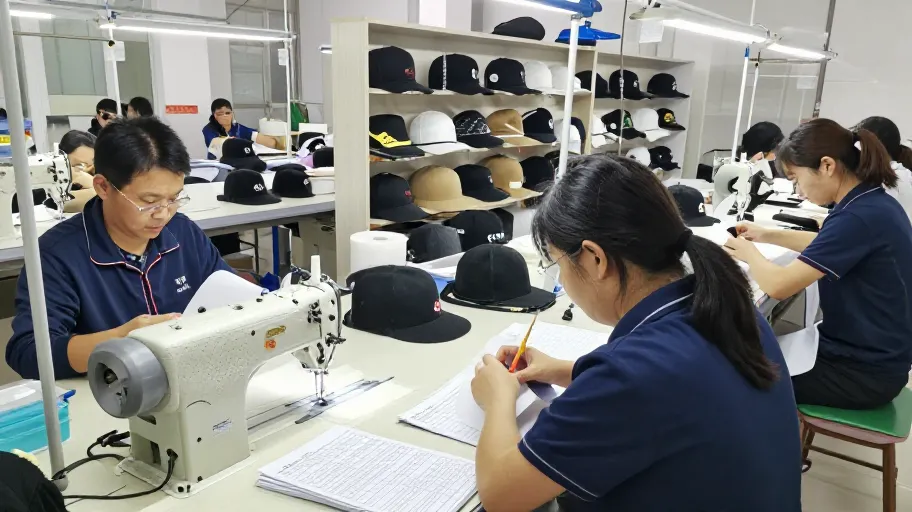
Evaluating hat headwear manufacturers in China for a private-label project means verifying three things before any commitment: construction capability for your specific design, accountability across the whole production chain, and documented process control from development to shipment. Use a structured framework, ask written approval questions, and score every candidate on the same scale.
Why comparison fails without a framework
Most buyers evaluate suppliers the way suppliers prefer: through catalogues, sales conversations and a single sample. That method makes every manufacturer look comparable, because each one controls the evidence you see. A private-label project is different from a one-off promotional order — you are selecting a partner whose output will carry your brand name, season after season.
That is why this guide uses the CAP-Verify framework: Capability, Accountability, Process control. It converts vague claims — "we can make any cap", "our quality is excellent" — into questions a supplier must answer in writing, which you can then score, compare and archive.
The CAP-Verify framework
C — Capability. Can this manufacturer construct the specific headwear styles in your range at the specification level your market requires? Capability is style-specific. A team that produces flat-brim snapbacks well may or may not be equipped for structured trucker panels, knit beanies, performance fabrics or licensed trims. Ask for construction evidence relevant to your designs, not general catalogues: which machine classes they run, which panel constructions they produce, which decoration methods exist in-house versus outsourced.
A — Accountability. Who is contractually responsible for each stage? Many "manufacturers" in search results are trading companies, subcontractors or hybrid operations. Neither model is inherently wrong — but you must know which entity physically produces your goods, who owns quality approvals, who handles decoration subcontracting, and who answers for a defect dispute. Ask directly: "Which factory will run my order? Can this be named in the contract?"
P — Process control. How does the supplier prevent variation between the approved sample and bulk production, and between reorder one and reorder five? Process control is where private-label projects succeed or fail. Look for written inspection checkpoints, material approval records, in-process checks, and a defined mechanism for handling nonconforming output. Ask what documentation you receive with each shipment.
Decision table: scoring candidate manufacturers
Score each candidate from 1 (weak or unverifiable) to 5 (documented and written). Do not award points for verbal assurances.
| Evaluation dimension | What to verify | Evidence to request | Score (1–5) |
|---|---|---|---|
| Style capability | Ability to build your exact silhouettes and specifications | Construction references for comparable styles | |
| Decoration methods | Embroidery, printing, patch, weaving — in-house or outsourced | Named processes and subcontracting disclosure | |
| Entity transparency | Whether manufacturer, trader or hybrid is disclosed | Business licence; named production site | |
| Development process | How tech packs and samples move to approval | Step-by-step development workflow in writing | |
| Process control | Inspection checkpoints between approval and shipment | Written QC documentation samples | |
| Material sourcing | Fabric, trims and closure sourcing channels | Material specification and sourcing description | |
| Communication | Responsiveness and precision during evaluation itself | Track reply quality in your own log | |
| Contract readiness | Willingness to put commitments in writing | Redline responses to your draft terms |
A supplier that scores unevenly is not automatically disqualified — but every score below your threshold becomes a question to resolve before you approve a production order.
Concrete approval questions to send every shortlisted supplier
Send the same list to every candidate so comparison stays fair. Ask for written replies.
- Which entity will physically manufacture our order, and can that be named in the agreement?
- Which construction methods and decoration processes are performed in-house, and which are subcontracted?
- Walk us through your development path from tech pack to approved pre-production sample. What approvals gate each step?
- What inspection checkpoints exist between material intake and shipment, and what documentation do we receive per order?
- What minimum order quantity applies to our specific styles and decoration mix? (Ask for your project's figures — do not rely on published ranges.)
- What is your quoted production timeline for our order quantity, and which factors could change it?
- How do you handle a nonconforming batch, and what is the escalation path?
- Which materials in our specification can you source, and can we nominate suppliers for specific components?
- What export documentation, labelling support and packaging options do you provide for our destination market?
Notice that none of these questions can be answered by a website. Every one forces a documented, project-specific response — which is exactly what makes the answers comparable.
Red flags worth documenting
A single warning sign is a data point; a pattern is a decision input. Log all of these in the same scorecard:
- Refusal to name the production site or entity
- Inability to describe inspection checkpoints in writing
- Answers that shift between contacts, or between email and call
- Pressure to skip pre-production approval
- No written response to defect-handling questions
- Capability claims that expand whenever you ask about a new style
None of these proves a supplier is unfit — but each one raises the evidentiary burden before you approve production.
What New Generation can confirm for your evaluation
As a Shenzhen-based OEM/ODM manufacturer of custom caps and headwear, New Generation works with overseas brands, importers and corporate buyers on private-label development. We support the evaluation process itself: we answer capability questions in writing, document our development and inspection workflow, and work from your tech pack to approved samples before any production commitment. For any question about sampling terms, costs, timelines or order minimums for your specific project, confirm the current policy directly with our team — figures belong in your quotation, not in a general article.
Frequently asked questions
Should I work with a factory or a trading company? Both models exist in Chinese headwear supply, and both can work — the decision depends on your internal resources. The essential step is transparency: know which entity manufactures your goods, and make sure accountability for quality is written into your agreement either way.
How many manufacturers should I shortlist before sampling? Compare at least three candidates using the same question set and decision table. Three scored responses reveal differences that a single supplier's pitch cannot. Narrow to one or two for the sampling stage.
What documents should a supplier provide before I approve production? At minimum: a written quotation for your specification, an approved pre-production sample signed by both sides, a stated inspection workflow, and agreed handling terms for nonconforming output. Request copies of the quality documentation format you will receive with each shipment.
How do I evaluate quality consistency across reorders? Ask how the supplier controls repeatability: retained approved samples, material batch records, and inspection checkpoints tied to the original approval. Then verify on your first order — consistency is proven by documentation plus delivered goods, not promised.
Can I visit the factory before committing? Ask, and record the response. Many buyers combine a factory visit with a sourcing trip; others rely on third-party audits. Either path works if the supplier is transparent about access and documentation.
Your next step
下载 Supplier Scorecard — the editable scoring template built around the CAP-Verify framework, with the decision table, approval questions and red-flag log pre-loaded so you can compare every hat headwear manufacturer in China on one page.
Prefer to start smaller? Use the ten approval questions above as your first-round email to any shortlisted supplier. The replies alone will reorganise your shortlist before you spend a cent on sampling.
#cap manufacturers china, #headwear manufacturers china, #cap factory








