


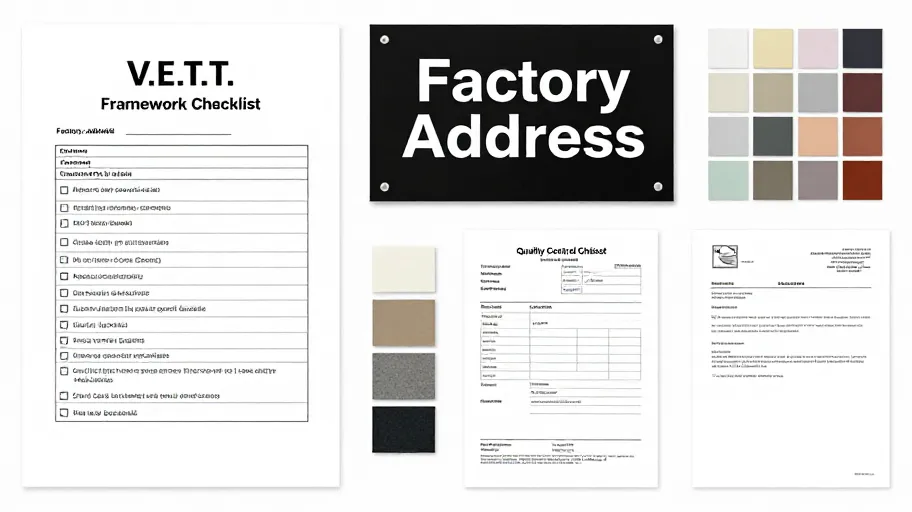
To evaluate Krishna Cap Manufacturer Co for a private-label project, treat the name as an unverified entity until documents prove otherwise. Run the V.E.T.T. Framework — Verify entity, Evaluate capability, Test communication, Trace compliance — before any payment. Confirm business registration, factory address, sample terms, quality controls and export experience in writing. No public search result, including this article, substitutes for supplier-confirmed evidence. This page gives you the method; the supplier gives you the facts.
Why this search is an entity-verification job, not a shopping task
When a supplier name surfaces repeatedly in a "cap manufacturer" search, the temptation is to jump straight to quoting. Resist that. A name appearing in search results tells you about visibility, not capability. For a private-label programme — where your brand, labels, packaging and re-orders are on the line — the evaluation sequence matters more than the inquiry speed.
Two entities can share confusingly similar names: a factory, a trading company, or a distributor repackaging someone else's output. None of these are inherently wrong partners. But you must know which one you are contracting with, because it determines who controls production, who answers for defects and who holds your tooling.
This article cannot and does not assert any specific facts about Krishna Cap Manufacturer Co's registration, capacity, certifications, sample policy or client list — none of that was supplied as verified evidence. What follows is the evaluation protocol you should run against them, or any candidate factory you are comparing them with.
The V.E.T.T. Framework
V — Verify the entity.
Ask the supplier for their business licence and, where applicable, export registration. Cross-check the legal company name on the licence against the name on invoices, contracts and bank details. If the website name, contract name and beneficiary name differ, request a written explanation of the relationship. A group structure is acceptable when documented; a vague one is not.
E — Evaluate capability against your specific project.
Capability is project-relative. A factory that excels at flat embroidered baseball caps may not suit a structured wool fedora line. Send a detailed tech pack — construction, panels, closure type, materials, decoration method, label and packaging spec — and ask the supplier to confirm in writing which elements they produce in-house and which they subcontract. Subcontracting is not disqualifying, but undocumented subcontracting of decoration or embroidery is a private-label risk, because that is where brand-critical quality lives.
T — Test communication before you test product.
Before paying for anything, run a structured communication test: send a drawing or sample photo with a deliberate ambiguity (for example, an unclear closure or an unspecified backing on embroidery) and see whether they ask clarifying questions or make silent assumptions. Suppliers who ask precise questions at inquiry stage handle ambiguity better during production, when ambiguity becomes costly.
T — Trace compliance and documentation.
For a branded programme, request in writing: which product-related testing or certification they can support for your destination market, what inspection arrangements they accept (yours or a third party's), and what documentation accompanies each shipment. Do not accept "we can do all certifications" as an answer — ask which certificate number, issued by which body, for which product scope, and ask to see current evidence. Confirm the current sample policy, tooling ownership and re-order terms directly; do not rely on assumptions, and do not rely on this article for any of those specifics, because none were supplied.
Decision table: proceed, hold, or walk away
| Signal | Green — proceed to sampling | Amber — hold, demand documentation | Red — walk away |
|---|---|---|---|
| Entity | Licence matches contract, invoice and bank beneficiary | Names differ but relationship explained in writing | Refuses to share licence or names never align |
| Capability | Confirms line-by-line what is in-house vs subcontracted, referencing your tech pack | Vague "we make everything" response with no detail | Cannot name materials, decoration methods or construction for your spec |
| Samples | Clear written sample policy with current terms you confirm directly | Sample offered but terms undocumented | Requests production deposit before any sample or proof |
| Communication | Asks precise, spec-level questions within a reasonable business response window | Replies fast but generic, ignoring technical detail | Pressures for quick payment or avoids written channels |
| Compliance | Names specific certificates, bodies and scopes with current evidence offered | Says "no problem" without naming anything | Refuses third-party inspection |
Approval questions to send in writing
Send these as a numbered list and require numbered answers. Unanswered lines become negotiation items, not assumptions.
- What is the exact legal entity name that will appear on our contract and invoice?
- Against our attached tech pack, which processes are in-house and which are subcontracted?
- What is your current sample policy, including cost treatment and shipping arrangement? (Confirm directly — policy varies and must be current.)
- What is your minimum order quantity and price break structure for this specific construction and decoration method?
- What is the production lead time for a first order versus a repeat order, and what is your stated delay-notification commitment?
- Which inspections do you permit during and before production, and who bears inspection costs?
- What certifications or test reports can you provide for our destination market, with issuing body and scope?
- Who owns the embroidery digitising files, moulds or tooling after the first order, and what happens if we re-order elsewhere?
- What is your defect-claim process, and within what window must claims be raised?
- What quality documentation accompanies each shipment (inspection reports, packing lists, material specs)?
Documentation discipline: your leverage is your file
Keep every answer in one thread. Escalate the relationship only when the file supports it: licence verified, capability mapped to your tech pack, sample approved against an approved reference sample you physically hold, and pre-shipment inspection terms written into the contract. The suppliers who answer all ten questions cleanly are the ones worth a sampling budget; the ones who answer five and deflect five are telling you where the project will hurt in month three.
FAQ
Is Krishna Cap Manufacturer Co a factory or a trading company?
This article asserts no verified facts about the entity. Use the V.E.T.T. verification step: request the business licence, match the legal name to contract and bank details, and ask directly which production processes they own. Documented answers matter more than labels.
What should I check before paying for samples?
Written confirmation of the current sample policy, cost treatment, shipping arrangement and — critically — whether the sample will be made on the same production line and decoration equipment as bulk. Ask this question explicitly; silent sample-to-bulk gaps are a major private-label failure point.
How do I compare this supplier against alternatives fairly?
Run the same ten written questions and the same decision table against every candidate on your shortlist. Identical questions, identical documentation requests. Side-by-side written responses reveal more than any sales presentation.
Do I need third-party inspection for a first order?
That is a risk decision, not a rule. Decide it based on order value, brand exposure and how completely the supplier answered the compliance questions above. Whatever you choose, write the inspection arrangement into the contract before the deposit, not after production starts.
Should I visit the factory in person?
For a flagship private-label programme, an on-site audit is the strongest verification available. If travel is impractical, a video walkthrough scheduled live (not pre-recorded), combined with third-party inspection, provides a meaningful level of verification. Confirm which options the supplier accepts in writing.
Run the evaluation before you spend a cent on samples
下载 Supplier Scorecard — the structured scoring file built around the V.E.T.T. Framework, with pass/fail fields for entity verification, capability mapping, communication testing and compliance tracing. Use it to score this supplier and every alternative on your shortlist with identical criteria.
Low-friction option: not ready to download? Start with the ten written approval questions above. Copy them into your next email, require numbered answers, and keep the thread — that single step already separates serious suppliers from the rest.
#cap manufacturers china, #headwear manufacturers china, #cap factory








