


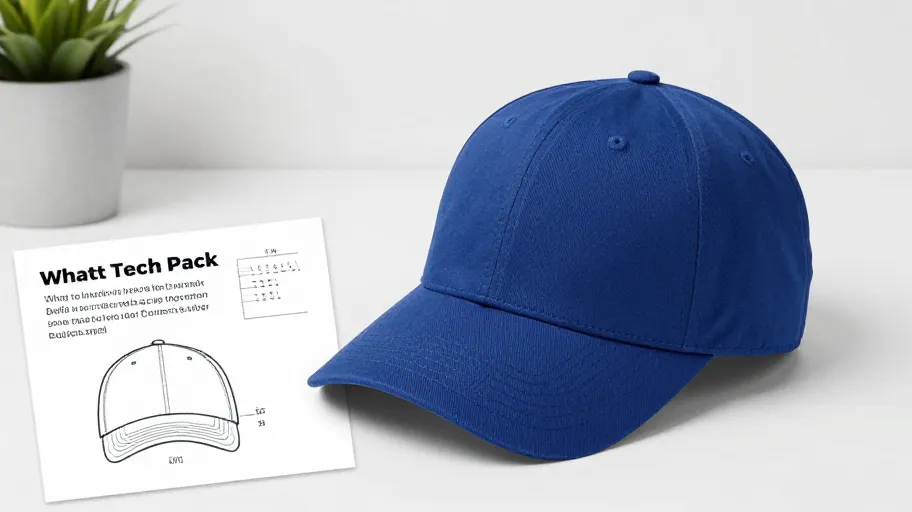
A detailed baseball cap tech pack is the single most effective tool to bridge the gap between your creative vision and a factory's production line. It eliminates ambiguity, reduces the likelihood of sampling errors, and accelerates the quotation process. By providing precise technical data regarding materials, measurements, and construction, you ensure that the OEM/ODM manufacturer can interpret your design correctly the first time, saving both time and resources in the product development cycle.
The High Cost of "Rough Sketches"
When sourcing custom headwear from Shenzhen or other manufacturing hubs, relying on mood boards or vague descriptions is a common pitfall. Product developers must understand that factories interpret instructions literally. Without a defined tech pack, a factory might default to standard constructions—such as a specific closure type or crown height—that do not align with your brand identity. This disconnect leads to "the sample trap," where weeks are lost waiting for a prototype that fails to meet expectations, necessitating a second or third round of sampling. To avoid this, your documentation must move beyond aesthetics and into engineering.
The "Spec-to-Sample" Alignment Framework
To professionalize your sourcing approach, adopt the "Spec-to-Sample" framework. This organizes your tech pack into five critical data pillars. Missing data from any column invites assumptions by the manufacturer.
1. Visual Orthographics and Bill of Materials (BOM)
A tech pack must start with flat, technical sketches (orthographics), not just stylized illustrations. These should include front, back, side, and top views. Every distinct part of the cap requires a callout.
- Crown Panels: Specify the number of panels (e.g., 5-panel, 6-panel) and construction style (e.g., unstructured, semi-structured, hard buckram).
- Brim (Visor): Define the shape (flat, curved, pre-curved) and the length.
- Closure: Detail the mechanism (snapback, buckle, Velcro, or fitted elastic).
- BOM List: Create a numbered list for every material component: main fabric, lining, brim core, thread, labels, and closures.
2. Material Specifications (Fabrics and Trims)
Saying "cotton" is insufficient. You must provide the exact fabric weight and composition to ensure the correct hand feel and durability.
- Fabric Type: Are you looking for 100% cotton twill, a polyester-cotton blend for moisture wicking, or brushed canvas for a vintage look?
- Fabric Weight: Specify GSM (grams per square meter) or OZ (ounces per square yard).
- Color Matching: Include Pantone Matching System (PMS) color codes. Relying on RGB or CMYK values from a screen can result in significant color deviations in dye lots.
3. Construction Details and Stitching
How the cap is assembled defines its structure and durability.
- Sewing Thread: Specify thread thickness (e.g., Tex 40) and material (polyester is standard for strength).
- Stitch Density: For premium branding, request the stitch count per inch (SPI). A higher density generally offers a tighter, more durable seam.
- Reinforcement: Indicate if sweatbands require taping or if specific panels need bar-tacking for stress relief.
4. Sizing and Grading
You must provide a measurement chart. If you are creating a "One Size Fits Most" snapback, you still need the circumference of the closure and the crown depth. For fitted caps, provide a grade rule table indicating measurements for S, M, L, and XL.
- Key Measurements: Include Crown Height, Brim Length, Brim Width, and Head Circumference.
5. Branding and Artwork Placement
This is often the most complex part of the tech pack.
- Logo Files: Vector files (AI, EPS, or PDF) are mandatory. Raster images (PNG, JPG) are not suitable for production machinery like embroidery or digital printing.
- Placement: Provide X and Y coordinates for logo placement relative to the center seam or the edge of the brim.
- Artwork Sizing: Specify exact dimensions in millimeters. Do not use percentage sizing.
- Technique: Specify the decoration method—embroidery (with requested stitch density), woven label, screen print, or sublimation.
Decision Table: Selecting the Right Brim Core
One of the most frequent points of confusion in a baseball cap tech pack involves the brim stiffness. The core material dictates the silhouette. Use this table to define your requirement before sending the brief.
| Desired Silhouette | Recommended Core Material | Stiffness Characteristics | Best Use Case |
|---|---|---|---|
| Classic Curve | Standard Plastic (PVC) | Moderate flexibility; holds shape but can be bent manually. | Everyday promotional caps, standard team sports. |
| Flat & Rigid | High-Density PE Board | Very stiff; resists bending and maintains a perfectly flat profile. | Streetwear, fashion accessories, "dad hat" trends requiring structure. |
| Soft & Casual | EVA Foam or Soft Wire | Soft and pliable; easy to shape or fold. | Vintage wash caps, bucket hats, leisure headwear. |
When requesting a sample, ask the factory: "What is the default gauge of your brim core for this silhouette?" to ensure it matches the decision above.
Approval Questions for Your Manufacturer
Once you have compiled your baseball cap tech pack, send it to the supplier with the following questions. Their answers will verify their understanding and capability.
- Material Confirmation: "Can you match the specified fabric weight and Pantone color within a standard commercial tolerance, or do you require a physical swatch for lab dipping?"
- Logo Adaptation: "Based on my provided vector logo, is the embroidery size too complex for the selected fabric? Will you need to simplify the details?"
- Prototype Accuracy: "Will the sample be produced using the final bulk materials, or will substitute materials be used for the first round?"
- Tech Pack Review: "Do you see any conflicts between the requested construction (e.g., 6-panel) and the branding placement (e.g., large center embroidery) that might cause warping?"
FAQ
What file format should I use for the tech pack itself? While PDF is the standard for the full document to ensure layout consistency across devices, ensure all individual design elements (logos, patterns) are attached as editable vector files (AI or EPS).
Can I send a physical sample instead of a tech pack? Yes, sending a physical "golden sample" is highly effective for communicating hand-feel and general shape. However, you should still supplement it with a document specifying any changes you require (e.g., "same shape as sample, but use PMS 286 blue fabric").
What if I don't know the specific fabric GSM? It is acceptable to ask the factory for their recommendation based on a desired outcome (e.g., "lightweight for summer"). However, verifying the chosen weight before bulk production is critical to maintaining quality control.
How detailed does the stitching diagram need to be? For standard caps, written instructions usually suffice. However, if you require unique stitching patterns (e.g., zig-zag top stitch or contrast needlework), include a close-up technical sketch.
Who owns the tech pack once I send it? You retain the intellectual property rights to the designs and specifications you create. Ensure your NDA or manufacturing agreement explicitly states that the tooling and molds created based on your tech pack are your property.
Conclusion
A robust baseball cap tech pack is not just administrative paperwork; it is a strategic asset in your supply chain management. It shifts the dynamic from reactive problem-solving to proactive engineering. By detailing your requirements in visual, material, and construction terms, you empower your manufacturing partner to deliver precision. Before you request your next sample, audit your documentation against the framework above to ensure every stitch is accounted for.
[Download the Tech Pack Checklist] Ensure your specs are factory-ready. Download our comprehensive Baseball Cap Tech Pack Checklist to verify every detail before production.
[Get a Quick Tech Pack Review] Not sure if your diagrams are clear enough? Submit your draft to our engineering team for a no-obligation feasibility review.








