


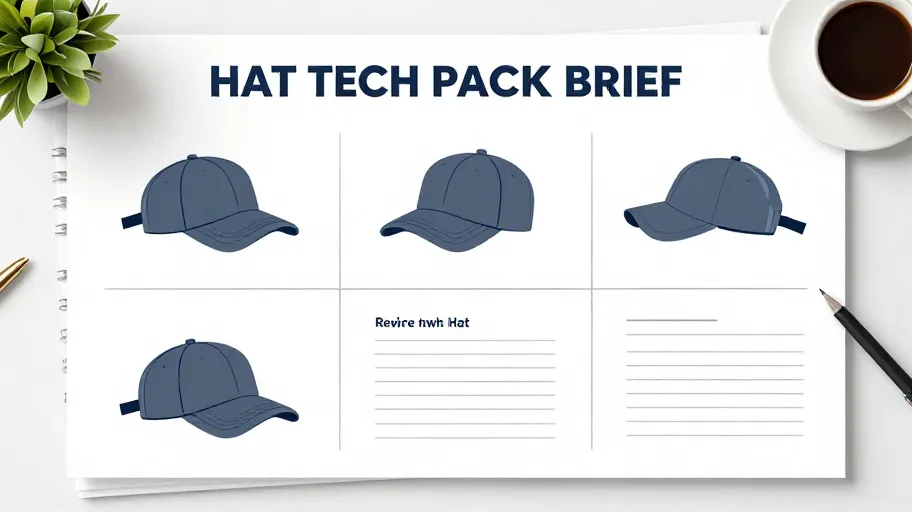
A complete 5 panel hat tech pack should specify construction, panel layout, materials, embellishment method and placement, closure and hardware, sizing and fit, labelling and packaging, and your approval checkpoints — all before you request a quotation. When these details are missing, suppliers price different assumptions, and you get quotes you cannot compare. This article gives you a framework to close those gaps first.
Use the SPEC-Fit framework before anyone quotes
At New Generation, a Shenzhen B2B OEM/ODM manufacturer of custom caps and headwear, we work from written briefs every day. The briefs that move fastest to usable quotations share one trait: they document decisions instead of leaving them to the factory's discretion. To make that easier to structure, we use a five-block framework we call SPEC-Fit:
- S — Structure: crown construction, brim type and stiffness, profile height, seams and any internal reinforcement.
- P — Panels and pattern: the five-panel layout itself, seam placement, pattern symmetry, artwork placement relative to seams, and size grading across your order.
- E — Embellishment: decoration method (embroidery, printing, patches, woven labels), stitch density or print specification, colour references, and exact placement measurements from defined anchor points.
- C — Components: closure type, eyelets, sweatband material, taping, buttons, zipper or strap hardware, and the finish of each.
- F — Fit and sizing: head-size range, adjustment range, and how the sample should be measured and checked against the spec.
Each block exists to remove one category of ambiguity. Leave a block vague, and the supplier fills the gap with their own interpretation — which may not match yours. The framework's value shows up twice: first in quote comparability, and later as the benchmark you and the factory both reference during sampling and production.
Decision table: lock it, leave it open, or confirm it
| Item in the tech pack | Lock before quoting | Can stay open until sampling | Must confirm with supplier |
|---|---|---|---|
| Crown construction and profile | Yes | — | Feasibility of exact construction |
| Panel layout and seam placement | Yes | — | Pattern adjustments if artwork crosses seams |
| Fabric type and colour reference | Yes | Exact dye-lot matching | Available material options and sourcing |
| Embellishment method and placement | Yes | Final stitch/print density | Recommended method for your artwork |
| Closure and hardware | Yes | Finish alternatives | Component availability |
| Sizing and adjustment range | Yes | Fit verification on sample | Measurement method alignment |
| Labels and packaging | Draft | Final packaging artwork | Labelling requirements you must comply with in your market |
| MOQ | No | — | Yes — confirm directly, per project |
| Sampling terms | No | — | Yes — confirm current policy directly |
| Lead time | No | — | Yes — confirm directly, per project and season |
The right-hand column matters as much as the middle one. Quantities, sampling terms, timelines and production policies are set by each supplier for each project. Do not take them from any article — including this one. Put them in writing as questions and confirm the current policy directly.
Construction and material details buyers forget
A five-panel cap looks simple, and that simplicity is exactly why briefs go thin. Details that change how a product looks, wears and quotes include:
- Brim behaviour: whether the brim is pre-curved or flat, and how stiff it should be.
- Crown shape: low, mid or high profile, and whether the front panel is structured with backing or left soft.
- Seam treatment: topstitch style and thread colour, which affects both appearance and how artwork can sit across panels.
- Internal finishing: sweatband type, seam taping, and whether the interior should look clean enough to be photographed for retail.
- Colour communication: physical colour references or a named colour system, not adjectives. "Navy" is a conversation; a swatch or code is a specification.
If any of these are undecided, mark them in the tech pack as open items with a named decision date. An open item the supplier can see is far safer than a silent assumption.
Approval questions to put in writing before quoting
Embed these into your tech pack as explicit checkpoints, so that both sides sign off on the same document:
- Does this construction match the reference sample or image we supplied — and if not, what differs and why?
- Which embellishment method do you recommend for this artwork, and what are the trade-offs of the alternatives?
- What material options fit our spec, and can you supply references for each before we approve?
- How will placement be measured on the sample, and from which anchor points?
- What is your current MOQ, sampling policy and lead time for this specification? (Ask fresh each project; do not rely on earlier conversations.)
- What inspection criteria will you apply against this tech pack during production?
- Who approves changes if a component or material becomes unavailable, and in what form is that approval recorded?
Question 7 is the one most briefs omit — and the one that prevents quiet substitutions later.
What to confirm directly with any supplier
To be direct about the limits of any generic guidance: no article can tell you a factory's MOQ, pricing, sampling terms, lead time, capacity, certifications or defect handling. These vary by supplier, product and season. Verify them in writing for your specific project. A supplier worth working with will answer specific questions with specific, current answers — and that exchange itself tells you something about how documentation-driven the relationship will be.
FAQ
How detailed does a 5 panel hat tech pack need to be for an accurate quote? Detailed enough that two different factories reading it would price the same product. If any element of construction, material, embellishment or sizing could be interpreted two ways, the quote can be interpreted two ways too.
Should I send a reference sample with the tech pack? A physical or photographed reference helps, but the tech pack still needs to stand alone. Write measurements and material descriptions explicitly so the document, not just the sample, is the benchmark.
Do I need to specify labelling and packaging before quoting? At least draft them. Labelling and packaging affect cost and lead time, and packaging artwork frequently changes between quote and production. Confirm any labelling obligations for your destination market directly.
Can the supplier help fill in the tech pack? Yes — an OEM/ODM partner such as New Generation can propose materials and construction options against your brief. Treat those proposals as inputs to your approval process, not as replacements for it.
What if I don't know my MOQ or order quantity yet? State a realistic range in the brief and ask the supplier to quote against scenarios. Quantities and any quantity-based terms must be confirmed directly with the supplier for each project.
Your next step
Before your next enquiry goes out, run it through the SPEC-Fit blocks and the approval questions above. Then download the full version:
[Download Tech Pack Checklist] — the complete pre-quote checklist for 5 panel hat and custom headwear projects.
Prefer to start smaller? Use the checklist embedded in this article as your first-pass review: five blocks, seven approval questions, and a confirm-directly list for supplier policies. When you're ready, send your completed tech pack brief and we'll review it together before any quotation.
#cap manufacturers china, #headwear manufacturers china, #cap factory








