


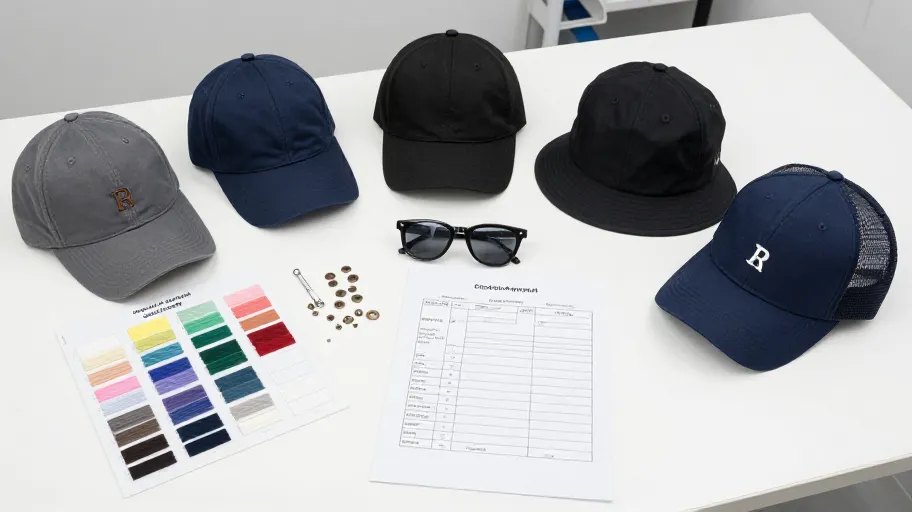
Approving a custom cap programme with an OEM/ODM headwear manufacturer comes down to one discipline: convert every verbal promise into a documented specification, verify it in a physical sample, and hold a formal sign-off before bulk production. This guide gives you a framework, a decision table and the exact approval questions to use.
Why structured approval matters when sourcing headwear from China
When you buy custom caps — baseball caps, truckers, bucket hats, beanies or visors — you are commissioning a made-to-order product. Your brand's logo placement, crown shape, brim stiffness, closure type, fabric weight and decoration method all exist only because you specified them. That means the quality you receive is largely decided before production begins, in how precisely you defined and then verified your requirements.
Overseas buyers face a structural challenge: the manufacturer is far away, the product is tactile, and communication crosses time zones and languages. Suppliers will differ in how they document specs, handle samples and confirm approvals — and no two supplier policies should be assumed to match. The buyers who protect themselves are the ones who treat specification and approval as a project-management job, not a courtesy handshake.
That is what this guide is for. It does not tell you what any particular factory's terms are — those vary and must be confirmed directly. It tells you what to define, what to ask and what to approve before you commit.
The S.T.A.F.F. framework: from spec sheet to final sign-off
Use a five-stage framework to run any custom headwear project. We call it S.T.A.F.F.:
| Stage | Name | What you do |
|---|---|---|
| S | Specification | Write a complete, unambiguous spec sheet. Every material, colour, decoration and packing detail in writing. |
| T | Tooling & pre-production | Confirm how your design translates into production inputs — embroidery files, printing setups, moulds, patterns — and who owns them. |
| A | Approval | Obtain and formally approve a sample against the spec sheet. Document deviations in writing. |
| F | Fit & Function | Verify the cap on real heads: sizing, crown height, brim curvature, closure adjustment, decoration durability under handling. |
| F | Final sign-off | Issue written approval for bulk production, referencing the exact approved sample and spec version. |
The framework's value is discipline: you never let production start while any stage is undocumented.
Decision table: what to lock down before requesting a sample
Ambiguity at the spec stage is what causes sample disputes later. Before you ask any supplier for a sample, put each of these into your spec sheet — and where the answer depends on supplier policy, ask rather than assume:
| Spec item | Options to define | Why it matters | Confirm with supplier |
|---|---|---|---|
| Cap style | 6-panel structured, unstructured, trucker, bucket, beanie | Drives pattern, cost structure and branding surface | Style availability and construction options |
| Fabric | Cotton twill, polyester, wool blend, mesh, recycled inputs | Affects feel, weight and print/embroidery behaviour | Which fabrics they can source, and any documentation they can provide on material composition |
| Crown and brim | Pre-curved vs. flat brim; structured vs. soft crown | The most visible quality signal on a finished cap | How they control shape consistency across a run |
| Closure | Strapback, snapback, fitted, elastic | Changes sizing approach and last-minute adjustments | Closure options and sizing ranges offered |
| Decoration | 3D/flat embroidery, woven patch, screen print, heat transfer, sublimation | Determines artwork file requirements | File formats they need and how artwork proofs are reviewed |
| Colour | Pantone references per component | Prevents "close enough" substitutions | Their colour-matching process and how matches are verified |
| Accessories & trim | Eyelets, stitching contrast, inner tape, labels, tags | Small parts carry brand perception | Which trims are available and how labelling is handled |
| Packing | Polybag, header card, carton spec, carton markings | Protects product and smooths customs handling | Standard export packing and any custom packing options |
| Compliance needs | Any tests or documentation your market requires | Import and retail requirements differ by market and product | What documentation they can supply, and what you must arrange separately |
Two notes on the last two rows. First, packing is routinely underestimated: a well-made cap in a badly packed carton can arrive damaged, and carton markings affect your clearance. Second, regulatory requirements for textiles and headwear vary by destination market and product claim — never assume a supplier's default documentation matches your market's requirements. Ask what they can provide and verify independently where needed.
Working with a sample: the approval questions that matter
A sample is only as useful as the questions you attach to it. When you receive a sample from a supplier such as New Generation or any other OEM/ODM headwear manufacturer, put these questions in writing:
- What exactly does this sample represent? Is it a pre-production sample built on production tooling, a hand-made prototype, or a stock-base sample with your decoration applied? Ask the supplier to state this explicitly, because each carries a different level of confidence for bulk production.
- Which spec version does the sample match? Reference your spec sheet by version number and date. If the sample deviates anywhere, require a written deviation list from the supplier rather than discovering differences yourself.
- How will bulk production be held to this sample? Ask what reference documents will govern the bulk run — the approved sample, the spec sheet, or both — and who on the supplier's side owns conformance.
- What happens if bulk goods deviate from the approved sample? Ask how the supplier handles deviations and disputes under their current policy. Do not assume any fee, remedy or compensation arrangement — confirm the current policy in writing before you commit.
- What are the current MOQ and lead-time terms for this configuration? Minimum order quantities and production schedules vary by style, fabric, decoration method and order size. Ask for the current terms for your exact configuration, in writing.
Question 5 and 6 deserve emphasis. Nothing in this article states what any supplier's MOQ, sample fee, shipping arrangement or lead time is, because those terms are project-specific and change. The professional move is simply to ask, document the answer, and hold the supplier to it.
Fit and function: the checks buyers skip
Spec sheets cover materials and measurements, but caps are worn, and wear reveals what spec sheets miss. Before final sign-off, evaluate your approved sample for:
- Fit across your size range. If you sell adjustable caps, test the closure at both extremes. For fitted caps, confirm the sizing ladder matches what your market expects.
- Crown and brim behaviour after handling. Squeeze the crown, flex the brim, then check whether it recovers to shape.
- Decoration integrity. Rub and flex the embroidered or printed area; check stitch density, thread tension and edge cleanliness up close.
- Interior finish. Sweatband seams, inner tape and label placement are where a buyer's hand goes first.
- Weight and feel consistency. If you approved a sample, later bulk units should feel identical. Note the sample's weight and construction details so you can compare against pre-shipment checks.
Document what you find. A short written sample-assessment note — even five bullet points emailed to the supplier — becomes your reference if bulk goods differ.
Final sign-off: the document that protects you
Before bulk production begins, issue a concise written approval that states:
- The spec sheet version approved, by number and date.
- The approved sample identified unambiguously (photos attached, courier waybill or sample ID referenced).
- Any deviations you accepted, listed explicitly.
- Confirmation that production should proceed only against these documents.
- The current agreed terms for your project — quantity, schedule, packing and documentation — as confirmed by the supplier in writing.
Keep every approval email. In cross-border sourcing, the buyer who can point to a dated written approval is the buyer whose position is clear if anything goes wrong.
Frequently asked questions
How many samples should I go through before bulk production? As many as it takes to reach a documented approval — and no fixed number applies to every project. Some designs translate cleanly from spec to sample; complex constructions or multi-component decorations may need another round. What matters is that each sample round closes specific open questions, and that you never approve a sample you have not inspected against the spec sheet.
What should I include in my first enquiry to a custom cap manufacturer? A short but complete brief: styles of interest, fabric and decoration preferences, target quantity range, destination market, any compliance or documentation needs, and your timeline expectations. A complete brief gets a more accurate, more comparable response — which is exactly why we've packaged one for you below.
How do I compare quotes between different headwear manufacturers? Compare like with like: same spec sheet version, same style configuration, same packing requirement. If each supplier quotes against a slightly different spec, the comparison is meaningless. Send one written spec to every supplier on your shortlist, then ask each to confirm their current terms for that exact configuration.
What if the bulk production doesn't match my approved sample? Start from your documentation: the spec version, the approved sample and the written deviation list. Raise the deviation in writing, referencing those documents, and ask the supplier to state their position under the terms you confirmed before production. This is precisely why the sign-off email matters — it converts a disagreement into a documented discussion.
Can I get my own labels and branding on the caps? Most OEM/ODM manufacturers offer custom labelling — woven labels, printed tape, hangtags — but options and any associated terms vary by supplier and project. List your labelling requirements in the spec sheet and confirm directly what the supplier can produce for your configuration.
Get the sourcing brief
Ready to brief a manufacturer properly? 获取采购 Brief — send us your style, quantity range and target market, and we'll respond with the current terms, options and next steps for your custom headwear project. No assumptions, no guesswork: you tell us the project, we confirm what applies to it.
Before you approve anything: the buyer's checklist
Take two minutes with this list before you green-light production:
- Spec sheet written, versioned and dated
- Sample received and inspected against the spec sheet
- Supplier's deviation list (if any) received in writing
- Sample terms, shipping responsibility and current MOQ/lead-time terms confirmed directly with the supplier
- Fit and function checks completed and noted
- Packing and carton markings specified
- Documentation needs for your destination market raised and answered in writing
- Final sign-off email sent, referencing spec version and approved sample
Approve only when every box is ticked. That discipline is the difference between buyers who repeat successful programmes and buyers who relaunch from scratch each season.
#cap manufacturers china, #headwear manufacturers china, #cap factory








