


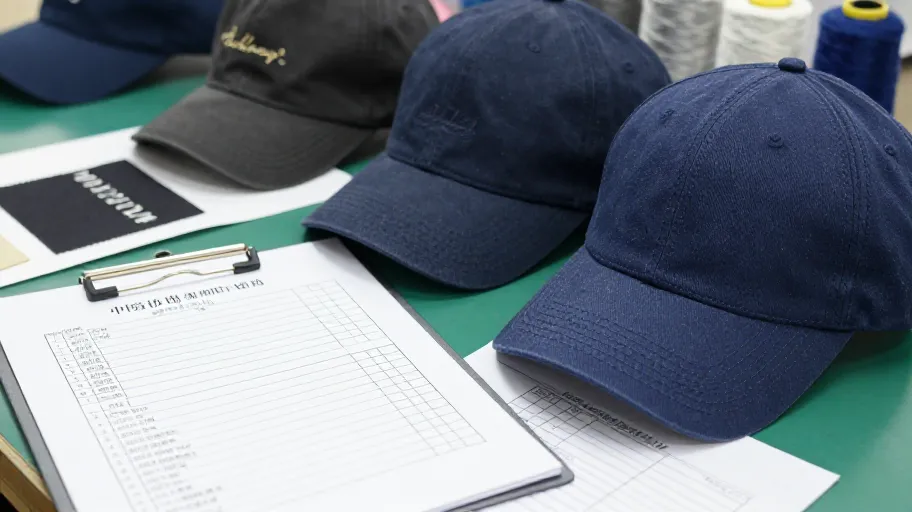
Sourcing custom caps from China at wholesale level is decided long before you compare prices: the buyers who get consistent results are the ones who arrive with a written specification, a documented sample process and pre-agreed approval criteria. This guide gives you a four-part framework — Specification, Process, Evaluation, Confirmation — plus the exact questions to put to any prospective cap manufacturer, so your next quotation round compares like with like.
Why the spec comes before the price
When buyers search for custom caps china wholesale, the temptation is to collect quotes and sort by price. That approach fails for headwear because a "custom cap" can mean dozens of different constructions: paneled or unstructured crowns, curved or flat brims, embroidered or woven labels, metal or plastic closures, different fabric weights and different finishing standards. Two factories can quote the same design and produce visibly different goods because the specification left room for interpretation.
A written spec protects you three ways. It forces every supplier to quote against identical assumptions. It becomes the reference document if a dispute arises. And it signals to the factory that you are an organised buyer, which shapes how your project is handled internally.
The SPEC framework for custom cap sourcing
Use four stages to move from idea to approved bulk production:
1. Specification. Write down everything the factory needs before quoting: cap style and construction, fabric type and weight target, closure type, branding methods and placement, colour references, packaging, and the standards you expect finished goods to meet. Attach reference images or a physical sample if you have one. If you are unsure about any element, state it as an open question rather than guessing — a supplier working from a guess will quote a guess.
2. Process. Agree how the project will run: who your contact is, how revisions to the sample are requested, what happens between sample approval and bulk production, and how packaging and labelling are confirmed. Get these points in writing, dated and versioned, so both sides work from the same document as the project evolves.
3. Evaluation. Define, before the sample is made, how you will judge it: stitching quality, crown shape, brim curvature, colour accuracy against your references, label and logo fidelity, closure function and overall finishing. Vague criteria produce vague outcomes; specific criteria turn sample review into a decision rather than a debate.
4. Confirmation. Bulk production should begin only after three things are confirmed in writing: the approved sample, the final specification (including any changes made during sampling), and the acceptance criteria you will use when the goods arrive. Photograph and keep the approved reference sample; it is the single most important document in your project file.
Comparing supplier quotes: a decision table
When quotations arrive, compare them against your spec, not against each other's headline numbers. Use a table like this for each shortlisted supplier:
| Comparison point | What to record | Why it matters |
|---|---|---|
| Spec compliance | Does the quote reference every line of your written spec? | Silence on a point is not agreement — flag and clarify. |
| Included services | What does the quoted price include (materials, construction, branding, packaging)? | Excludes buried in a quote become cost changes later. |
| Sample terms | Confirm directly with the supplier: sample arrangement, revisions and current policy. | Policies vary; confirm before requesting rather than assuming. |
| Communication | Response clarity, willingness to answer questions, document quality | How a supplier behaves pre-sale reflects how the project will run. |
| References to verify | Ask for evidence you can verify, then verify it | Claims without verification carry no decision weight. |
Note what is deliberately absent from this table: any assumption about what a supplier's sample, fee or production arrangement "should" look like. These are project-specific facts. Confirm each one directly with the supplier and record the answer in your project file.
The sample stage: questions to confirm before you request
Before asking any supplier for a pre-production sample, put these questions in writing and keep the answers with your spec:
- What exactly does the quoted sample arrangement cover, and what is the current policy on fees or conditions?
- Who bears sample shipping costs, and how is that confirmed?
- How many revision rounds are included in the current arrangement, and how are further changes handled?
- How long will sampling take for this specific design, confirmed case by case?
- Will the sample be made on the intended production construction and materials, or is it a representation?
- Who is my named contact, and through which channel do I send revision requests?
The point is not to interrogate the supplier but to remove ambiguity. A supplier who answers these questions clearly and documents them is demonstrating exactly the working style you want in production.
The approval stage: concrete questions and documentation
Approving the sample is the moment your project either becomes controllable or stays open-ended. Put these items on your approval checklist:
- Colour accuracy: Does the sample match your Pantone or physical colour references under the same light? Note any approved deviation in writing.
- Construction: Crown height, panel count, brim shape and closure — does each match the spec, or does it need a documented change?
- Branding fidelity: Stitch density, logo placement, label positioning and any print or embroidery detail — compare against your artwork file, not from memory.
- Finishing: Seams, interior taping, sweatband, eyelets and overall cleanliness of the build.
- Specification update: If anything changed during sampling, update the master spec and date it. Bulk production must follow the updated document, not the original.
- Acceptance criteria: Agree how quality will be checked on the bulk order and what documentation you will receive — inspection reports, photos or a confirmation protocol you define together.
Keep the approved sample as your sealed reference. When bulk goods arrive, you evaluate against that sample and the dated spec — nothing else.
One caution worth repeating: avoid characterising any supplier's stated sample terms, timelines or policies as predictable across the market. Policies differ between manufacturers and can change. Whatever a supplier tells you today, get it in writing and verify it applies to your current project.
Checklist: your pre-quote pack
Before sending an enquiry to any custom cap manufacturer, assemble:
- Written specification covering construction, materials, closures and branding
- Artwork files with colour references
- Packaging and labelling requirements
- Reference images or physical sample, if available
- List of questions on sample terms, revisions and communication
- Space in your project file for dated versions of every document
If assembling this pack feels heavy, that is exactly the gap a structured brief solves — which brings us to the next step.
FAQ
How do I know a supplier's quoted price covers what I asked for? Compare the quote line by line against your written specification. If the quote is silent on any element — materials, branding method, packaging — treat that as an open point and ask for it in writing before comparing prices.
What should I ask about samples before requesting one? Ask the supplier to state its current sample arrangement: what is included, how revisions are handled, how shipping is arranged and what conditions apply. Do not assume terms from previous projects or other suppliers — confirm the current policy directly and record it.
Can I get a sample made exactly like production? Ask. Some projects sample on production-intent materials and construction; others use a representation first. The supplier can tell you which applies to your design — get the answer documented so you know what the sample does and does not represent.
What happens if I want to change the design after approving the sample? Changes after approval should trigger an updated specification and, where the change affects construction or materials, confirmation with the supplier before production proceeds. Build this into your process at the start, not after the change arises.
How do I evaluate bulk goods when they arrive? Evaluate against two documents: the approved sample and the dated final specification. Agree the inspection and documentation approach with the supplier before production starts, so acceptance is defined rather than negotiated on arrival.
Start your project with a Sourcing Brief
If you are comparing manufacturers for a custom caps china wholesale project, send us your Sourcing Brief — your styles, quantities under consideration and target markets — and we will respond with the specification points, sampling questions and approval criteria your project needs to run cleanly from quote to bulk.
Download the free pre-quote checklist — one page covering the spec, sample questions and approval documents described above — and bring it to your first supplier conversation, whoever that supplier turns out to be.
#cap manufacturers china, #headwear manufacturers china, #cap factory








