


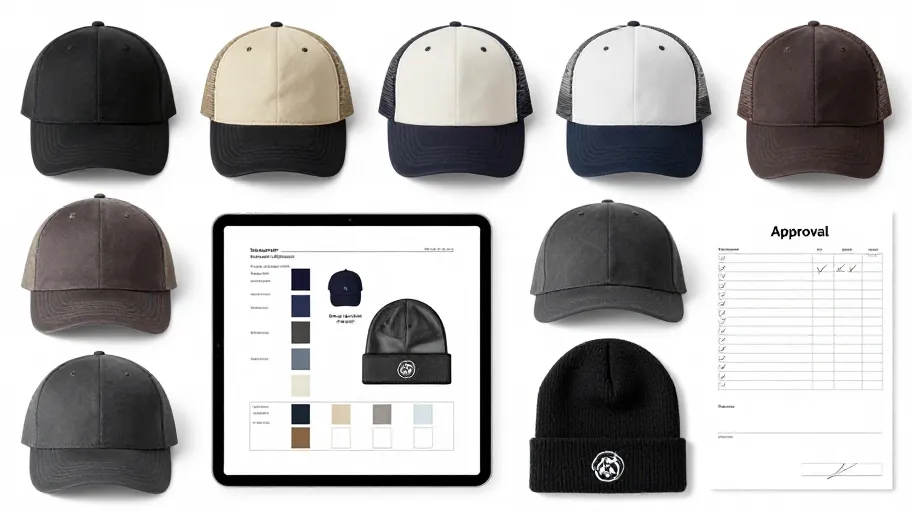
Ordering custom hats in bulk goes well when three things are documented early: a complete specification, a prototype that matches it, and a written approval gate before mass production. This guide gives buyers a working framework — Specification, Prototype, Approval — plus the exact questions to put to any manufacturer before confirming an order.
Why bulk custom hat orders go wrong before production starts
Most sourcing problems with custom hats in bulk do not happen on the production line. They happen earlier, in the gap between what the buyer described and what the supplier understood. A fabric weight is assumed rather than stated. An embroidery placement is sketched instead of measured. A closure type is named by one party and interpreted differently by the other.
When those gaps reach mass production, correcting them costs far more than clarifying them upfront. The remedy is not a longer negotiation — it is a disciplined sequence: define the specification, verify it with a prototype, and approve against a written record. Any manufacturer you are comparing should be able to support that sequence; if one resists documenting it, treat that as information about how the order would run.
The S.P.A. Framework: Specification, Prototype, Approval
Use three gates, each with its own output:
- Specification. A written document covering every variable that affects the finished hat. No order discussion should proceed past this point.
- Prototype. A physical sample made against the specification, used to confirm that the document and the factory's interpretation agree.
- Approval. A signed or recorded sign-off confirming the approved sample is the production reference, so both sides share one benchmark.
Each gate protects the next. A weak specification produces a prototype you cannot evaluate objectively; a skipped approval leaves you with no reference if the bulk run differs from the sample.
Specification decision table
Complete this table with your supplier before quoting or sampling. Every row should end with a confirmed value, not a preference.
| Specification item | Why it matters | Question to confirm with the supplier |
|---|---|---|
| Headwear type and construction (e.g. structured/unstructured 6-panel, 5-panel, trucker, bucket, beanie) | Determines pattern, machinery and finishing route | Which construction types does this factory produce in-house, and which involve partners? |
| Crown and brim profile | Drives fit and look; hard to judge from drawings alone | Can you confirm profile dimensions against a physical reference sample? |
| Main fabric and lining | Affects weight, feel, print/embroidery behaviour and cost | What fabric options can you offer for this design, and what documentation can you supply for them? |
| Closure type (strapback, snapback, fitted, elastic) | Changes assembly and sizing logic | Which closures do you support, and how is size range defined? |
| Decoration method and placement (embroidery, woven patch, print) | Placement and method interact with fabric choice | Can you show how each decoration method performs on the proposed fabric? |
| Colour specification | Colour disputes are among the hardest to resolve after production | Which colour reference system will we both use, and who approves the match? |
| Packaging and labelling (hangtags, care labels, polybags, carton spec) | Affects landed cost and retail readiness | What packaging details do you need from us, and what do you supply? |
| Order quantity and size breakdown | Quantity shapes pricing and production planning | What is your current MOQ policy for this construction and decoration mix? |
Two items in that table — MOQ policy and fabric documentation — are exactly the kind of point buyers assume and suppliers define differently. Get both in writing.
Running the sampling stage
The prototype exists to answer one question: does the factory's interpretation match the specification? Evaluate it against the document, not against memory or mood.
- Compare against the spec, line by line. Check construction, fabric, closure, decoration placement and colour against each confirmed row in your table.
- Photograph and measure the sample. Create a visual record so both sides can reference the same object later.
- Record every deviation. Note where the sample differs from the spec, however minor, and agree on which deviations are acceptable and which require revision.
- Confirm the sample's status. Ask explicitly: is this the sample that will serve as the production reference? Confirm with the supplier how their current sample policy works for your project, including any conditions attached to sample stages.
- Iterate deliberately. If a second round is needed, specify exactly which points change so the revision is testable.
At New Generation, we ask buyers to work through this stage with a written record on both sides, because the sample is only useful if what it proves is documented. You should hold any supplier to the same discipline.
The approval gate: questions to ask before signing off
Before bulk production begins, close the loop with these questions:
- Which physical sample is designated as the approved production reference, and who holds it?
- What documentation accompanies approval — spec sheet, sample photos, colour references, packaging spec?
- If production deviates from the approved reference, what process do we follow to review and resolve it? (Confirm the supplier's current policy — do not assume it.)
- What inspection points exist during and after production, and what reporting will we receive?
- What shipping and delivery arrangements apply to this order, and who confirms them? (Confirm current terms directly with the supplier.)
- Which contact owns the project from approval through shipment?
If a supplier cannot answer these clearly in writing, the gap is not on your side of the table.
FAQ
How many samples should I approve before bulk production? Approve as many rounds as needed until the prototype matches the specification exactly — then stop and record the final sample as the production reference. What matters is a documented endpoint, not a fixed number of rounds. Confirm with your supplier how their sampling process is structured for your project.
Can I get samples before committing to an order? Suppliers handle sample requests differently, including any costs, shipping arrangements and conditions. Ask each supplier you are comparing to state its current sample policy in writing, and compare those answers directly rather than assuming one policy applies across the market.
What should a custom hat specification include? At minimum: construction type, fabric and lining, closure, colour references, decoration method and placement, size breakdown, packaging and labelling, and order quantity. Use the decision table above as a checklist and fill every row with a confirmed value.
How do I keep colour consistent between the sample and the bulk run? Agree on a shared colour reference system before sampling, apply it to the fabric and thread, and confirm in writing that the approved sample's colours are the production benchmark. Ask the supplier how colour matching is checked and reported during production.
What information should I prepare before contacting a manufacturer? A design or sketch, target decoration method, intended quantity range and size breakdown, packaging requirements, and your target market — plus any compliance requirements your market imposes, which you should verify independently for your destination country.
Get your sourcing brief
Ready to move from shortlist to short spec? Request your sourcing brief (获取采购 Brief) from New Generation. Send us your design direction and quantity range, and we will respond with the specification template, sampling structure and project questions you need to compare suppliers on equal terms.
Before you commit: pre-order confirmation checklist
Print this and complete it with every supplier you are evaluating:
- Specification table completed — every row has a confirmed value
- MOQ policy for this construction and decoration mix confirmed in writing
- Sample process, stages and current sample policy confirmed in writing
- Colour reference system agreed and applied to fabric and decoration
- Approved sample designated as production reference, held by a named party
- Production inspection points and reporting method confirmed
- Shipping and delivery arrangements confirmed directly with the supplier
- Any compliance requirements for your destination market verified independently
- Single named project contact confirmed on both sides
#cap manufacturers china, #headwear manufacturers china, #cap factory








