


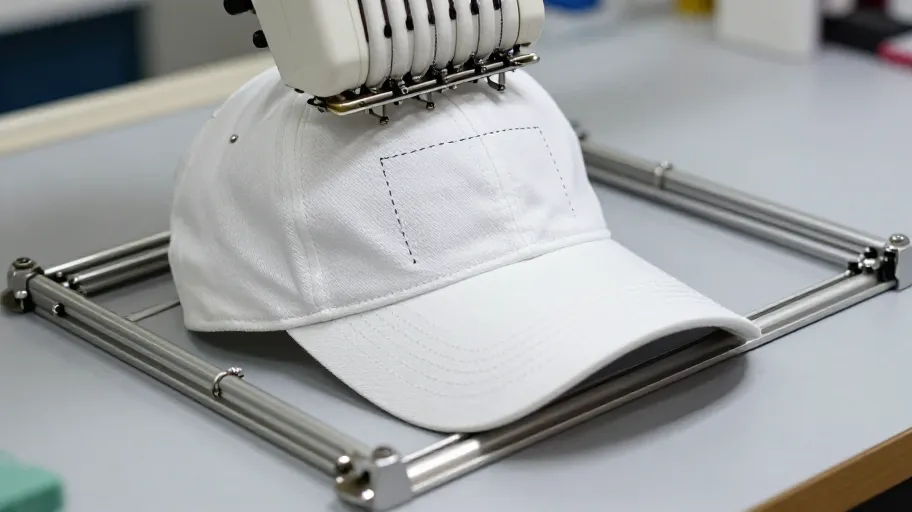
An embroidery cap frame is the hooping device that holds a curved cap panel steady while a machine stitches your logo. For B2B buyers, the practical comparison job is straightforward: verify each supplier's frame type, usable stitching area and sample-approval process, then document both before signing off on production artwork.
Why the cap frame deserves comparison, not just a spec check
When importers compare custom headwear quotations, the embroidery cap frame sits behind the scenes of almost every quality dispute. The frame determines how the cap is held, how flat the stitching surface is, how large a logo can be stitched, and how well placement repeats across a production run. Two suppliers quoting the same design can produce noticeably different results because their frames and hooping practice differ.
That is why this guide treats the cap frame as a comparison item rather than a technical footnote. The goal is not to rank machines or brands; it is to give you, the buyer, a repeatable method for verifying what a supplier can actually hold, stitch and reproduce — before you commit artwork and deposit.
The FRAME Check: a five-step comparison method
Use this named framework when you evaluate any supplier's cap embroidery setup:
- F — Fit. Ask which cap styles (structured, unstructured, six-panel, five-panel, visors) the supplier's frames accommodate. A frame that fits a structured six-panel cap may not suit a soft, unstructured crown without adaptation.
- R — Registration. Ask how the supplier keeps the design centred and aligned panel-seam to panel-seam. Registration is what makes the fiftieth cap in a run match the approved sample.
- A — Area. Ask for the usable stitching area the frame supports on the front panel, sides and back closure. This defines the maximum logo dimensions you can realistically order — and you should ask for it in writing, not as a verbal maximum.
- M — Materials. Ask how the frame handles the specific fabrics and constructions in your range — heavy brushed cotton twill, lightweight performance mesh, corduroy, wool blends. Fabric behaviour under tension differs, and hooping practice should be documented per material.
- E — Evidence. Ask for a sewn-out sample on your chosen cap and fabric, plus photos or video of the sample on-frame. Evidence replaces assurance.
The FRAME Check is deliberately supplier-neutral: it does not assume any factory's equipment or capability. Every element becomes a written question, and every answer becomes part of your approval file.
Spec comparison decision table
Use this table when you compare two or more suppliers' responses. Score each row, then weight the rows according to what your brand's range depends on most.
| Comparison item | What to ask the supplier | What a strong answer looks like | Risk if unanswered |
|---|---|---|---|
| Frame compatibility | Which cap constructions can be framed without modification? | A written list tied to the styles you intend to order | Last-minute style changes or re-quotes after sampling |
| Usable stitching area | Maximum stitch width and height per panel position, in writing | Documented dimensions you can design against | Logo redesign or forced size reduction late in the project |
| Placement repeat | How is centring and seam alignment controlled across a run? | A described, checkable method, not an assurance | Inconsistent placement you discover at inspection |
| Fabric handling | How does hooping differ across the fabrics in your range? | Per-fabric practice, reflected in the sample | Puckering, distortion or hoop marks on delicate materials |
| Sample evidence | Can you provide a sewn sample on the actual cap and fabric? | A physical or well-photographed sample before bulk approval | Approving on screen what the frame cannot reproduce |
| Approval record | Will the supplier accept a written, signed sample approval? | Yes, with a defined revision step if the sample fails | Disputes with no agreed reference standard |
The sample and approval gate
A sewn sample is only useful if you approve it against defined criteria. Before sign-off, ask these questions and record the answers:
- Is the sample stitched on the exact cap style, colour and fabric you ordered — or on a substitute?
- Was the sample produced on the same frame setup that will run your bulk order?
- Does the logo sit within the documented stitching area, with no edge stitches crowding seams?
- Do stitch density and underlay suit the fabric, without puckering or gaps?
- Are thread colours matched to your Pantone or physical reference under agreed lighting?
- Has the digitised file been archived with a version number so bulk production uses the approved file?
- What is the supplier's defined process if the sample does not meet these criteria — and is it in writing?
Then apply a simple gate:
| Sample outcome | Decision |
|---|---|
| Meets all documented criteria | Approve in writing, with dated photos on file |
| Minor, fixable deviation with a clear cause | Hold; request one defined revision and a re-sample |
| Placement, density or colour outside agreed spec | Reject against the written spec, not against opinion |
The approval file — spec answers, sample photos, signed acceptance — is what protects both sides when the bulk order ships.
Frequently asked questions
Does the cap frame brand matter more than the operator? Both matter, and neither can be assumed. Ask instead for evidence: frame compatibility with your styles, the supplier's placement method, and a sewn sample. Evidence answers the question that brand names cannot.
Can any logo size be embroidered on a cap front? No. Every frame has a usable stitching area, and curved cap panels constrain size further. Ask each supplier for documented maximum dimensions per panel position and design within them.
Should I approve artwork digitally before the sewn sample? Digital approval is a useful intermediate step, but it is not the approval. Approve the digitised layout on screen, then approve the physical sewn sample separately — they test different things.
How do I compare suppliers whose frame specs read differently? Convert every response into the FRAME Check structure: fit, registration, area, materials, evidence. Normalising the answers into the same five categories makes an uneven comparison readable.
What if my cap style changes after sampling? Treat a style change as a new frame-compatibility question. Re-confirm fit, stitching area and fabric handling for the new construction, and request a fresh sample against the new spec.
Download the sourcing brief
Get the 获取采购 Brief — a structured questionnaire covering frame compatibility, stitching area, fabric handling, sample approval and the commercial terms you must confirm per supplier before committing artwork.
Prefer to start smaller? Copy the FRAME Check and the seven sample-approval questions above into your next supplier email, and run the checklist before you request any sample.
#cap manufacturers china, #headwear manufacturers china, #cap factory








