

Sourcing headwear for Australia comes down to three controllable decisions: lock a written specification, control the sampling round, and enforce a documented approval gate before mass production starts. The Spec–Sample–Gate (SSG) framework gives importers, wholesalers and brand buyers a repeatable way to compare suppliers — including Shenzhen OEM/ODM manufacturers — on evidence rather than promises, and to convert every unknown policy into a direct question answered in writing.
Why this is a comparison job
Buyers comparing headwear suppliers for the Australian market face a structural problem: the things that determine outcome quality — spec handling, sampling discipline, change control — are invisible in a catalogue. Price lists and product photos tell you what a factory can show, not how it behaves when a spec is ambiguous or a sample revision is requested. The SSG framework reframes the comparison around observable behaviour: does the supplier document, or does it improvise?
This matters for Australian-bound goods in particular because distance compresses your ability to intervene. A spec error caught at sampling is a revision; the same error caught after shipping is a claim, a delay, or a season missed. Everything below is designed to move decisions earlier in the timeline.
The Spec–Sample–Gate framework
SSG has three stages:
- Spec — define the product in writing: construction, materials, closures, sweatbands, stitching, decoration method (embroidery, printing, patch, woven label), colour references, and packaging. Every attribute gets a field; every empty field becomes a question.
- Sample — request physical samples against the spec, and treat each sample as a measurement, not a gift. Compare sample to spec line by line and log deviations.
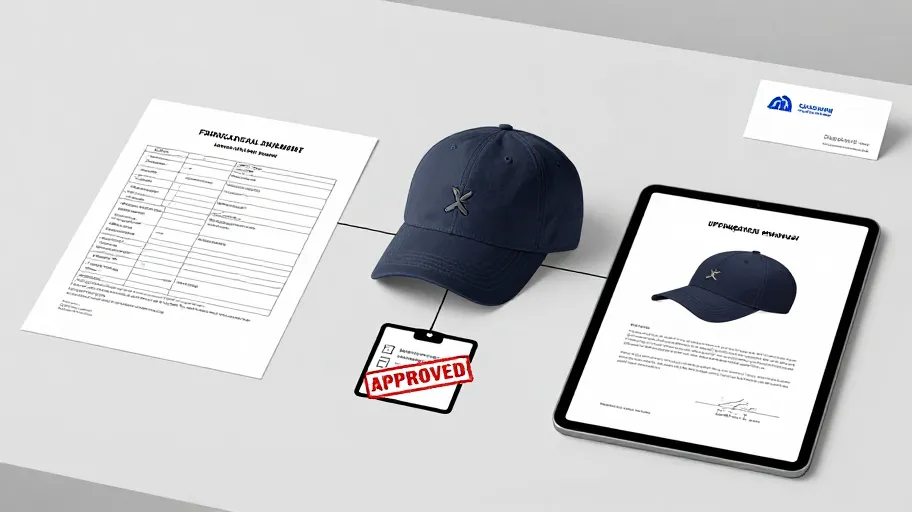
- Gate — no mass production begins without a written approval that references a specific, numbered sample. Any change after approval requires a new approval.
The framework is supplier-agnostic. You can run it against any candidate manufacturer, which makes it a fair comparison instrument.
Supplier comparison decision table
Use this table to score candidates. Score each row and require documentary evidence before awarding points.
| Comparison dimension | What to ask for | Strong signal | Weak signal |
|---|---|---|---|
| Spec handling | Will they co-sign a detailed spec sheet? | Supplier redlines unclear fields and asks questions | Supplier says "we know how to make caps" without documentation |
| Sample process | Written sampling procedure and current sample policy (cost, revision terms) | Clear, current policy stated in writing for your project | Vague or verbal commitments |
| Change control | Procedure for deviations between approved sample and bulk | Documented change-notification process | "Don't worry, same as sample" |
| Material documentation | Ability to provide material and construction details on request | Responsive with traceable documentation | Resists documentation requests |
| Communication | Named contact, time-zone overlap, revision responsiveness | Structured responses referencing spec line numbers | Fragmented chat messages |
| Compliance posture | Willingness to walk through documentation relevant to Australian import requirements | Invites verification and states what is available per project | Deflects or generalises |
Score honestly: a supplier with honest "not available" answers can be a better partner than one that agrees to everything.
Building a spec that survives the time-zone gap
A spec sheet for custom headwear should, at minimum, name the product type (for example structured six-panel cap, unstructured dad cap, bucket hat, beanie, visor), panel count and construction, crown and visor materials, lining, sweatband material, closure type, eyelet treatment, decoration method and artwork placement, colour standards (reference chips or codes, not adjectives), labelling requirements, and packing method. Because dimensional tolerances and measurement methods vary by project and supplier capability, state your required measurements and ask the supplier to confirm in writing which tolerances they can hold for your product — do not assume a number applies.
Two habits improve outcomes. First, convert every descriptive word ("navy", "medium brim") into a reference. Second, ask the supplier to restate critical dimensions in their own words in the reply. Misunderstanding lives in the gap between your sentence and their interpretation.
Sampling: request in writing, measure in person
Request samples that represent the actual production intent — same materials, same decoration method, same construction you intend to order at volume. Log each sample against the spec sheet and record deviations with photographs and measurements.
Sample policy, cost, shipping arrangements, revision terms and lead time are set per supplier and per project and change over time. Confirm the current policy directly with the supplier in writing before budgeting or scheduling. Do not rely on stated policies in older correspondence or third-party summaries.
Ask these sampling questions explicitly:
- Which sample type will you provide for this project, and what does it include?
- What is the current cost and revision process, and how are revisions limited?
- What is the current sampling lead time for this exact construction and decoration method?
- Which parts of the sample will match bulk production, and which will not, and why?
- How will deviations between sample and bulk be communicated and approved?
The approval gate: questions to close before mass production
The approval gate is the single highest-leverage control in the process. Before authorising production, get written answers to:
- Which numbered sample is the approved reference for this order?
- Has any material, subcontractor or process changed since that sample? If yes, what and why?
- Which inspection points will you perform, and at which production stages?
- How will bulk goods be checked against the approved sample before packing?
- What is the agreed process if delivered goods deviate from the approved sample?
- What documentation accompanies the shipment (packing list, construction details, material information relevant to your import process)?
- What is the current production lead time for this order quantity, confirmed in writing?
Question 6 is your responsibility too: confirm the documentation your Australian import pathway requires with your freight forwarder and customs broker, and ask the supplier whether they can provide it — verify per project rather than assuming.
Pre-production approval checklist
- Spec sheet completed, with no blank critical fields
- Supplier written confirmation of required measurements and tolerances for this product
- Physical sample received and measured against spec; deviations logged
- Sample revision history documented with dated references
- Approval issued in writing, referencing a numbered sample
- Change-control procedure confirmed for post-approval deviations
- Inspection and checking process before packing confirmed in writing
- Shipment documentation list agreed with your forwarder/broker
- Current production lead time confirmed in writing for this order
- Single point of contact and escalation path named
FAQs
What should I verify first when comparing headwear suppliers for Australia? Start with documentation behaviour, not price. A supplier that co-signs a spec sheet, states sample policy in writing for your project, and accepts a numbered-sample approval gate is demonstrating the controls that protect your order. Confirm each item directly — policies are project-specific.
How many sampling rounds should I plan for? Plan for at least one revision and ask the supplier how their revision process works and what the current terms are. Treat sampling as a measurement exercise: each round exists to close specific spec gaps, not to browse options.
Can I rely on a supplier's stated MOQ and lead time from a catalogue or platform page? No — treat any published figure as a starting point and confirm the current MOQ, price and lead time in writing for your exact construction, decoration method and quantity before committing.
What documentation matters for Australian importers of custom headwear? Requirements depend on your product's materials and your import pathway. Ask your customs broker what applies, then confirm with the supplier which documents they can provide for your order. Verify per project; do not generalise from other buyers' experiences.
How do I handle a deviation discovered after delivery? This is why the approval gate exists. If your written approval referenced a numbered sample and you confirmed a deviation-resolution process in advance, you have a documented basis for resolution. Agree on that process before production, not after a dispute.
Take the next step
If you are comparing OEM/ODM headwear partners for the Australian market, start with a structured enquiry rather than a general one.
获取采购 Brief — request the sourcing brief and use it to standardise your supplier comparison.
Or, if you are not ready to enquire, download the pre-production approval checklist above and run it against your current supplier conversations. Documentation discipline is free — and it is the cheapest quality control you will ever buy.
#cap manufacturers china, #headwear manufacturers china, #cap factory