

A sustainable baseball cap is only as credible as the documentation behind it. For B2B buyers, the real purchase decision is not “eco or not” — it is whether a supplier can specify materials, prove their origin, produce a consistent sample, and hold that standard through bulk production. This guide gives you a framework, a comparison table and an approval checklist to run that process with any manufacturer you evaluate.
The SPEC-Confirm™ framework
When buyers get burned on sustainable headwear, the failure point is almost never intention — it is process. Marketing language replaces specification, and specification is never converted into a signed approval. The SPEC-Confirm™ framework closes that gap in four stages:
S — Specify. Convert every green claim into a written line item: fibre content, recycled percentage, dye type, trim materials, closure, sweatband, lining and packaging. A claim like “recycled cap” is not a specification. “Fabric made from a stated percentage of a stated recycled input, confirmed by a stated document type” is — and the exact figures must come from the supplier in writing.
P — Probe. Ask where each claim can be verified. Which certificates exist, in whose name, and with what scope? Are they current? Do they cover the specific material batch you are buying, or a broader product family? Note: New Generation has not supplied certification details for any specific material at time of writing, so treat certification scope as an open question to confirm directly.
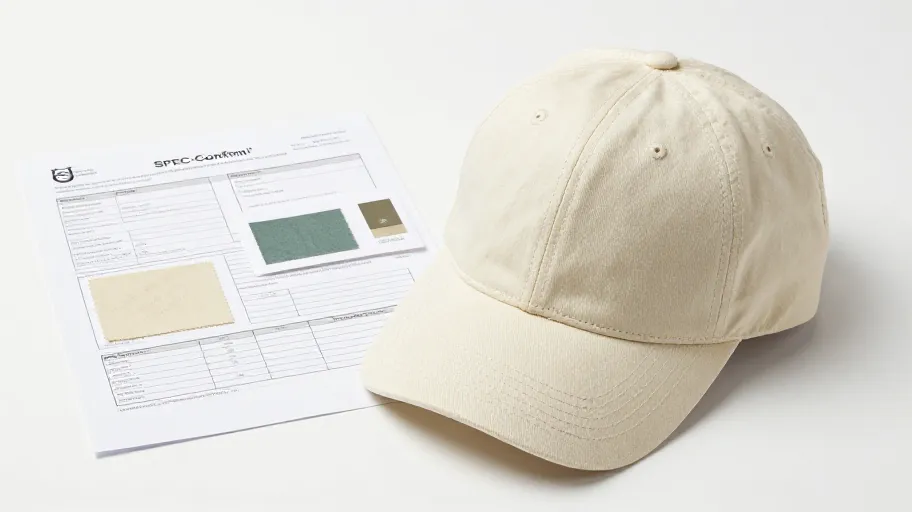
E — Evaluate. Test the sample against the specification, not against a photograph. Construction, crown shape, brim stiffness, stitching density, embroidery registration, hand feel and colour fastness should each be judged against the written spec sheet. Where you need numerical tolerances — colour deviation, stitch count, measurement allowance — ask the supplier to state and commit to them in writing rather than assuming any figure.
C — Confirm. Lock the approved sample as the golden sample. Both parties sign off on it, and it becomes the reference standard for pre-shipment inspection. Any change to materials, dye lot or subcontracting between approval and production should require written notice and re-approval.
Decision table: comparing sustainable cap options
Use this table to compare suppliers or material options on the same axes. Fill every cell from supplier-confirmed documents, not from assumptions.
| Criterion | What to compare | Evidence to request | Risk if left vague |
|---|---|---|---|
| Shell fabric | Fibre type, recycled content percentage, weight | Supplier-confirmed spec sheet and material documentation | Claim cannot be verified at inspection |
| Dye and finish | Dye type, finish chemistry, colour fastness approach | Written finish description; test scope confirmation | Colour inconsistency and unverified inputs |
| Trims and closure | Sweatband, button, eyelets, strap, slider materials | Full trim breakdown including small components | “95% sustainable” cap with non-compliant trims |
| Packaging | Recycled or reduced packaging materials | Packaging spec in writing | Sustainable product shipped in unspecified packaging |
| Sample policy | Sample availability, cost handling, terms | Direct confirmation of current policy from supplier | Budget and timeline surprises |
| Production consistency | How bulk is held to approved sample | Golden-sample procedure and inspection plan | Approved sample ≠ delivered goods |
| Documentation | Certificate scope, validity, ownership | Copies with scope and validity dates to verify | Outdated or irrelevant certificates accepted as proof |
Sample and approval questions to put to your supplier
These questions are deliberately concrete. A supplier who answers them in writing is demonstrating process maturity before you spend a yuan.
- Can you provide a written specification sheet covering fibre content, fabric weight, trim materials and packaging for the exact cap we are quoting?
- What documentation can you provide for the recycled or sustainable inputs, and does it cover the specific material batch we would order?
- What is your current sample policy — availability, cost handling and shipping terms — and what must we confirm before sampling begins?
- Which measurable tolerances (colour, dimensions, stitching) will you commit to in writing for bulk production?
- If a material or dye lot changes between sample approval and bulk production, what is your notification and re-approval procedure?
- Can we retain the approved golden sample and use it as the inspection reference for the production run?
- Which inspection checkpoints do you operate in-house, and what records can we receive at each gate?
Do not accept verbal answers on any of these. Request them in writing, dated, attached to your quotation.
Documentation verification checklist
- Specification sheet received for the exact cap model
- Material origin and recycled-content claims documented
- Certificate scope, validity and ownership verified against your order
- Trim and packaging materials itemised
- Sample evaluated against written spec, not images
- Tolerances and acceptance criteria stated in writing
- Golden sample approved, signed and retained by both parties
- Change-notification and re-approval procedure agreed
- Current sample, cost and shipping policies confirmed directly with the supplier
- Inspection gates and records agreed before order confirmation
One honest boundary: this article cannot tell you what any policy costs, how long anything takes, or which certifications apply to a given order — none of that was supplied, and it changes per project. The right move is to confirm each item in writing with your supplier at quotation stage.
FAQ
Is a recycled-fabric baseball cap more difficult to customise with embroidery or printing? It can behave differently from virgin fibre — thread tension, backing choice and colour registration may need adjustment. The practical answer is to test decoration on the actual sustainable fabric during sampling and approve the decorated sample, rather than assuming transferability from conventional caps.
How do I verify a sustainability claim rather than just trusting it? Ask for documentation, then verify its scope: does it name the material you are buying, is it current, and who holds it? A certificate for a product family does not automatically evidence your specific order. Confirm scope and validity in writing before treating any claim as proven.
At minimum: the final fabric, final trims, final decoration, final packaging if branded, and a signed spec sheet attached. Any element absent from the approval sample is an element you are accepting on trust.
Can I order a small trial run before committing to volume? Minimum order quantities, sampling terms and production policies are project-specific and were not supplied for this article. Confirm current terms directly with the supplier and decide whether a trial stage fits your ramp-up plan before signing.
What is the single biggest risk in sustainable cap sourcing? Specification drift: an approved sample that does not match bulk production. The SPEC-Confirm™ framework, a retained golden sample and a written re-approval procedure for any material change are your strongest defences.
Next step: 获取采购 Brief — request the sourcing brief and get the structured question set to run SPEC-Confirm™ with your shortlisted manufacturers.
Before you go: download the free pre-purchase checklist above and tick off all ten items before you confirm any sustainable baseball cap order with any supplier.
#cap manufacturers china, #headwear manufacturers china, #cap factory