


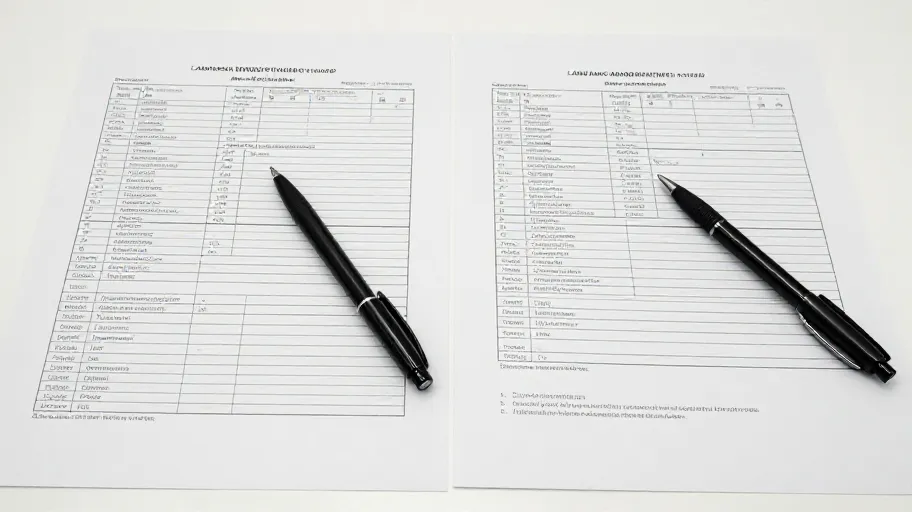
Comparing two quotes from a baseball cap manufacturer means normalizing them onto identical line items — terms, add-ons, landed cost, compliance, verification and documentation — then scoring each gap. The supplier whose quote survives a line-by-line audit, not the lowest headline number, deserves your order.
Why two supplier quotes almost never line up
When a procurement lead receives two quotations from baseball cap manufacturers, the first frustration is structural: the quotes are not built the same way. One may bundle embroidery set-up into a unit price; the other lists it separately. One may quote FOB with a named port assumption; the other quotes ex-works and leaves the rest to you. One includes a sample charge line; the other is silent on samples altogether.
None of these differences tells you which supplier is better. They tell you that the quotes are not yet comparable. The decision method below — the TALC-VD framework — forces both quotations into the same shape before you judge anything.
TALC-VD stands for:
- Terms — trade terms, payment structure, what the price actually includes.
- Add-ons — set-up, tooling, moulds, digitizing, packaging, revisions, sample charges.
- Landed cost — freight, destination charges, duties, insurance, and every cost between the factory floor and your warehouse.
- Compliance — labelling, material declarations, restricted-substance documentation, whichever applies to your market.
- Verification — what each supplier can evidence on request versus what they merely assert.
- Documentation — what is written into the PO and approval trail versus what lives in a chat message.
Run every line of both quotes through these six lenses and the comparison becomes mechanical rather than emotional.
The line-by-line decision table
Rebuild both quotes into this single table before you form any opinion. Score each row: which quote is clearer, which is more complete, which commits in writing.
| Comparison line | What to place in each cell | What a strong answer looks like | Red flag |
|---|---|---|---|
| Unit price & what it covers | Unit price + explicit inclusions list | Written scope: materials, construction, decoration, base packaging | Vague scope; "price includes everything" with no itemization |
| Trade terms | Incoterms as quoted | Named term, named point | Term missing or assumed |
| Sample policy | Current policy verbatim from supplier | A written, current policy you have confirmed directly | Silence on samples; verbal-only promises |
| Set-up / tooling charges | Each one-off charge, line by line | Each charge listed separately with ownership stated | Bundled, unexplained or appearing later |
| Revision & resubmission | Cost and limit of artwork or spec revisions | Stated in writing before approval | Undefined until after you commit |
| Decoration method detail | Stitch count assumptions, print setup, color separation | Method and assumptions documented | "Same as sample" with no written spec |
| Materials & trims | Fabric, sweatband, closure, eyelet, bill material per spec sheet | Full Bill of Materials per colorway | Generic fabric descriptions |
| Packaging | Inner packing, carton spec, labeling | Itemized packing line | Hidden carton/label charges |
| Freight & destination | Freight basis, who books, insurance | Explicit responsibility split | "Freight not included" with no basis |
| Duties & import costs | Who classifies, who pays, HTS assumption documented | Responsibility stated in writing | Nothing about import costs anywhere |
| Payment structure | Deposit %, balance trigger, currency | Written schedule tied to approval milestones | Payment terms shifting mid-negotiation |
| Compliance documentation | Labeling, material declarations, testing scope — confirm current evidence | Supplier provides verifiable current documents | Assertions without documents |
| Lead time & capacity basis | Production window as quoted by supplier, in writing, per order size | Committed in the PI/contract | Ranges quoted verbally only |
| Change-order process | How a mid-production change is priced and approved | Defined procedure | No process at all |
| Dispute & remediation | What happens on rejected goods or delays | Defined remedy path in contract | Not addressed |
The table's job is not to pick a winner immediately. Its job is to expose where each quote is silent. Silence is a decision input: the supplier who documents more is the supplier who has had to answer these questions before.
Approval questions to send both baseball cap manufacturers
Email both suppliers the same list and compare the answers side by side. Consistency of questions is what makes the comparison fair.
- Please itemize every one-off charge in this quotation — set-up, tooling, digitizing, sampling, packaging — and state which are chargeable now and which are contingent.
- Please confirm your current sample policy in writing, including how samples relate to the final order approval.
- Please provide the Bill of Materials for each colorway, including closure type, sweatband material and bill construction.
- Please state the trade term, the named point, and who is responsible for freight, insurance and destination charges under that term.
- Please confirm which compliance and labeling documentation you can currently provide for our destination market, and how we can verify it.
- Please describe your change-order process once the PO is approved: how a specification change is quoted and re-approved.
- Please state the production window for our quantity in the proforma invoice, and what remedy applies if it is not met.
- Please confirm who our escalation contact is during production and what interim verification we receive (e.g., pre-production sample approval step — confirm your process).
A supplier's willingness to answer in writing — completely, promptly and without renegotiating the answer later — is itself a comparison criterion. Track it.
What to do when the quotes are close
When two normalized quotes land within a narrow band of each other, stop comparing price and start weighting the TALC-VD columns:
- Terms clarity — which quote leaves fewer undefined lines?
- Verification depth — which supplier answered the eight approval questions with documents rather than claims?
- Documentation discipline — which supplier's answers match what they will put in the contract?
Assign a weight to each column that reflects your risk profile — for a new private-label launch, verification may outweigh a marginal unit-price difference; for a repeat reorder programme, terms and change-order process may dominate. Record the weights before you score, so the decision method is fixed before the outcome can bias it.
This is exactly what a structured scorecard is for: it converts two messy quotations into one documented decision your management team can audit.
FAQ
Should I ask both suppliers to re-quote in the same format? Yes — and the line-by-line table above is the format. Ask each baseball cap manufacturer to fill in the same rows with the same level of detail. A supplier who resists standardizing their own quote has told you something about how they will communicate during production.
The lower quote skips several lines entirely. Is that a problem? Treat skipped lines as unknowns, not zeros. A missing freight line does not mean free freight; it means the cost is undefined and you must confirm it directly before comparing totals. Quote only what is documented.
How do I compare compliance claims between two suppliers? Compare evidence, not assertions. Ask both for the specific documentation applicable to your destination market and verify its current status directly with the issuing source where possible. A claim without a document is not a comparison input.
Who should sign off internally on the final choice? Whoever owns the landed-cost budget and whoever owns quality approval should both review the completed decision table. The scorecard exists so the sign-off is based on the documented comparison, not on which quotation arrived first.
Can I use this framework for more than two suppliers? Yes. Add a column per supplier. The framework's value is that every extra quote costs you one column, not a new analysis method.
Download the Supplier Scorecard
Turn this method into a working document. Download the Supplier Scorecard and score both quotes line by line across all six TALC-VD lenses — terms, add-ons, landed cost, compliance, verification and documentation — so your supplier decision is documented, defensible and ready for internal sign-off.
Not ready to download? Start lighter: copy the fifteen-row decision table above and the eight approval questions into an email to both suppliers today. Getting both quotes into the same shape is the single highest-value step you can take this week — and it costs you nothing but one email.
#cap manufacturers china, #headwear manufacturers china, #cap factory