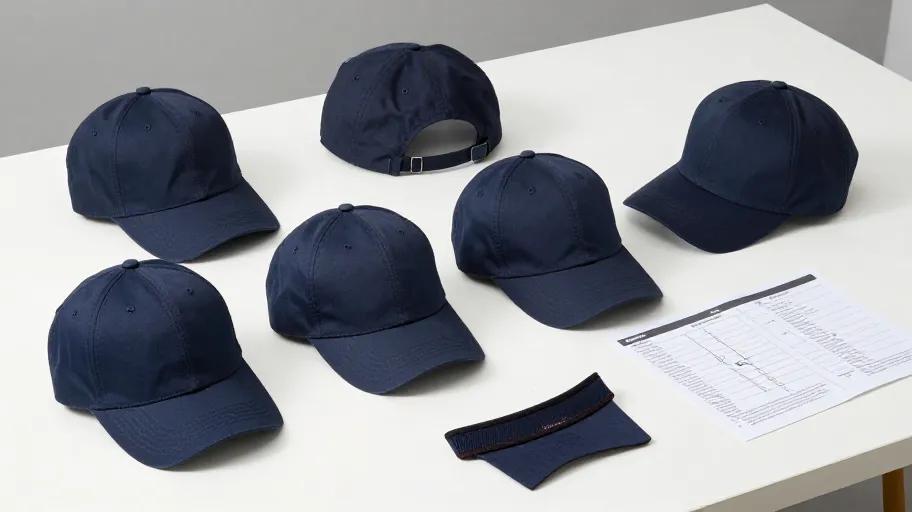
When you evaluate a baseball cap manufacturer, your fit and compatibility checks should produce a written record — not a feeling. Log how the crown sits, how the brim holds shape, how closures and trims interact, and how closely each sample matches your spec sheet. A structured record lets you compare manufacturers objectively and gives you documented grounds to approve, query or reject. That record is what this guide helps you build.
The F.I.T. Gate Framework
Before approving any sample from a baseball cap manufacturer, run it through three recorded gates:
- F — Fabric behaviour. How materials respond to wear, moisture and handling during your own testing conditions.
- I — Interface hardware. How closures, eyelets, buttons, sweatbands and adjustment systems interact with each other and with the shell.
- T — Trueness to spec. Whether the delivered sample matches the dimensions, construction and details you specified — not what a previous buyer requested.
The framework's value is repeatability. If you score the same fields for every manufacturer in your shortlist, your comparison stops being an impression and becomes a documented evaluation you can defend internally.
Decision table: recording each check
| Check field | What to record | Pass | Conditional | Fail |
|---|---|---|---|---|
| Crown fit on reference head forms | Fit notes at multiple head sizes; photos of pressure points | Even contact, stable position | Minor pressure noted, supplier offers revision | Slipping, gapping or asymmetry |
| Brim shape and return | Visual shape after your handling test; curvature memory | Holds intended curve after test | Slight relaxation, supplier proposes fix | Deformation or inconsistent curve |
| Closure engagement | How slider/buckle/strap behaves across adjustment range | Smooth, secure across range | Stiff at extremes, supplier to confirm remedy | Slipping, sharp edges or failure |
| Sweatband interface | Attachment method, edge finish, comfort notes | Clean seam, no lifting | Minor finish queries | Separation, rough edges |
| Eyelet and button seating | Alignment, reinforcement, attachment | Aligned, secure | Cosmetic variance, documented | Misalignment or loose seating |
| Spec conformance | Side-by-side of spec sheet vs. sample measurements | All recorded values match | Small deviations, supplier confirms correction | Unexplained deviation from spec |
Fill this table once per sample, per manufacturer. The scorecard you keep becomes the evidence base for your final sourcing decision.
Fit checks: what to measure and log
Record every fit observation in your own words and with photographs, dated and labelled with the sample batch. Note the head forms or wearer references you used, because fit feedback means nothing without the reference it was judged against. Log where the crown contacts, where it gaps, and how the cap behaves after repeated handling in your test conditions — your conditions, not a brochure's. Ask the baseball cap manufacturer to confirm which head form or last their patterns were built on, and whether the sample you received reflects your spec or a stock base.
Avoid approving on a single sample. Request whether duplicate samples from the same batch behave the same way; inconsistency between two samples from one batch tells you something one sample never can. Confirm the manufacturer's current sampling policy, including any costs and revision terms, directly with them before building your comparison timeline.
Compatibility checks: where components meet
Compatibility failures hide at the joins. When closures interact with shell panels, when eyelets sit over seams, when sweatband material meets brim binding — these interfaces determine whether the cap performs as a product, not just as a photo. Record each interface with a photograph and a one-line judgement.
Also record compatibility with your own downstream requirements: does the cap accept your label and packaging approach? Does the embroidery or print placement you planned sit where the panel seams allow? These are questions only your project can answer, so put them to the manufacturer in writing and log the responses alongside your physical findings.
Approval questions to put to the manufacturer
Before signing off any sample, send these questions and file the answers:
- Which head form or pattern base was this sample built on, and does it match our submitted spec?
- Can duplicate samples from the same batch be provided for consistency checking, and under what current terms?
- What is the process for logging and correcting deviations found during our fit and compatibility checks?
- Which components in this sample are sourced externally, and how is their compatibility verified?
- Who is the named contact for technical queries during sampling, and how are written confirmations issued?
- What are the current terms for revisions if a compatibility issue is found at this stage?
None of these presume any particular policy. Their answers — and the speed and clarity of those answers — become rows in your supplier evaluation.
FAQ
Why does a written fit record matter more than an experienced eye? An experienced eye is per-sample; a written record is comparable across manufacturers and across time. When you evaluate three baseball cap manufacturers six weeks apart, the record is the only thing that keeps the comparison honest.
How many samples should I check before approving? There is no universal number. What matters is whether duplicate samples behave consistently and whether deviations from spec are documented and explained. Ask the manufacturer what duplicate-sample arrangements they currently support.
What if the sample fits well but deviates from my spec? Treat spec deviation as a signal about process control, separate from fit quality. A cap can fit well and still indicate loose spec discipline, which matters more at bulk scale. Log the deviation and ask for written explanation and correction.
Should I test closures under stress? Test within conditions that reflect your intended use, and document exactly what you did. Record the method, the observation and the outcome so the same test can be repeated on the next manufacturer's sample.
How do I compare manufacturers fairly if samples arrive at different times? Use the same decision table fields for every sample, photograph everything, and date each record. A consistent template neutralises the timing difference.
Take the record-keeping further
Download the Supplier Scorecard and turn your fit and compatibility findings into a documented, defensible comparison across every baseball cap manufacturer on your shortlist.
Before your next sample run, grab the pre-sample request checklist — the questions to send before any cap ships, so your evaluation starts documented.
#cap manufacturers china, #headwear manufacturers china, #cap factory