
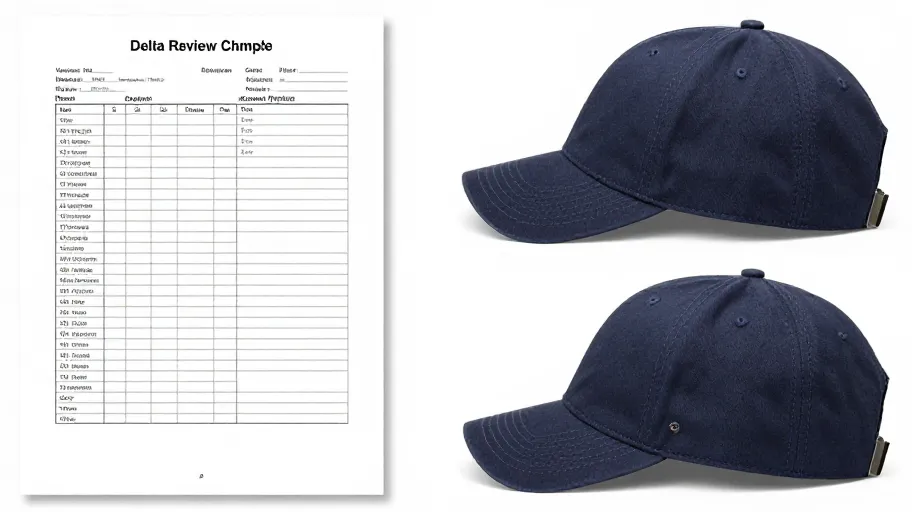
A revised baseball cap sample should be reviewed against a version-numbered tech pack using a delta review: you audit only the documented changes since the last revision, then run a short regression pass on previously approved features. This keeps development moving forward instead of restarting the spec from zero. The method works because every change is traceable, every approval is documented, and every open item stays visible until it is closed.
Why revised samples go wrong
Most revision failures in custom headwear development are not manufacturing failures. They are communication failures. Somewhere between the buyer's feedback and the factory's sewing line, the scope of the change got lost. The buyer asked for a flatter crown; the factory also adjusted the brim curve. Nobody documented it, so nobody caught it.
The baseball cap tech pack is the instrument that prevents this — but only if it is treated as a living, version-controlled document rather than a one-time PDF sent before sampling. When your tech pack carries a revision number, a dated change log, and a clear status per feature (approved / open / rejected), a revised sample becomes a measurable event instead of a guessing game.
The Delta Review Method
The Delta Review Method is a four-step routine for evaluating any revised cap sample. The word "delta" refers to the difference between revisions: you review the change, not the entire cap.
Step 1 — Read the revision log before touching the sample. Open the current tech pack version and the revision log side by side. The log should state, feature by feature, what was changed since the previous revision and why. If the factory's documentation does not include this, request it before proceeding. A sample that arrives without a change list cannot be delta-reviewed; it can only be re-reviewed from scratch, which is exactly the restart you are trying to avoid.
Step 2 — Verify each logged change on the physical sample. Handle the sample and check only the logged items. Was the crown panel actually re-cut? Does the sweatband attachment match the updated spec? Record a pass, fail, or partial result per item. A camera, a ruler and the annotated tech pack page are enough equipment for this step.
Step 3 — Run a regression pass on approved features. Changes interact. Adjusting a crown seam can shift how the visor sits. Replacing an eyelet tape can change how the front panel behaves after washing. After checking the delta, spend a shorter, structured pass re-confirming every feature you approved in the previous revision. Your baseball cap tech pack should let you filter the spec by approval status so this pass takes minutes, not hours.
Step 4 — Update the tech pack version and close the loop. Every review ends with one of three outcomes per feature: approved, revise again, or escalated for discussion. Log the outcome, issue a new version number, and share the updated document with the factory before the next sample is cut. This single habit is what makes each revision cumulative rather than circular.
Decision table: approve, revise, or escalate
| Situation | Delta result | Regression result | Decision |
|---|---|---|---|
| All logged changes match spec | Pass | All approved features still pass | Approve sample; move to next project stage after confirming current terms with supplier |
| Logged changes match, regression finds a new issue | Pass | One or more failures | Revise: document the regression as a new open item with photo evidence |
| Logged change partially executed | Partial | — | Revise: state precisely what portion passed and what did not; avoid vague "redo" instructions |
| Logged change not executed at all | Fail | — | Escalate: request the factory's explanation and confirmation of the change scope before authorising another sample |
| Sample deviates from spec in unlogged ways | Fail | — | Escalate: ask whether the deviation was intentional; if undocumented changes appear repeatedly, review your communication workflow with the supplier |
Concrete approval questions to send with your review
Before you sign off on any revised cap sample, send these questions to your supplier and keep the written answers in your project file:
- Please confirm the complete list of changes made between revision [X] and revision [Y] of this baseball cap tech pack.
- For each approved feature, please confirm no construction, material or pattern change was made other than the logged items.
- What is your current policy on sample revisions, including any charges and how they are handled? (Confirm the current policy directly; do not rely on past orders or assumptions.)
- Which changes, if approved at sample stage, will be locked for production, and what is your process for confirming the production sample matches the approved revision?
- If a future revision is needed, what information do you need from us to execute the change exactly as specified?
- Can you confirm the materials and trims on this revised sample match the tech pack's bill of materials, item by item?
These questions convert vague satisfaction into documented approval — which is what protects both sides when the order scales.
Revised-sample approval checklist
- Revision number and date recorded on the tech pack
- Change log received from factory before review begins
- Each logged change verified on the physical sample (pass / partial / fail)
- Regression pass completed on all previously approved features
- Photos taken of every failure, referenced to the spec page
- Outcome logged per feature: approved, revise, or escalate
- Updated tech pack version shared with factory
- Supplier's written answers to approval questions filed
- Commercial terms (samples, revisions, production) confirmed directly with supplier in writing
- Approval decision recorded with a named approver and date
FAQ
Do I need a new tech pack for every sample revision? No. You need a new version of the same tech pack. Version control — a number, a date, and a change log — is what lets the factory and your team agree on exactly what changed. Discarding the document and starting a fresh one destroys the audit trail that makes delta review possible.
What if the factory says a change I requested isn't possible? Treat it as an engineering conversation, not a refusal. Ask for the specific constraint — pattern, material, construction method — and ask what alternative achieves the same design intent. Record the agreed alternative in the revision log so the next sample is reviewed against the real spec, not the original one.
How many revisions should I expect before approval? This depends entirely on your design complexity, how precisely your initial spec communicated intent, and your supplier's sampling process. Confirm the revision workflow and any associated costs directly with your supplier before development begins, and budget your review time for more than one pass.
Should the pre-production sample be reviewed the same way?
Who should sign the final approval? One named person with authority to commit the brand. Shared or informal approvals are a frequent source of disputes, because no one can later establish what was actually agreed. Record the approver's name and the date in the tech pack.
If you want a structured way to run every review in this article, download our Tech Pack Checklist — it turns the Delta Review Method into a repeatable pre-approval routine your whole team can follow.
Short on time today? Start with just the approval questions and the checklist above, and download the full Tech Pack Checklist when your next sample lands.
#cap manufacturers china, #headwear manufacturers china, #cap factory