

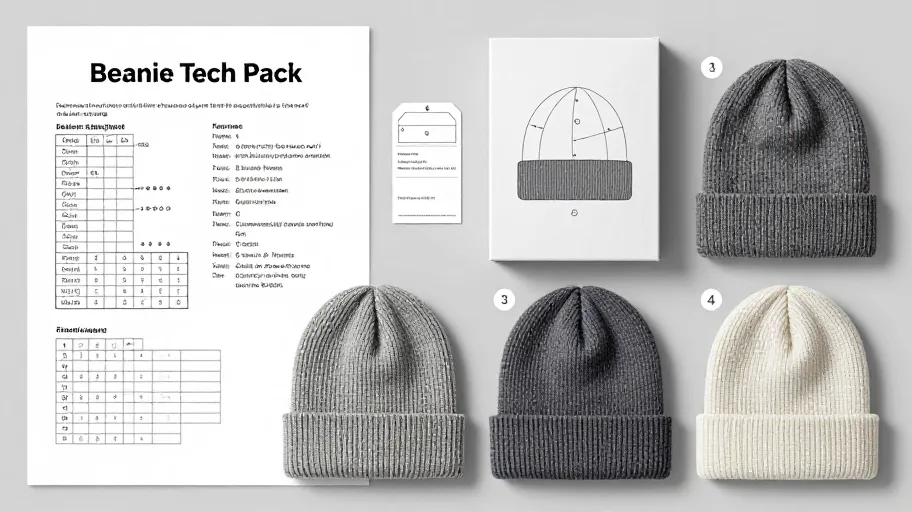
A beanie tech pack is the written measuring stick that lets you compare physical samples objectively: documented yarn and knit specifications, construction details, label placement, packaging, and an approval record tied to a numbered sample. Photos cannot capture weight, stretch recovery, seam behaviour or interior finish, so a complete tech pack — used with a side-by-side scoring table — is what turns sample comparison from impression into evidence.
Why photos are not an approval instrument
Photographs flatten exactly the attributes that decide whether a beanie matches your brand intent:
- Weight and density. Two beanies can photograph identically while differing in warmth, drape and perceived quality.
- Stretch and recovery. A cuff that looks fine in a photo may lose shape after repeated stretching. Only a documented measurement against the spec sheet captures this.
- Surface texture. Fine knit irregularities, pilling tendency and yarn lustre rarely survive compression into a JPEG.
- Interior finish. Seam allowances, linking quality and lining attachment are invisible from the outside angle a supplier chooses to shoot.
- Colour truth. Lighting and screen calibration shift colour perception between your office and the factory floor.
None of this means a supplier is acting in bad faith. It means the approval medium is wrong. A beanie tech pack moves the comparison from "looks right" to "measures right".
The S-T-A-P-L-E framework for sample comparison
When physical samples from two or more suppliers arrive on your desk, run each one through six documented checkpoints. This is the framework we recommend every private-label buyer adopt before approving anything.
S — Specifications
Record the stated specification for every attribute and measure the physical sample against it: yarn composition as declared, knit structure, weight per unit, cuff style, fold configuration, closure or pom type. Each row in your tech pack should have three columns: specified value, measured value, verdict (pass / query / fail). Where a supplier cannot state a specification in writing, treat that as a finding in itself.
T — Texture evidence
Handle each sample and record descriptive evidence, not adjectives alone: hand-feel, stretch behaviour when pulled and released, recovery observation, surface uniformity across the whole garment, and how the cuff holds its fold. Photograph your own samples under identical lighting with a reference object for scale, and file those images in the tech pack as your evidence, not the supplier's.
A — Assembly
Inspect construction: seam or linking consistency, thread or yarn joins, cuff attachment, any lining attachment, and symmetry between panels. Turn the beanie inside out and document what you see. Assembly differences that are invisible in marketing photos are the most frequent source of post-delivery disputes, because they were never documented at approval stage.
P — Packaging
Confirm how each unit is folded, tagged, polybagged and cartoned, and match it to what your warehouse and retail channel require. Packaging mismatches discovered at inbound inspection are expensive to resolve; packaging confirmed inside the tech pack is a preventable problem.
L — Labelling
Verify every label element against your written requirement: brand label, size or fit identifier, care symbols, composition declarations, country-of-origin marking, and any tracking or QR label. Confirm the current policy and applicable requirements for your destination market directly with the supplier and your compliance adviser — do not rely on what a previous order carried.
E — Evidence trail
Each sample round gets a version number, a date, a signed or emailed verdict, and one retained physical "golden sample" per approved version. When bulk goods arrive, you compare them against the retained sample and the approved tech pack version — not against memory or a chat history.
Decision table: scoring samples against the tech pack
Score each attribute 0 (fail), 1 (query), or 2 (pass). Total the score; anything below full marks generates a written query before approval.
| Checkpoint | What you compare | Sample A verdict | Sample B verdict | Evidence filed |
|---|---|---|---|---|
| Yarn composition matches declaration | Written spec vs. documentation | ☐ | ☐ | Spec sheet |
| Knit structure and density | Visual + tactile vs. spec | ☐ | ☐ | Your photos |
| Weight per unit | Measured vs. specified | ☐ | ☐ | Measurement log |
| Stretch and recovery | Pull test observation | ☐ | ☐ | Notes + photos |
| Seam / linking quality | Inside-out inspection | ☐ | ☐ | Macro photos |
| Cuff construction and symmetry | Physical comparison | ☐ | ☐ | Notes |
| Label set completeness | Against label requirement list | ☐ | ☐ | Label checklist |
| Packaging format | Against packaging brief | ☐ | ☐ | Packing notes |
| Documentation completeness | Tech pack fields filled in writing | ☐ | ☐ | Supplier responses |
| Version identified and retained | Sample tagged with version number | ☐ | ☐ | Golden sample tag |
A supplier whose submission scores well on documentation as well as physical quality is showing you how the eventual production relationship will run: documented, comparable, disputable on evidence.
Approval questions to send before sign-off
Send these in writing and attach the answers to the tech pack version:
- Can you confirm each specification value in the attached table in writing, including yarn composition and knit structure?
- Which attributes of this sample are you able to hold consistent in bulk production, and which carry variation — and how will that variation be documented?
- How do you identify and segregate the approved golden sample on your side once we sign off?
- What is your current sampling arrangement — cost, timing and shipping — for the next round if this one needs revision? Confirm the current policy directly.
- What documentation will accompany bulk production so we can verify conformity against this approved tech pack?
- How are labels applied and verified, and who checks the label set before packing?
- If a bulk delivery does not match the approved sample, what is your process for reviewing and resolving it? Confirm the current policy directly.
Questions 4 and 7 are deliberately open: terms differ between suppliers and change over time, so no article should state them for you. Written answers, dated and attached, become part of your evidence trail.
Building the evidence trail
Three habits protect you after approval:
- Version everything. "Tech pack v3, sample round 2, approved 12 March" beats "the one we liked".
- Retain the golden sample. One physical unit per approved version, tagged and stored, is the reference for any future comparison or dispute.
- Confirm policy in writing each time. Sampling arrangements, revision terms and post-delivery review processes should be confirmed for each project rather than assumed from a previous one. Confirm the current policy directly.
FAQ
Can I compare samples fairly if suppliers send different formats of documentation? That is precisely why you issue your own beanie tech pack first. When every supplier fills in the same template, their responses and samples become directly comparable, and gaps in documentation become visible scoring criteria rather than hidden risk.
How many sample rounds should I plan for? Plan for at least one revision round in your sourcing timeline, and treat each round as a versioned event with its own verdict. The exact number depends on how completely your initial specifications are defined and confirmed — document each round rather than targeting a fixed count.
What if a supplier refuses to fill in my tech pack format? Treat it as a sourcing signal, not an automatic rejection. Ask which fields they can confirm in their own format, and transfer their answers into your template yourself. A supplier who documents well in a different format may still be workable; one who documents nothing is harder to hold to a standard.
Should I approve based on the best sample or the best-documented supplier? Weight both. An excellent sample with thin documentation creates approval risk you cannot enforce later; a well-documented sample that is slightly off-spec but clearly correctable is a manageable path. The decision table is designed to surface exactly this trade-off.
How do I handle colour approval without relying on photos? Request a physical colour reference — a swatch, retained sample or standard reference — and compare under controlled lighting. Record the reference in the tech pack and require bulk production to match the retained reference rather than a screen image.
Get the Beanie Brief
Download our Beanie Brief — a ready-to-use beanie tech pack template with built-in sample-comparison fields, the approval-question list and the golden-sample record sheet. Bring it to your next supplier conversation and compare candidates on evidence, not impressions.
[获取 Beanie Brief → Get the Beanie Brief]
Before your next sample round: 10-minute checklist
Short on time? Run this quick pre-approval checklist on any sample already on your desk:
- Specifications written down and measured against
- Your own photos taken under controlled lighting
- Inside-out assembly inspected and noted
- Stretch and recovery observed and recorded
- Label set compared to your written requirement
- Packaging format confirmed against your brief
- Sample tagged with a version number
- Written responses filed from the supplier
- Golden sample retained
- Approval verdict sent in writing
#cap manufacturers china, #headwear manufacturers china, #cap factory