


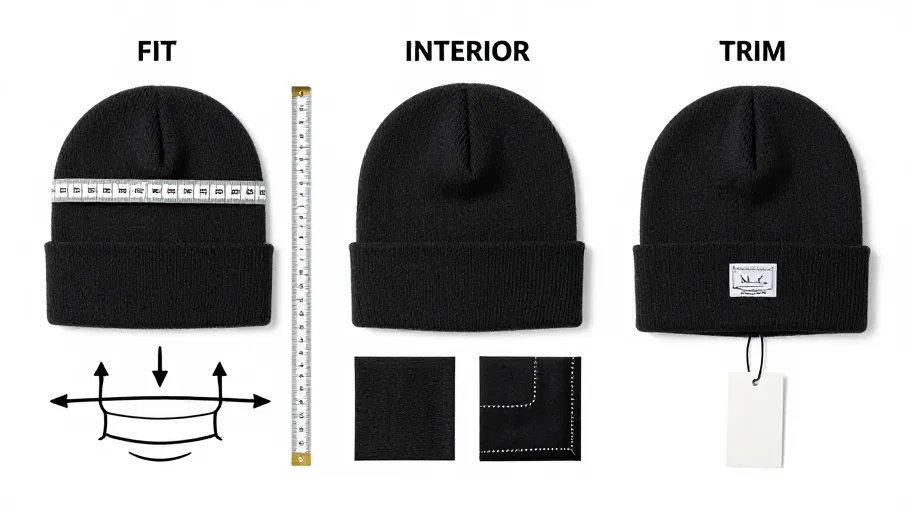
A beanie tech pack is only quotable when it documents three measurement groups beyond the logo: fit (head circumference, finished length, cuff height, stretch behavior), interior (fold construction, lining, seam finish) and trim (label size, placement zone, hangtag attachment). We call this the FIT-3 method. Most first-round sampling problems trace back to one of these three groups being described in words rather than numbers — or not described at all.
Why first briefs fail before sampling even begins
When a brand sends "cuffed beanie, ribbed knit, embroidered logo" to three suppliers, the brief sounds complete to the buyer and incomplete to the manufacturer. Each factory fills the gaps with its own interpretation: whose head circumference, whose cuff proportion, whose fold, whose label position. The samples that come back are not wrong — they are answers to questions the buyer never asked in writing.
The fix is not a longer brief. It is a structured one. A beanie tech pack that closes the FIT-3 measurement groups gives the supplier nothing to interpret and gives the buyer a documented baseline for every later comparison: between quotes, between samples, between production runs.
The FIT-3 method: the three measurement groups to lock before quoting
F — Fit measurements
These are the numbers that decide whether the beanie sits correctly on the intended market's head and stays there.
- Head circumference target. Specify the head size the beanie is engineered to fit — not the flat measurement of the beanie itself. A beanie's relaxed width and its stretched width are two different numbers; document both as your target range and let the supplier propose how to achieve it.
- Finished length, unstretched. Measure from the bottom edge of the cuff (or lower hem, for cuffless styles) to the top of the crown, laid flat, unstretched.
- Cuff height. The folded portion at the bottom. Whether the cuff is worn folded or unfolded changes the visible length and the logo placement, so state which condition your measurement refers to.
- Crown construction and target shape. Domed, flat-top, or seam-joined four/six-panel construction each produce a different silhouette and a different measurement reference. Name the construction, then measure against it.
- Stretch behavior. Document the minimum and maximum head circumference the beanie should accommodate without distortion or slippage. Ask the supplier how they propose to engineer the stretch — yarn choice, knit structure, and finishing all play a role, and the buyer's job is to specify the outcome, not the method.
I — Interior measurements and construction
The interior decides comfort, warmth and how the beanie behaves after washing.
- Fold and hem specification. Single fold, double fold, rolled edge or raw-edge cuff — each has a different fabric consumption and a different interior appearance. Specify the finished interior depth, not just the exterior look.
- Lining. If the beanie is lined (fleece, jersey, Thinsulate-type insulation or unlined), document the lining's coverage zone and how its edges are finished inside. Lining adds bulk at the crown and cuff; note where the interior should remain flat.
- Seam finish. Overlocked, flatlocked or tubular (seamless) construction changes both interior feel and stretch recovery. A tubular knit and a seamed knit of the same exterior dimensions behave differently on the head — specify which you expect.
- Interior label zone. Where the woven label, heat-transfer care label or size strip sits inside, and how much of the interior it may occupy. A label that overlaps a seam changes the fit at that point.
T — Trim and placement measurements
Trim errors are the most visible errors and the easiest to prevent with numbers.
- Logo placement grid. Define logo position with two references: distance from the cuff's top fold line (or hem) and horizontal offset from the center-front seam or a defined knit landmark. "Centered on the cuff" is an instruction; "logo baseline sits X mm above the cuff's upper edge, horizontally centered" is a specification.
- Embroidery footprint. Embroidery stiffens the knit. Document the maximum stitch area you will accept and whether a backing layer is permitted inside — backing affects interior comfort and stretch at the logo site.
- Label and hangtag dimensions. Folded and unfolded label sizes, attachment point, and hangtag string position relative to the cuff edge.
- Decoration condition. State whether placement measurements refer to the beanie laid flat, on the head, or on a form — the same logo sits differently in each condition.
Decision table: structuring the spec before you brief a supplier
| Spec decision | Options to document | What it drives | Confirm with supplier |
|---|---|---|---|
| Cuff style | Single fold, double fold, rolled, cuffless | Fabric consumption, finished length, logo zone | Yarn gauge feasibility for chosen fold |
| Head fit target | Relaxed width + stretch range for target circumference | Knit structure, yarn recovery | Proposed construction to hit the range |
| Crown construction | Domed, flat, multi-panel seamed | Silhouette, seam placement, measurement reference | Seam position relative to logo |
| Interior finish | Unlined, lined, flatlocked, tubular | Comfort, warmth, bulk, cost structure | Interior appearance samples per option |
| Decoration method | Embroidery, woven patch, knit-in, heat transfer | Interior feel, stretch at logo, durability | Backing and its effect on stretch |
| Label plan | Woven, heat-transfer, size strip | Interior fit at attachment zone | Attachment method and placement tolerance |
This table is the core of a quotable beanie tech pack. Completed, it lets you compare supplier responses line by line instead of comparing incompatible quotations.
Concrete approval questions to close the spec
Before you approve any sample, put these questions to the supplier in writing and require written answers:
- Can your construction hit our stated stretch range while keeping the specified finished length stable after repeated wear? What evidence can you provide?
- What placement tolerance can you commit to for the logo position we specified, and how will you verify it in-line during production?
- How will the interior finish look at the cuff and crown — can you send an unwashed interior photo set of the exact construction quoted?
- What happens to cuff height after the finishing process you use — should our tech pack measure before or after finishing?
- What is your current sample policy, sampling cost, shipping arrangement and timeline for this construction — and are any of those conditions different once we move to production?
- What documentation will you provide per shipment so we can verify the approved spec was followed?
For every policy question, confirm the supplier's current position directly. Terms around sampling, fees and shipping are set by each supplier and can change; no article can state them on a manufacturer's behalf.
Pre-brief checklist
Use this before sending your beanie tech pack to any manufacturer:
- Head circumference target stated, with relaxed and stretched width range
- Finished length defined with its measurement condition (flat, unstretched, cuff folded)
- Cuff height and fold style specified
- Crown construction named
- Interior finish and lining coverage documented
- Logo placement defined with two numerical references
- Embroidery footprint and backing decision recorded
- Label dimensions and interior attachment zone specified
- Supplier policy questions (sample, cost, shipping, timeline) listed for written confirmation
- Approval criteria for the first sample agreed in advance
A tech pack that passes this checklist gives the supplier a single interpretation path — and gives you a documented reference when you need to compare, verify or dispute anything later.
Frequently asked questions
How detailed does a beanie tech pack need to be before the first quotation? Detailed enough that two different manufacturers reading it independently would produce the same specification. In practice, that means every line in the FIT-3 groups is stated as a number with its measurement condition, not as an adjective.
Should I specify the knit gauge and yarn, or leave that to the manufacturer? Specify the outcome — weight, hand feel, stretch range, warmth — and let the manufacturer propose the construction. But document whatever construction they propose, because that proposal becomes your approval baseline for sampling and production.
What measurement condition should the tech pack reference? Pick one and state it on every page: laid flat and unstretched is a workable baseline, with stretch measurements noted separately. The error to avoid is mixing conditions between documents.
Can I use the same tech pack for cuffed and cuffless styles? Use the same structure, but re-measure for each style. Finished length, logo placement and interior finish all reference different landmarks when there is no cuff, so the FIT-3 groups need their own numbers per style.
How do I verify the supplier followed the tech pack in production? Agree the verification method before production: which measurements are checked, at what stage, against which tolerance, and what documentation accompanies each shipment. Put the agreement in writing as part of the approval.
Next step: Get the Beanie Brief — a structured first-brief template built around the FIT-3 measurement groups, ready to send to your shortlisted manufacturers.
Lower commitment: copy the pre-brief checklist above into your next sourcing document and confirm each line with your supplier before the first sample is cut.
#cap manufacturers china, #headwear manufacturers china, #cap factory








