

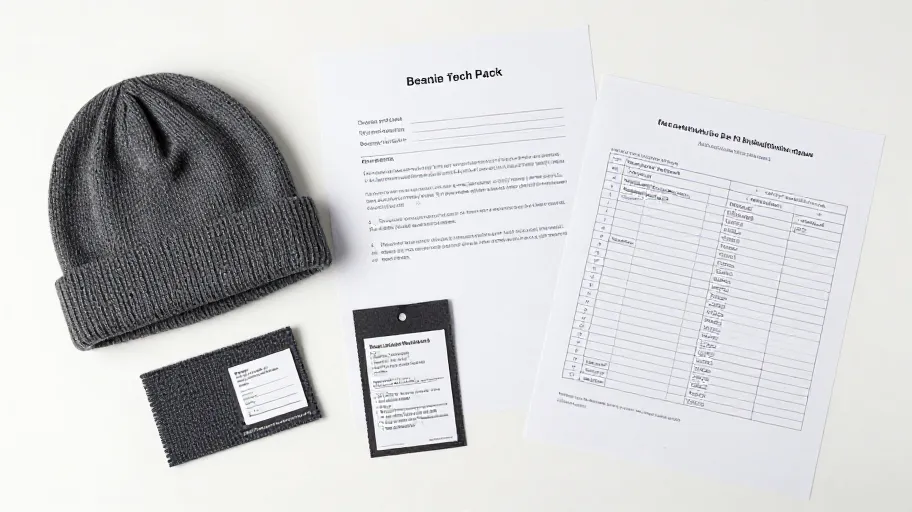
When a supplier suggests changing a material in your beanie tech pack, ask for the substitution in writing, a stated reason, the full revised specification, a pre-production sample against the new spec, and evidence supporting any equivalence claim — then approve, reject, or conditionally approve through a documented change-control step. Your tech pack, not the email thread, should remain the single source of truth.
Why material substitutions deserve a process, not panic
A supplier proposing a substitute yarn, lining, or trim is not, by itself, a signal of a problem. Mills discontinue yarns. Dye lots shift. A substitute can reflect genuine supply constraints — or it can quietly downgrade the hand feel, stretch recovery, and durability your customer associates with your brand. You cannot tell the difference from a one-line message saying "equivalent quality available."
The difference between a well-managed sourcing operation and a reactive one is not whether substitutions happen. It is whether every substitution passes through a documented gate before it reaches your customer.
The SUB-SPEC Framework
When a substitution proposal lands, work it through six questions — S.U.B.S.P.E.C.:
- Substitute — what exactly is proposed? Demand the full revised spec line: fibre composition, yarn count, weight, finish, and dye method for the proposed material, written against your original spec.
- Use-case — where does it matter? Identify which end-use properties the original material carried: stretch and recovery, thermal feel, pilling behaviour, colourfastness, seam behaviour. Ask the supplier to address each property individually, not "quality" as a vague whole.
- Spec — what else changes? A yarn change can ripple into knit structure, weight, label content, and packaging. Ask the supplier to list every downstream spec line the substitution touches.
- Evidence — what documentation accompanies it? Revised fibre-content declaration, updated labelling information, and any composition documents your market requires. Confirm compliance obligations with your own advisors; do not rely on a supplier's verbal assurance.
- Price and terms — what is the commercial impact? Ask whether the change affects unit cost, and confirm current sample, shipping, and production policies directly with the supplier rather than assuming anything from prior projects.
Decision table: approve, reject, or conditionally approve
| Scenario | Evidence status | Recommended decision | Required record |
|---|---|---|---|
| Full revised spec supplied, sample approved, equivalence documented per property | Complete | Approve | Signed change-order appended to tech pack; new revision number |
| Substitute spec supplied, but no sample evaluated yet | Partial | Conditional approval | Written approval contingent on pre-production sample sign-off |
| Supplier says "same quality" without revised spec or documentation | Insufficient | Hold — do not approve | Written request for full spec, reason, and evidence |
| Substitution affects label/composition declaration; compliance unconfirmed | Incomplete | Hold pending compliance confirmation | Documented confirmation from your compliance advisor |
| Substitute only affects non-critical trim, documented and sampled | Complete | Approve | Change log entry with sample reference |
| Supplier declines to provide reason or revised spec | Refusal | Escalate or re-source | Escalation note; consider alternative quotation |
Nine approval questions to put in writing
- What is the exact reason for the proposed substitution?
- What is the complete specification of the substitute material (composition, weight, finish)?
- Which properties of the original material does it match, and which differ — stated item by item?
- Which other spec lines in the tech pack change as a result?
- Can you supply a pre-production sample using the substitute before production?
- What documentation supports composition and labelling under the substitute?
- Does the substitution change the quoted unit cost, and if so, by what mechanism?
- What are the current sample, revision, and shipping policies associated with this change? (Confirm directly.)
- Who at your company signs off on the change, and what is your revision-control process?
A supplier who answers these questions cleanly is demonstrating a workable change-control capability — whichever factory you ultimately choose.
Recording the change in your beanie tech pack
Treat the substitution as a revision, not a conversation:
- Increment the tech pack revision number and date.
- Replace or annotate the affected spec line, keeping the original visible for traceability.
- Attach the supplier's written substitution proposal, your questions, and their answers.
- Reference the approved pre-production sample by reference number.
- Record the approver's name and date on the change order.
This discipline protects both sides. Six months later, when a QC inspection or a customer complaint references the material, the record answers the question without archaeology in email threads.
Red flags in supplier responses
- "Same quality" without a revised spec sheet
- Resistance to producing a sample in the substitute material
- Composition changes mentioned casually, after pricing is agreed
- No named person responsible for the change
- Answers that arrive verbally but never in writing
None of these proves bad intent — but each is a reason to slow the approval gate, document more, and compare quotations before committing.
Pre-approval checklist
Before you sign off on any material change:
- Written reason for substitution received
- Full revised specification attached to tech pack
- Downstream spec changes identified (label, knit, weight, packaging)
- Pre-production sample in substitute material approved and referenced
- Composition and labelling documentation updated
- Compliance obligations confirmed with your own advisor
- Commercial impact on cost confirmed in writing
- Current sample, shipping and revision policies confirmed directly with supplier
- Revision number incremented; change order signed and dated
Frequently asked questions
Should a material substitution always mean a new beanie tech pack? Not a new document — a new revision. Keep one living tech pack with traceable revisions so every stakeholder works from the same source of truth.
What if the supplier says the original material is discontinued? Ask for the discontinuity in writing, the substitute's full spec, and a sample. Discontinuity is a reason for a proposal; it is not, on its own, grounds for approval.
Who is responsible for confirming that a substitute material meets my market's requirements? Confirm regulatory and labelling obligations with your own compliance advisors. Ask the supplier what documentation they can provide to support that process, and verify the documents you receive.
Can I approve a substitution conditionally? Yes — approve subject to sample sign-off or documentation delivery, and record the condition in the change order so production cannot proceed on an incomplete approval.
How do I compare two suppliers' substitution responses? Use the same SUB-SPEC questions with both, and score completeness: full spec, documented reasoning, sample availability, written answers. Completeness of response is itself sourcing evidence.
获取 Beanie Brief — get the structured beanie brief template with built-in material-substitution disclosure fields, approval gates and change-control sections. Use it to make your next supplier conversation precise, documented and reversible.
Low-friction option: Start with the free pre-approval checklist above — copy it into your next supplier email and see how completely they answer. When you're ready for the full document, the Beanie Brief is waiting.
#cap manufacturers china, #headwear manufacturers china, #cap factory