


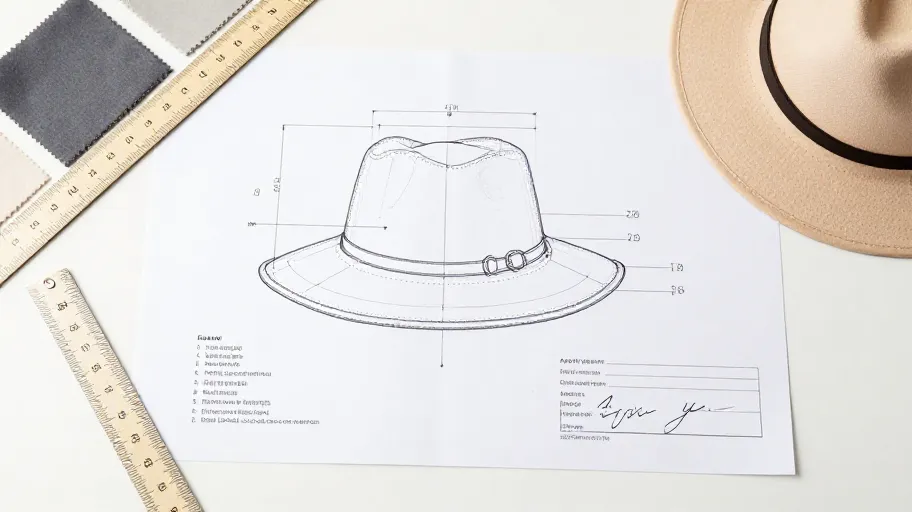
The buyers who avoid the most disputes when working with hat manufacturers in China are not the ones who find the "best" name on a list — they are the ones who document the product in three separate artifacts: the technical drawing, the bill of materials, and the approval notes. This Drawing–BOM–Approval framework turns vague conversations into verifiable records, gives every candidate factory the same basis to quote against, and gives you something to point to when someone asks, six weeks from now, exactly what was agreed.
Why a search list is not a selection method
When you search for the best hat manufacturers in China, what you actually get is a mix of directories, vendor profiles and marketing pages. None of those results can tell you how a specific factory will handle your cap: your fabric, your closure, your embroidery density, your packaging. The only thing a search list reliably gives you is a candidate pool.
That reframes the job. Instead of hunting for a single best factory, the stronger move is to shortlist candidates and then evaluate each one against the same documented spec. A Shenzhen OEM/ODM manufacturer of custom caps and headwear — and any comparable candidate — should be able to read your drawing, price your BOM, and confirm your approval notes line by line. The factory that engages with all three documents seriously is demonstrating something a sales page cannot: process discipline.
The Drawing–BOM–Approval framework
The framework is simple: every detail in your spec has exactly one home. Construction belongs on the drawing. Materials and components belong on the BOM. Decisions, confirmations and exceptions belong in the approval notes. When a detail lives in the wrong place — or in all three, or in none — that is where reinterpretation starts.
The drawing answers: what does the cap look like and how is it built?
The technical drawing carries geometry and construction: crown profile, panel count, visor shape and curvature, closure position, seam placement, embroidery or patch placement and sizing zones, hole placement, and stitch type per seam. Measurements and stated tolerances belong here too — but because dimensional tolerances and any associated acceptance criteria are project-specific, confirm what tolerance regime your supplier works to and record it in the approval notes once agreed.
The BOM answers: what is the cap made of, and from which confirmed components?
The bill of materials carries every physical input: shell fabric and weight, sweatband material, visor board or brim construction, closure type, eyelet material, thread, labels, tags, and packaging components. Each line should reference a confirmed component. Where a component has not yet been confirmed, the BOM line should say "pending confirmation" rather than quietly carrying a placeholder that later becomes the shipped reality.
The approval notes answer: what was decided, by whom, and against what evidence?
Decision table: where each spec item belongs
| Spec item | Drawing | BOM | Approval notes |
|---|---|---|---|
| Panel count and seam placement | ✔ | ||
| Crown height and visor curvature | ✔ | ||
| Embroidery placement and sizing zone | ✔ | ||
| Stitch type per seam | ✔ | ||
| Shell fabric type and weight | ✔ | ||
| Sweatband and visor construction materials | ✔ | ||
| Closure type and hardware | ✔ | ||
| Thread, labels, tags, packaging | ✔ | ||
| Dimensional tolerances and acceptance criteria | ✔ (values) | ✔ (how they will be checked) | |
| Approved pre-production sample reference | ✔ | ||
| Corrections applied from a previous sample round | ✔ | ||
| Sample policy, costs, shipping responsibility | ✔ (as confirmed in writing by the supplier) | ||
| Actions if a component becomes unavailable | ✔ |
If an item does not fit any single cell cleanly, that ambiguity itself is a finding — resolve it before quotation, not after production.
Approval questions to send every candidate supplier
Before you approve a pre-production sample or commit to production, send each shortlisted factory the same set of questions. The answers — or the refusal to answer — become part of your comparison record.
- Which sample reference are we approving, and is it the exact unit you will use as the production standard? Ask for the sample's own identification so no one can later substitute a different unit.
- How will each stated tolerance be checked, and by whom? Confirm what measurement method the factory uses and what evidence of conformity they will provide.
- What is your current sampling policy for this project? Ask what the sample involves, what it costs, who covers shipping, and the terms attached — and request the answer in writing rather than as a verbal assurance.
- If a BOM component becomes unavailable mid-project, what is the process? Confirm whether substitution requires your written approval and what evidence you receive before approving any substitute.
- What documentation will accompany production? Ask what records the factory provides at each stage — pre-production confirmation, in-process checks, and pre-shipment — so your approval notes have an evidence chain.
- What is not included in your quotation? Ask each supplier to state explicitly what sits outside the quoted scope — additional sample rounds, artwork adjustments, special packaging — so the approval notes define the boundary before money moves.
Comparing candidates on equal terms
The framework also gives you a fair comparison method. Give every shortlisted manufacturer the identical drawing, the identical BOM and the identical question set. Then compare the responses, not the marketing.
- Did the factory respond to each drawing line, or only the easy ones?
- Did the BOM come back with confirmed components or with placeholders?
- Did the answers to the approval questions arrive in writing, with specifics, or as generalities?
- Were any policies — sampling, shipping responsibility, scope boundaries — stated as current and confirmed, or left vague?
Use this low-friction checklist during your next supplier review call:
- All three artifacts prepared: drawing, BOM, approval notes template
- Each spec item assigned to exactly one artifact
- Tolerance values on the drawing; checking method agreed in the notes
- Sampling policy, costs and shipping responsibility confirmed in writing
- Approved sample identified by a unique reference
- Component-substitution process documented
- Quotation scope boundary stated explicitly by the supplier
- Documentation deliverables per stage confirmed
A factory that engages seriously with all three documents is telling you something about how it handles detail. A factory that pushes back toward "just send us a picture and a quantity" is telling you something too — and you can verify which pattern holds by running every candidate through the same documents.
FAQ
How do I verify a hat manufacturer's claims instead of relying on a search ranking? Ask each candidate for evidence tied to your project: how they responded to your drawing and BOM, what documentation they provide at each production stage, and what current policies they confirm in writing. Claims on a profile page cannot substitute for how a factory handles your specific documents.
Can I put everything in one specification document instead of three? You can, but it weakens your position. When construction, materials and decisions share one document, revisions become hard to track and each party can interpret "the spec" differently. Three artifacts with distinct purposes keep revisions visible and responsibilities clear.
What if a supplier disagrees with where I placed a detail? Treat the disagreement as information. A factory may have a production-driven reason to move a detail — that is a valid conversation. What matters is that the final location of each detail is recorded in the approval notes and agreed before production begins.
How many sample rounds should I budget for? That depends on your product's complexity and how complete your initial documents are; there is no universal count. Ask each candidate to state, for your specific project, what their current sampling policy involves — including costs, shipping responsibility and terms — and record the answer in your approval notes before starting.
Who owns the approved documents during production? You should. Keep your drawing, BOM and approval notes as the controlling versions, require the factory to work against your revision numbers, and confirm in writing that any change requires your approval before implementation.
#cap manufacturers china, #headwear manufacturers china, #cap factory








