


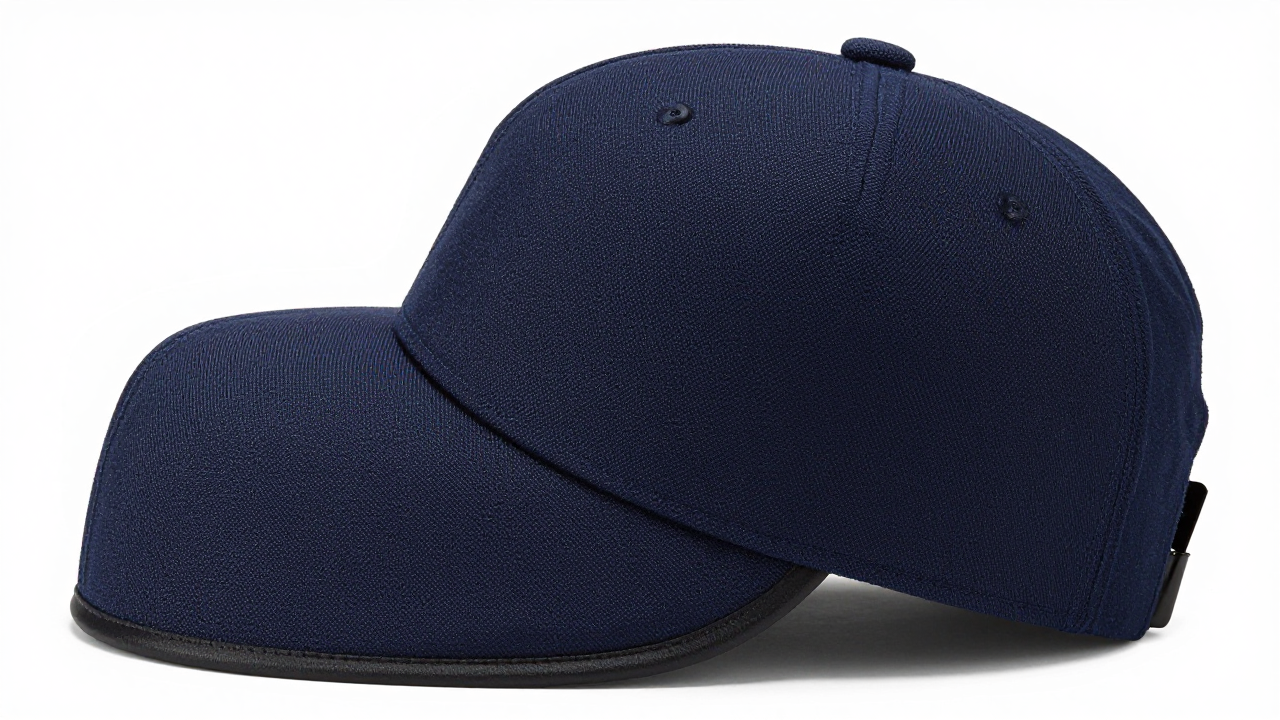
Most buyers think the savings come from a lower FOB quote. They don't. The money sits in landed cost per sellable unit, and three levers move it: packaging density, the under-run allowance, and…
reorder fidelity. Compare cap manufacturers on price per piece and you will pick the wrong one roughly half the time. Below is the model we'd actually recommend by volume, then the math behind it.
What Does Cheap Actually Mean When You Compare Cap Manufacturers?
Cheap means landed cost per sellable unit. Packaging density alone can swing that number by 40% on identical caps from the same factory, and it is the line item almost nobody puts in the sourcing budget.A finished six-panel cap weighs 3.2 to 4.5 ounces. It occupies 700 to 950 cubic inches. That gap is the whole story. On air freight, the dimensional weight divisor of 139 means a 900-cubic-inch cap bills as roughly 6.5 pounds. You are paying for 6.5 pounds of air to move a quarter-pound of cotton twill.
Ocean is gentler but still volume-based. Loose-packed at 12 caps per carton, we routinely see freight land at $0.80–$0.90 per cap. Nested and flat-packed at 48 to 60 per carton, the same shipment clears at $0.28–$0.35. On a 10,000-piece order that is a $5,000 difference created by a carton spec, not a negotiation.
Here's where we got it wrong for years. We assumed the FOB price dominated everything. It doesn't, not for headwear. Caps are low-value and high-cube, which inverts the normal math most apparel buyers carry in their heads. A $0.20 unit concession on a 10,000-piece run saves $2,000. Fixing your carton configuration saves more than that and costs nothing except a conversation.
The second lever is the under-run allowance. The trade norm is ±3%, and plenty of factories quietly quote -5% on the assumption you won't read that clause. Take a 10,000-piece order at $4.20. A 5% shortfall is 500 caps you cannot sell. At a $28 retail price, that's $14,000 of missing shelf inventory — booked to save $2,100 on the invoice. Ask for ±2% and accept a slightly higher unit price to get it. The trade is almost always worth taking.
Third lever: reorder fidelity, which gets its own section below because it decides whether 60% or more of your lifetime spend lands on budget.
How Do US Cap Manufacturers and Overseas Factories Actually Compare?
Five sourcing models cover nearly every US cap buyer, and they differ by roughly 3x on unit cost and 90 days on lead time. No single model wins on both, so the right answer is always a volume-and-velocity trade.Ranges below are what we see quoted in the market for a six-panel cotton twill cap with one front embroidery location, 1,000 pieces, 2025–2026 pricing. Verify your own HTS classification before you model duty — headwear sits under 6505.00.20, and the all-in rate moves with origin and Section 301 status.
Two notes the table can't hold. First, the China model carries a development cost — pattern making, grading, and a first-round sample run typically $600–$1,500, and that is sunk if you switch factories. Second, the nearshore number looks expensive per unit until you price the cash conversion cycle. Sixty days faster means sixty fewer days of working capital sitting in a container.
Which Comparison Dimension Do Most Buyers Skip?
Reorder fidelity — a factory's ability to reproduce order #1 on order #5. It never appears in an RFQ, and it separates suppliers that look identical on a sample from suppliers that hold up over three years.Fidelity breaks in four places. Embroidery files get re-digitized by a different technician and the stitch angle shifts by two degrees. Fabric gets bought per order instead of committed, so dye lots drift. Pattern templates get re-cut. And the production line that ran your first order gets reassigned.
In March 2024 a Nashville screen-print shop sent us three of their prior reorders to inspect. Same design, same factory, 14 months apart. The third run read 1.5 shades off on a heather gray, which at 2,400 units meant a permanent markdown cycle on a cap they'd sold at full price twice before. Nobody at the factory had done anything wrong by their own standards. They just hadn't retained the lab dip.
What actually prevents this is boring. Ask any candidate factory who owns the digitized embroidery file and in what format — Wilcom native or a flattened .DST, because only native files preserve the object structure. Ask whether they retain a lab dip and a sealed production sample per colorway, and for how many years. Ask if your pattern template is stored under your account or reused. A factory that answers all three without checking with someone is a factory that has done this before.
We keep every account's digitized files and pattern templates under a written seven-year retention commitment. That's not a differentiator we advertise much, but it's the reason our 2024 reorder volume grew faster than our new-account volume.
What Goes Wrong Most Often When Buyers Switch Cap Manufacturers?
Failures cluster in three places: samples sewn on the sample-room line rather than the bulk line, spec sheets that describe appearance instead of measurement, and freight booked before packing density is confirmed.August 2021. A buyer in Portland, Oregon called at 6:40 a.m. her time about 11,400 five-panel trucker caps that had been sitting at the Port of Long Beach for 19 days. The caps were fine. The problem was that the cartons had been packed at 12 per box to protect the front panels, which pushed the shipment from a 40-foot container into a rolling booking, and the rolling booking cost her the back-to-school window. Eleven thousand caps arrived in October for a season that ended in September. The unit price had been excellent.
The sample-room trap is equally common and harder to spot. Many factories hand-build the first sample with their most senior sewer on a single-needle machine, then move bulk to a multi-head line. The sample looks great. Bulk comes back with the crown 4mm low and the eyelets 2mm out of position. Insist that your pre-production sample come off the bulk line, and say so in writing before you pay the deposit.
Spec sheets fail because they use words. "Mid-crown, structured, slightly curved brim" means nothing to an auditor in another hemisphere. Write crown height in millimeters, brim length in millimeters, stitch count per logo, and the closure type by part number.
How Do You Hold Quality Consistent Across Reorders?
Write the spec in numbers an auditor can measure with a caliper: crown height within ±3mm, 8,000–12,000 stitches per front logo, AQL 2.5 for major defects and 4.0 for minor under ANSI/ASQ Z1.4, and a retained lab dip for every fabric.That standard has been stable for decades, which is exactly why a factory that flinches at citing it is telling you something. The stitch range matters more than buyers expect. Below 8,000 stitches a 3D puff logo loses its edge definition; above 12,000 on a lightweight twill the fabric starts puckering around the foam. For 3D puff specifically, ask what foam thickness they use — 6mm is the practical floor, and 8mm is where most logos start looking bloated.
Then build two inspection gates into the purchase order. One at 30% of production, one at 70%. Not a final AQL inspection — a mid-run check. Final inspections catch problems after the whole run is wrong. Mid-run checks catch them at 3,000 pieces instead of 10,000.
Can You Negotiate Better Terms Without Breaking the Relationship?
Yes, by negotiating around the price instead of at it. Under-run allowance, payment split, and freight consolidation usually move more money than a unit-price concession, and they cost the factory less, which keeps the relationship intact.Three asks that work. First, tighten under-run to ±2% and offer to pay for the over-run at cost — factories resist tight tolerances because they eat the shortfall, so remove that fear. Second, restructure payment from 30/70 to 40/60 against the pre-production sample approval. Cash-flow timing matters more to a mid-size factory than 15 cents a unit. Third, ask them to consolidate your order with another US shipment on the same sailing. We've seen that save $600–$900 per booking purely from avoiding a partial container.
What doesn't work: leading with a competitor's quote on a lower spec and asking them to match it. Every factory in the room knows what a 4-panel poly cap costs versus a 6-panel brushed twill. You'll get matched, and you'll get matched on their cheapest line.
So Which One Do You Actually Pick?
If you're launching a brand and ordering under 3,000 units a year, buy blanks from a US distributor and decorate locally. The unit cost hurts and your margin will be thin, but you avoid $1,000+ in development costs, 90 days of lead time, and the cash-flow risk that kills first-time headwear brands. Move off this model when your annual volume clears roughly 5,000 units in a single silhouette and you need a crown shape nobody else sells.
If you're between 3,000 and 25,000 units a year with a design you intend to own, go direct to a cut-and-sew cap manufacturer overseas — China for the widest trim and embroidery range, Vietnam or Bangladesh if your duty model demands origin diversification. Budget for the development cost and the 100-day cash cycle. Model the freight at both packing configurations before you sign, not after.
If you're above 25,000 units, split. Run 70% of volume through your primary origin and 30% through a second. You lose a little on per-unit price and you buy yourself a working alternative the first time a port backs up or a tariff line moves.
And if you sell into a channel with hard launch dates — team sports, retail drops, promotional — pay the Mexico or US premium. Speed is the product there, and the unit cost difference is the cheapest insurance you'll ever buy.
Frequently Asked Questions
How much does it cost to manufacture a custom cap in the United States?
Custom cut-and-sew caps land at $3.20–$5.80 FOB from Asia and $5.10–$7.40 from Mexico, before duty and freight. Domestically decorated blanks run $8.50–$16.00 all-in. Add $0.30–$0.90 per cap for ocean freight, or roughly $2.50–$4.00 for air.
What is the minimum order quantity for custom caps?
Cut-and-sew factories typically require 500–1,000 pieces per colorway, with 1,000 being the common floor for custom trims like metal eyelets or woven labels. US distributors selling decorated blanks will fill orders as small as 24–144 pieces. Below 500 units, blank-plus-local-decoration is almost always cheaper.
How long does cap production take from sample to delivery?
Plan on 75–110 days door-to-door from a Chinese cut-and-sew factory: 10–15 days for sampling and revisions, 25–35 days of production, 30–35 days of ocean transit, plus customs clearance. Nearshore Mexico compresses this to 35–60 days because most of the journey is by truck.
How do I verify a cap manufacturer is legitimate before paying a deposit?
Request their business license, a video walkthrough of the production floor during working hours, and two US customer references you can call directly. Then order a paid sample off the bulk line. A factory that cannot produce a live video call at 2 a.m. your time is not running a factory — they are brokering.








