


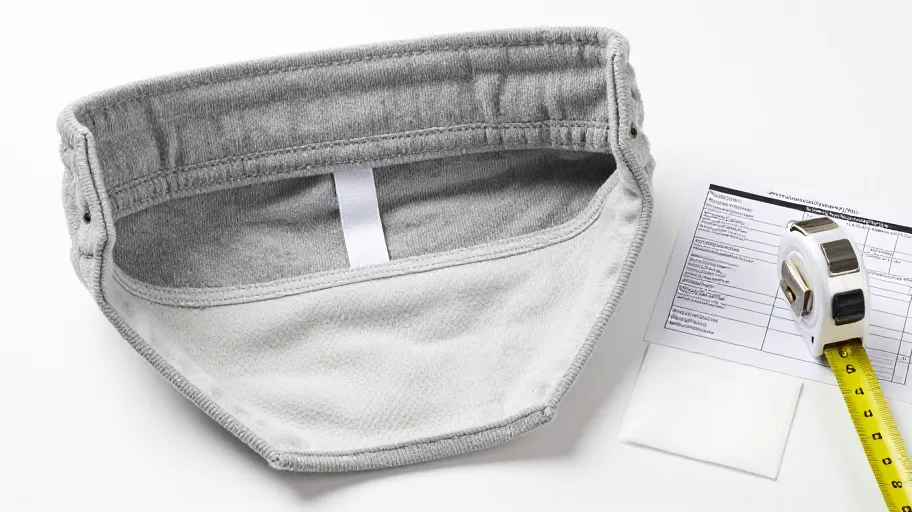
The cap sweatband is the strip sewn to the inside lower crown that sits against the wearer's forehead, and it is one of the easiest details to leave undefined in a custom cap brief. Before sampling, confirm five things in writing: band material, construction method, interior label placement, comfort finishing, and how the approved sample will be documented as the production reference.
Buyers who define these details early tend to move through sampling with fewer revision rounds, because the sweatband affects comfort, interior appearance and branding at the same time. Buyers who leave it open tend to discover at sample review that they have no position to compare against.
The Sweatband Specification Sheet: five lines to fill in before sampling
Use this framework in your cap brief. Each line becomes an approval question at sampling.
| Line | What you define | Why it matters before sampling |
|---|---|---|
| 1. Material | The fabric or composition of the cap sweatband | Determines feel against the skin, moisture behaviour and cost tier; sampling the wrong material wastes a round |
| 2. Construction | How the band is sewn to the lower crown, its width and any folding or layering | Affects whether the band holds its shape and how the interior looks |
| 3. Interior label | Whether an inside label is sewn on the sweatband, and its content and placement | The sweatband is a standard location for inside branding; decide late and you may pay for a revision |
| 4. Comfort finish | Any edge treatment, taping or seam placement on the band | Seam position against the forehead is the detail wearers notice most |
| 5. Approval evidence | What the approved sample must document: photos, a kept physical sample, written confirmation of each line | Gives you a fixed reference when mass production begins |
Fill in lines 1–3 before you request samples; lines 4–5 can be finalised during sample review. The point is not to specify everything at once — it is to make sure nothing is left silent.
Comparing sweatband options: a decision table
Your supplier's available options should be confirmed for your specific project. Use this table to structure the comparison, not to assume what is on offer.
| Decision | Option A | Option B | What to ask the supplier |
|---|---|---|---|
| Band material | A fabric matching or complementing the crown fabric | A different, purpose-chosen band fabric | Which band materials do you offer for this cap construction, and can you show both in one sample round? |
| Construction | Single-layer sewn band | Folded or multi-layer band | How is each version sewn to the lower crown, and how does the seam sit on the inside? |
| Label | Woven or printed inside label sewn on the sweatband | No inside label | What label types can be attached to the sweatband, and where is placement most secure? |
| Finish | Plain edge | Taped or bound edge | What edge treatments are available, and can they be shown on the sample? |
Two warnings from sourcing practice. First, do not describe any option as standard — suppliers differ, and what one factory includes by default another may treat as a custom request. Second, ask for the options to be shown physically or photographed on the actual sample; a written spec alone will not tell you how the band feels or looks inside the crown.
Where the sweatband sits in the production sequence
On the manufacturing side, mass production proceeds after sample details are confirmed, and the sequence runs through cutting fabric, decorating, sewing the crown panels, attaching the brim and sweatband, shaping, and packaging. Within that sequence, the sweatband is sewn to the lower crown, and the inside label is added on the sweatband.
The practical implication for you as a buyer is timing: sweatband decisions are effectively locked at sample approval, because production moves on to attaching the band and sewing in the label as part of the assembly flow. If you discover after approval that you want a different band material or a label moved, you are no longer adjusting a sample — you are adjusting a running production plan. That is precisely why the five-line specification sheet belongs in your brief before sampling, not after.
When you review a supplier's process, ask them to confirm in writing which of your sweatband details carry over from the approved sample to mass production, and how changes after approval are handled for your specific project. Do not accept a verbal "it's fine" — get the mechanism documented.
Approval questions to put in writing
Before samples are made, send your supplier questions in these categories:
- Material confirmation. "Which band material are you proposing for this cap, and can you supply a physical or photographic reference of it?" Keep the answer attached to the sample record.
- Construction confirmation. "Show me how the sweatband is sewn to the lower crown — width, seam placement and any folding." Ask for an interior photo of the sample, not only exterior shots.
- Label confirmation. "Will the inside label be sewn on the sweatband? Confirm the label type, artwork, size and exact placement." Provide the label artwork with your brief rather than after sampling.
- Approval record. "What does the approval package include — physical sample, photos, written spec?" Confirm this directly; sample handling and policies vary by supplier and project and must be verified with the factory for your order.
- Carry-forward confirmation. "Which of these details are treated as fixed once the sample is approved, and how would a post-approval change be handled?" Ask for the answer in writing.
Each question converts an assumption into an approval item. That is the entire discipline of sourcing custom headwear well.
Sample review checklist (save this)
When your sample arrives, check the sweatband against this list before responding:
- Band material matches what was agreed, verified by touch and photo
- Band is securely sewn to the lower crown with no loose threads or skipped stitches at the join
- Seam position inside the crown is where you specified, and comfortable against the forehead line
- Inside label is present on the sweatband, correct artwork, correct orientation and placement
- Interior overall looks clean and consistent with the sample photos you approved
- You have a written record of each of the five specification lines as approved
- You know which details are now fixed for mass production
If any line fails, return specific notes referencing the specification line number, not general impressions. "The band feels wrong" is not actionable; "band material differs from Line 1 of the agreed spec" is.
FAQ
How wide should a cap sweatband be? There is no single answer to set here — band width interacts with crown construction, closure type and comfort preferences. Define your preference or ask the supplier to propose a width for your cap style, then confirm it as Line 2 of your specification sheet and check it on the sample.
Is the inside label always sewn on the sweatband? The sweatband is a standard location for inside labels in cap assembly — the sewing step for the label is part of attaching the sweatband area of the crown — but placement options should be confirmed with your supplier for your specific construction. Treat it as a decision, not a default.
Can I change the sweatband material after the sample is approved? Technically it can be raised, but because mass production proceeds after sample details are confirmed — including attaching the sweatband — changes at that point affect a running plan rather than a sample. Raise material preferences before sampling, and if a post-approval change becomes necessary, ask your supplier in writing how it will be handled and what it means for your project.
What should I send the supplier with my brief? A cap style reference or sketch, your logo or label artwork, your target market or use case, and the five sweatband lines filled in as far as you can. Incomplete briefs do not fail — they simply produce samples that answer the wrong questions. A project-specific review of your brief will surface what is missing.
How do I know the mass-production caps will match my approved sample? You reduce the risk by documentation, not hope: keep the approved physical sample, photographs of it and the written specification sheet, and confirm with the supplier which details are treated as the production reference. Ask how sample-to-production consistency is handled on your specific order before you approve.
Ready to lock down your sweatband specification? Submit a cap brief, reference image or logo for project-specific review, and we will work through each line of the specification sheet with you before samples are made.
Quick start — copy this into your enquiry: the five-line Sweatband Specification Sheet above plus the sample review checklist. Send it with your cap reference and logo, and note which lines you have not yet decided so they can be resolved before sampling.
#cap manufacturers china, #headwear manufacturers china, #cap factory








