


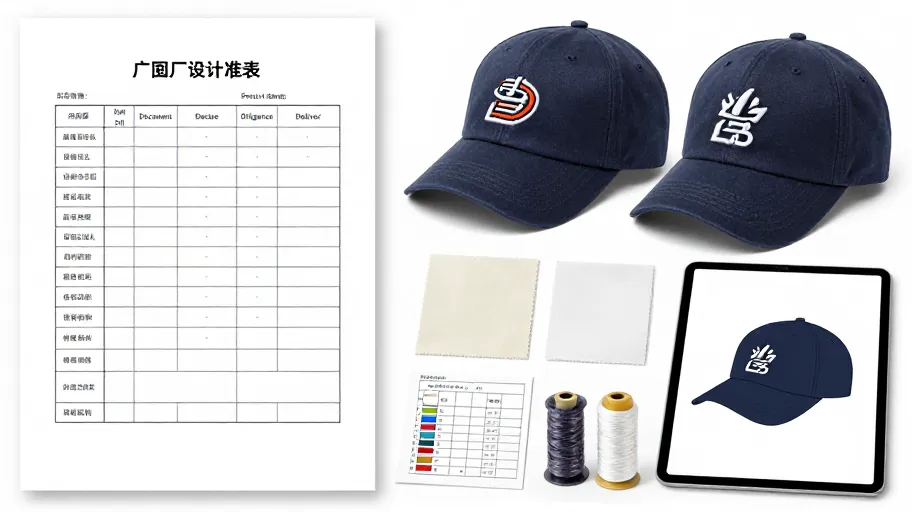
Ordering a custom baseball cap from a manufacturer in China goes smoothly when you treat it as a documented process, not a conversation. This guide walks you through five gates — Define, Document, Decide, Diligence, Deliver — so your brief is complete, your quotes are comparable, and your approval to start production is backed by evidence, not email memory.
Why a written brief changes the outcome
Most sourcing problems trace back to a brief that leaves room for interpretation. When a buyer writes "a quality six-panel cap with embroidery," two factories will respond with two different constructions, two different fabric weights and two different interpretations of what "quality" means. The quotes that come back will not be comparable, and the discrepancy only surfaces after samples arrive — or worse, after production.
A complete brief does three things: it forces you to make decisions you would otherwise defer, it lets every supplier quote against the same specification, and it becomes the reference document you fall back on when a question arises mid-production. Treat the brief as the contract's technical annex, and most downstream disputes become unnecessary.
The 5D Sourcing Framework
Use five gates to move from idea to approved production. You should not pass a gate until the previous one is documented.
| Gate | What it means | Your output | Risk if skipped |
|---|---|---|---|
| Define | Clarify purpose, audience and order context | A one-paragraph project summary | Specs chosen for the wrong use case |
| Document | Write the full technical brief | A written specification sheet | Non-comparable quotes and rework |
| Decide | Compare suppliers on identical terms | A scored, side-by-side comparison | Decisions driven by price alone |
| Diligence | Verify capability and agree terms in writing | Confirmed scope, terms and references | Assumptions that surface at production |
| Deliver | Approve against evidence and control changes | Signed-off sample and change log | Silent substitutions and disputes |
The remainder of this article focuses on the first two gates and the approval discipline of the last.
Gate 1–2: What to define before contacting a manufacturer
Before you send anything, settle the following in writing. You do not need answers to every question — but you should know which items are decided and which are open, and say so explicitly to the supplier.
Project context. What is this cap for — a retail collection, a promotional giveaway, a uniform program, a wholesale line? The intended use shapes decisions on fabric, construction and decoration. A cap that must survive repeated industrial laundering is specified differently from a retail fashion piece.
Style and construction. Decide: structured or unstructured crown; six-panel or five-panel; curved, flat or adjustable-preference brim; closure type (strapback, snapback, fitted, elastic). If you are unsure, send reference images of caps you like and say precisely what you like about each — the brim shape in one photo, the crown height in another.
Materials. State the fabric family you want (for example cotton twill, wool blend, performance fabric) and, if it matters to your market, any fabric composition or certification requirement. Do not assume a supplier's standard offering matches your requirement — ask what they can source and confirm in writing.
Decoration. Specify placement, size on the physical cap, thread colours by reference (Pantone or a physical standard), and technique: 3D or flat embroidery, woven label, print, sublimation, appliqué. Attach artwork in the vector format the supplier requests, and state which elements must match exactly and where the supplier has creative latitude.
Accessories and finishing. Eyelets, button cover, sweatband material, inner tape, labels (main, care, hangtag) and packaging. Each of these is a line item in a quote; leaving them undefined means every supplier fills the gaps differently.
Commercial unknowns to ask about — not assume. MOQ per style and per colour, sample policy including any fees, tooling or digitising charges, production lead time, shipping terms and Incoterms, payment terms, and what happens if a shipment does not match the approved sample. This article does not state any of these terms, because they vary by project and must be confirmed directly with your supplier in the current quotation.
Decision table: settle these before requesting quotes
| Decision | Options to weigh | Why it matters before quoting |
|---|---|---|
| Crown construction | Structured vs. unstructured | Changes panel interfacing, fabric needs and unit cost basis |
| Panel count | Six-panel vs. five-panel | Alters pattern, embroidery placement geometry |
| Closure | Snapback, strapback, fitted, elastic | Different components, sizing logic and MOQ implications |
| Decoration technique | Embroidery, print, woven label, patch | Drives digitising/tooling questions and approval standards |
| Fabric direction | Cotton twill, blend, performance | Affects sourcing, weight, and any composition claims you make downstream |
| Colour control | Pantone reference vs. physical standard | Determines what "match" means at approval |
| Sample pathway | One round vs. staged rounds | Sets your timeline expectations and revision plan |
If any row is still open when you contact a supplier, label it as open in your brief rather than letting the supplier decide silently.
Gate 5: The sample and approval stage
- Is this sample made on the actual production line and process, or is it a hand-made prototype? If it is a prototype, what will differ at production?
- Which exact fabric, thread and component lots will production use — and are they the same ones in this sample?
- Which measurements apply, and what tolerance range do we both accept on each measurement? Get the tolerance written into the spec, not verbal.
- What colour standard governs the crown, brim, decoration and closure — and is the physical standard held by both sides?
- What is the defect classification we agree on: what counts as a critical, major and minor defect for this style?
- What happens if bulk goods deviate from the approved sample — inspection, rework, or rejection terms, as stated in your confirmed agreement?
- Who keeps the sealed reference sample, and how is a duplicate sealed for both sides?
Every answer goes into your approval email. "Approved as shown, with the exceptions listed below" is a strong sentence; "looks good" is not.
Pre-production approval checklist
Copy this into your sourcing file and tick each line before you authorise production:
- Technical spec sheet completed and sent to supplier
- Vector artwork approved and version-dated
- Fabric, thread and components confirmed in writing against the spec
- Pantone or physical colour standards agreed and held by both parties
- Pre-production sample received and inspected against the spec
- All measurement tolerances documented and accepted
- Defect classifications agreed
- MOQ, pricing, payment terms, lead time and shipping terms confirmed in the current quotation
- Labelling, packaging and carton marking specified
- Sealed reference samples held by both sides
- Change-log started: any post-approval change documented and re-confirmed by both parties
If you want a structured starting point instead of building this from scratch, use the brief template below.
[CTA — primary]: 获取项目 Brief — request the project brief template and start your custom baseball cap project with a complete specification.
FAQ
How detailed does my design brief need to be before first contact? Detailed enough that two different suppliers would quote the same product. At minimum: construction, fabric family, decoration with placement and colour reference, closures, labelling and packaging, plus an explicit list of what is still undecided. You can refine with the supplier's input, but let them refine a defined brief, not invent one.
Should I request a sample before committing to production? Most buyers do, but the pathway, fees, timeline and what the sample represents should be confirmed directly with the supplier for your specific project. Ask whether the sample reflects the production process and what, if anything, will differ in bulk. Do not assume any sample policy; get it in the current quotation.
What should I do if the bulk goods don't match the approved sample? This depends on the terms you agreed before production, which is why the approval questions above matter. Confirm in writing, before production starts, how deviations are handled — inspection rights, rework, replacement or rejection — and keep the sealed reference samples on both sides as the arbiter.
How do I compare quotes from different manufacturers fairly? Quote every supplier against the identical written specification, including fabric, decoration, accessories and packaging. Where a supplier proposes an alternative, ask them to quote both versions. Compare on total confirmed scope — not unit price alone — and score against your Decision gate criteria.
Can I change the design after approving the sample? You can, but every change after approval carries cost and schedule consequences that must be confirmed with the supplier, and the change should be documented in a change log with a re-confirmed spec version. Silent changes are how small deviations become disputes.
[CTA — primary]: 获取项目 Brief — get the structured brief template and send your first enquiry with a complete, comparable specification.
[CTA — low-friction checklist]: Before you contact any supplier, save the pre-production approval checklist above into your sourcing file — it costs nothing and protects every order.
#cap manufacturers china, #headwear manufacturers china, #cap factory








