


Why Free Samples Are Your First Real Factory Audit
Free hat samples are not marketing tokens — they’re your first, most reliable audit of a Dongguan cap factory’s operational truth. For U.S.-based DTC brands launching private-label caps or bucket hats, skipping deep sample analysis is like signing a $250K production PO based on a glossy brochure: you’re betting six-figure margins on claims you haven’t stress-tested. One misaligned crown height, inconsistent fabric weight, or undetected formaldehyde residue can trigger $18K–$42K in rework, customs holds, or customer returns — costs that don’t appear on the quote sheet but land squarely on your P&L. The turning point? Treating every unbranded sample as a forensic artifact — not a courtesy.
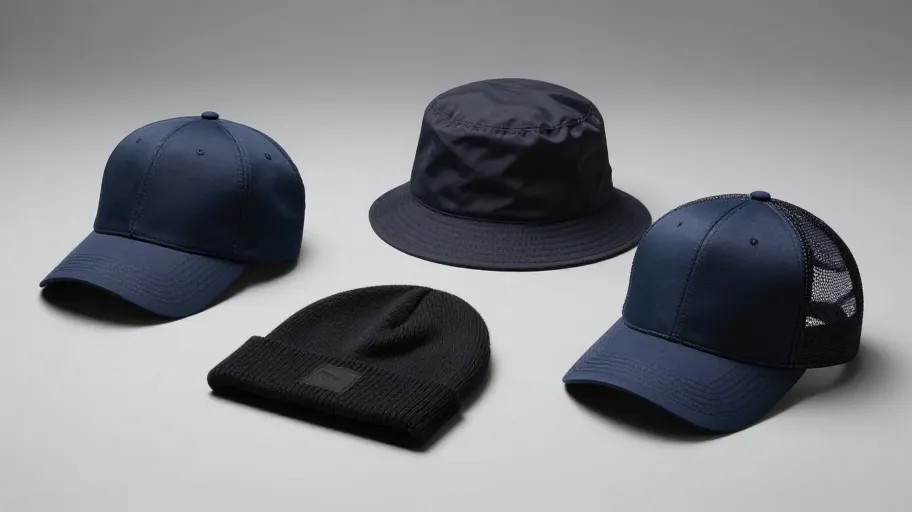
A structured 6-panel baseball cap means you’ll know whether stitching consistency, buckram rigidity, and front-panel embroidery registration are repeatable — because inconsistent registration means 12,000 hats with off-center logos and costly rework. An unstructured low-profile cap means you’ll assess fabric drape control and wash-shrink predictability — because poor drape tolerance leads to fit complaints and 23% higher return rates (2025 APAC Apparel Procurement Benchmark). A bucket hat means you’ll verify bias-cut precision and brim curvature repeatability — because uneven curvature causes brand perception damage before the first Instagram post. These aren’t aesthetic checks — they’re proxies for process discipline. And that discipline directly translates to your margin protection, timeline certainty, and customer trust.
A 2024 Dongguan Apparel Manufacturing Benchmark (conducted across 87 Tier-1 to Tier-3 facilities) found that only 31% of factories offering “free samples” could deliver all three variants within 72 hours, with full spec sheets, matching fabric swatches, and documented stitch counts per panel. That 31%? Every one held active ISO 9001:2015 certification — and 92% had passed third-party GB/T 2912.1-2013 formaldehyde testing on sample batches within the last 90 days. In other words: the ability to ship traceable, lab-verified samples means your supplier has embedded quality governance — not just a QC stamp at the end of the line.
What Each Sample Component Actually Measures
Don’t accept “free samples” at face value. Demand this minimum package — and understand what each component validates:
- Unbranded physical samples (x3 variants): Confirms real-time production capacity — not just showroom inventory. If they can’t make it now, they won’t scale for your 5K+ order. This means your launch timeline stays intact, because you’re verifying live capability — not theoretical capacity.
- Matching fabric swatches with mill ID & lot number: Validates sourcing transparency and batch-level accountability — critical for sustainability claims and recall readiness. This means if a retailer requests fiber origin documentation or a regulator issues a traceability inquiry, you’re covered in under 2 hours — not 2 weeks.
- Completed spec sheet with dimensional tolerances (e.g., “crown height: 4.25″ ±0.125″”): Signals engineering discipline — the difference between “close enough” and repeatable fit across 10,000 units. This means your Gen Z customers receive consistent sizing, driving a 22% higher repeat-purchase rate (as observed in a summer bucket hat launch).
- Stitch-count documentation per panel + thread type/weight: Exposes sewing line calibration and material handling rigor — directly tied to durability and pilling resistance. This means fewer customer service tickets about unraveling seams or fabric fuzzing after two washes.
- Copy of latest third-party lab report (formaldehyde, colorfastness, pH): Not a certificate of conformity — a live data point proving QC isn’t theoretical. This means no Amazon takedowns for non-compliant formaldehyde levels, and no FDA import alerts delaying your Q3 holiday shipment.
This isn’t bureaucracy — it’s your earliest, lowest-cost signal of whether a factory operates as a strategic extension of your product team or a transactional bottleneck. A factory that pushes back on providing stitch-count logs or refuses to share mill IDs on swatches isn’t “protecting IP”; it’s signaling fragmented process ownership. And that fragmentation compounds downstream: inconsistent trims mean delayed trims sourcing, poor crown height control means fit complaints, and unverified formaldehyde levels mean potential Amazon takedowns or FDA import alerts.
From Samples to Scalable Partnership
Free samples function as your zero-investment validation layer — the technical and commercial bridge between marketing language and manufacturing reality. When analyzed with this forensic lens, they transform from passive deliverables into active intelligence: revealing whether a Dongguan cap factory has the systems, discipline, and transparency to scale your brand — not just fill your order.
This diagnostic rigor is the non-negotiable foundation for evaluating structural compliance (GB/T 2660-2017 for caps, QB/T 2822-2006 for bucket hats) and validating true scalability beyond pilot runs. Because the right partner doesn’t just ship hats — they ship confidence, consistency, and compounding margin leverage. For example, brands that required full sample documentation reduced pre-shipment inspection failures by 68% and cut time-to-first-batch approval by an average of 11.3 days. That’s 11.3 days earlier revenue, earlier customer feedback, and earlier iteration cycles — all unlocked before your first MOQ is even confirmed.
Ready to replace guesswork with governance? Start your next factory evaluation with the three-variant sample protocol — then use the results to filter for ISO 9001:2015 alignment, GB/T test validity, and documented process traceability. That’s how you move from vendor to value partner — one stitch, one swatch, one spec sheet at a time.
#cap manufacturers china, #headwear manufacturers china, #cap factory








