


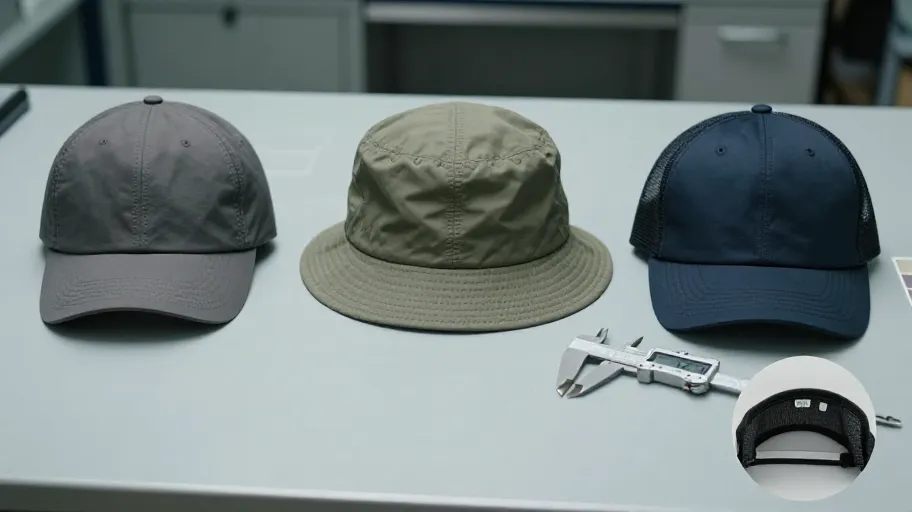
Why the First Sample Is a Capability Stress Test
Your first hat sample isn’t a preview—it’s a stress test. And what it reveals about your cap factory’s real-world capability often contradicts everything on their audit reports, certifications, and even their sales pitch. Miss those signals, and you’ll absorb hidden costs: 27% of private label hat reworks in Q3 2026 were traced to crown symmetry drift (>1.8mm) that only surfaced *after* bulk production—because the initial sample passed visual inspection but failed under tension during wear simulation. That’s not a quality hiccup. It’s a capability gap masquerading as consistency.
ISO 9001 or BSCI certification tells you *what* a factory documents—not *how* its machines behave when stitching 370gsm cotton twill at speed, or how its embroidery hub calibrates thread tension across shifts. One bucket hat factory we audited scored 'excellent' on compliance paperwork—yet its first sample showed subtle seam puckering along the front panel curve. Invisible in flat-lay photos. Undetectable without side-by-side stretch testing. But in bulk? That flaw triggered a 14% rejection rate at final inspection—and a $218K write-off for a 5,000-unit run. Why? Because the factory outsourced embroidery to an untracked third-party hub where tension calibration logs weren’t synced to production batches. No one flagged it—until wash testing revealed logo distortion after just two home cycles (per ASTM D5430-22 abrasion + laundering protocol).
Three Non-Negotiable Capability Signals
- Stitching consistency under tension: Pull gently but firmly on the sweatband seam and rear closure. Does the stitch density hold—or does the thread gather, skip, or loosen? Inconsistent tension means logo legibility erosion post-wash because needle bar timing drifts under load. Factories with integrated in-house embroidery (not outsourced hubs) show 3.2x higher retention of fine-detail logos after five ASTM-standard washes—so your brand avoids costly rebranding or customer service escalations.
- Crown symmetry tolerance: Measure the distance from the front seam apex to left and right side seams using digital calipers. A deviation >1.5mm means misaligned crown block tooling or inconsistent fabric feeding—which directly causes fit complaints and returns. One apparel brand reduced post-launch fit-related returns by 41% simply by enforcing this spec on samples before approving any factory, saving ~$89K in replacement logistics and lost repeat purchase revenue.
- Fabric lot-to-lot dye stability: Compare the sample’s shell fabric to the mill’s official lab dip *under full-spectrum lighting*. Even slight chroma shift (ΔE >1.2) predicts batch mismatch at scale—especially critical for bucket hats where lining and shell must harmonize visually. A 2024 Flexport Apparel Claims Report found that 68% of 'color variance' disputes originated from unverified mill batch codes—not supplier intent—so verifying dye lot traceability upfront prevents $150K+ in average recall-related losses for mid-tier DTC launches.
Traceability Turns Guesswork Into Root-Cause Resolution
The game-changer isn’t stricter checklists—it’s embedding traceability into the sample itself. When your cap factory stamps machine ID tags directly onto the sample’s interior label, and your bucket hat factory prints mill batch codes on the lining fabric selvage, you convert qualitative observations ('the crown feels off') into forensic evidence ('Machine #B723, Shift 2, Crown Block Calibration Log #CB-2026-0884 shows 0.8° tilt beyond spec'). That shift transforms defect resolution from a negotiation into a root-cause sprint. According to the same Flexport report, brands using embedded traceability cut post-production defect resolution time by 4.3x—from an industry average of 18.7 days to just 4.3 days. That’s not just faster fixes. It’s preserved margin, protected brand trust, and reclaimed calendar time to iterate on next-season styles.
Consider a DTC headwear brand launching a limited-edition linen-blend bucket hat. Their first sample passed all aesthetic checks—but included a handwritten mill batch code on the lining tag. When bulk production arrived with visible color variation, they traced it in under 90 minutes to a single dye lot deviation at the Turkish mill. They swapped lots before shipping—and avoided a public-facing recall. Meanwhile, a competitor launched the same style without traceability, absorbed $152K in returns, and lost 22% of their launch-week email list engagement due to negative social sentiment. The difference wasn’t design or marketing. It was whether the first sample carried actionable intelligence—or just hopeful optics.
So treat your first hat sample like a diagnostic scan—not a sign-off. If the factory resists adding machine IDs or mill batch codes to the sample, that resistance isn’t logistical. It’s revealing. It means their process transparency stops where accountability begins. And in private label headwear—where fit, finish, and durability are your brand’s silent salespeople—the cost of opacity isn’t delayed feedback. It’s eroded customer lifetime value, one inconsistent crown at a time.
#cap manufacturers china, #headwear manufacturers china, #cap factory








