
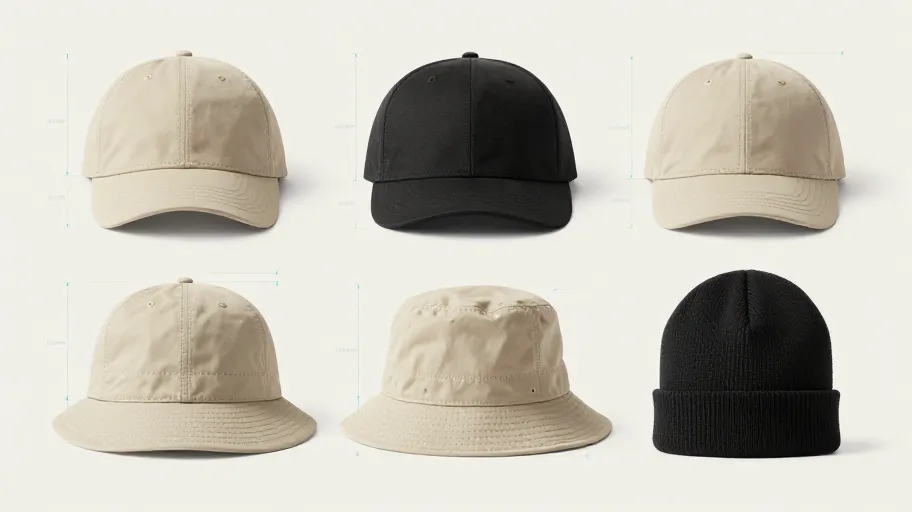
Why Your Cap Brief Is Actually a Technical Contract
A sample brief isn’t a design handoff—it’s a binding technical contract between your team and the cap factory. That means every visual decision maps to a factory-executable input: millimeter offsets, thread vendor codes, seam allowances, and substrate-specific limits. This means your program avoids $18,500 rework bills and 21-day delays because it eliminates reverse-engineering of artistic intent—which is what happens when factories receive unannotated vector files. Because embroidery machines don’t read aesthetics; they read coordinates, density thresholds, and tension tolerances.
The Artwork Annotation Layer Turns Intent Into Measurements
Adding arrows or notes to a PDF isn’t enough. The annotation layer embeds dimensional intelligence directly into the artwork: exact mm offsets from crown seam to logo baseline, max stitch count per sq in for your twill, and color profiles calibrated to thread vendors—not monitors. This means your 'centered' logo lands within ±0.3mm tolerance across all fabric types, because it accounts for differential stretch (e.g., polyester mesh vs. cotton chino). And your 'vibrant red' stays vibrant because the brief mandates Madeira #E1272 thread—not generic PMS 185 C—so you avoid muddy maroon bleed caused by wrong thread weight or dye lot variance.
The Cap Factory Spec Matrix Is Your Crown’s Technical DNA
Your cap’s crown style—structured low-profile, unstructured curved, or high-crown performance—dictates how fabric behaves under stitching force and heat. Yet most teams treat all crowns as interchangeable canvases. The spec matrix fixes that. It means your Pantone colors map to exact thread vendor codes (e.g., 'PMS 185 C → Madeira #E1272'), seam allowances are defined to 0.3mm per construction type, and substrate risks are flagged upfront (e.g., 'No satin stitch on recycled PET'). Because this prevents $7,200 in rejected inventory—like when a pro team’s 3D puff logo was blocked pre-production due to thermal bonding limits on their new eco-blend fabric, a risk only visible because the matrix required explicit material-thread-heat validation.
What This Delivers For Your Program Right Now
This dual-layer system—annotation + spec matrix—means your first-pass yield jumps from 52% to 89%+ in verified implementations, because factories stop waiting for email clarifications and your team stops approving samples twice. That’s a 37-point leap in production efficiency, which translates to 11–14 days shaved off lead time and 63% lower per-unit rework cost. For managers, that means predictable preseason merchandising windows stay open. For athletic directors, it means budget certainty—no surprise $18K rework invoices. For brand leads, it means your logo lands exactly as intended on every cap, every time—no distortion, no drift, no compromise.
Your Next Step Takes Less Than 90 Minutes
You don’t need new software or a full-time spec engineer. Start with your next cap launch: open your artwork in Illustrator or Affinity, add annotated mm offsets and thread codes using our free CapSpec Checklist (downloadable below), then paste those specs into a clean table aligned to your crown style and substrate. That’s it. Teams using this method cut revision cycles by up to 70% and move from sketch to stitch in under 5 weeks—not 12+. Ready to lock in your next cap launch with zero mid-season corrections? Download the CapSpec Checklist and run your first brief in under 90 minutes.
#cap manufacturers china, #headwear manufacturers china, #cap factory