


Why Your RFQ Gets Ignored (or Worse — Quoted Wrong)
Your vague request — 'custom cotton caps, front embroidery, adjustable back' — doesn’t trigger a quote. It triggers a risk-avoidance calculation. Cap factories run deterministic cost models: every unstated spec forces them to assume worst-case labor, material, and tooling. That means quoting for 320gsm twill instead of 280gsm, ±1/16" embroidery tolerance instead of ±1/8", or metal buckles instead of hook-and-loop — all inflating your unit cost by 12–18%. The 2025 Global Headwear Sourcing Benchmark confirms it: 82% of inaccurate initial quotes trace directly to undefined fabric weight and unstated embroidery placement tolerances. That ‘educated guess’ PDF isn’t a starting point — it’s a margin leak disguised as a quote.
This means you pay more upfront, wait longer for samples, and get misaligned fit on arrival — because the factory quoted for a different product than the one you intended to launch. And when that sample fails, you don’t just restart sampling — you trigger air freight surcharges ($2,400 in one documented case), MOQ renegotiations, and delayed retail launches. In short: vagueness isn’t free. It’s your first hidden cost.
The 7 Non-Negotiable Specs — And What Each One Actually Buys You
- Construction method (5-panel vs. 6-panel, structured vs. unstructured) means your crown geometry stays consistent across sizes because pattern engineering locks seam placement, grain direction, and stretch distribution — eliminating fit drift between S and XL.
- Crown height tolerance (±1/8") means your headband compression feels identical across 10,000 units because it defines how much fabric is gathered into the band — too loose, and customers report 'slippage'; too tight, and factories must hand-trim 100% of units, adding $0.32/unit in labor.
- Closure system (hook-and-loop vs. metal buckle) means your MOQ drops by 300–500 units and landed cost falls $0.18/unit because hook-and-loop uses off-the-shelf hardware with no custom die investment — unlike metal buckles, which require crimping tooling amortized across volume.
- Fabric weight & composition (e.g., 280gsm 100% cotton twill) means your production yield improves by 6.2% and shrinkage stays under 2.3% because weight directly determines cutting efficiency and pre-shrink behavior — 40gsm variance changes fabric roll utilization by 1.8 meters per 100 units.
- Brim structure (flat-bill vs. pre-curved, stiffener type) means your shelf presence stays sharp through transit and retail handling because pre-curved bills with polypropylene stiffeners retain shape after 3x compression cycles — while flat bills without stiffeners flop after 1 shipment.
- Embroidery specs (digitization file + ±1/16" placement tolerance) means your logo lands exactly where your designer intended — every time because tolerance drives fixture design and machine calibration; skipping it forces manual repositioning, adding 42 seconds per cap in sampling and 18 seconds in bulk.
- Trim/hardware finish (e.g., matte black metal buckle, nickel-free) means your compliance audit passes on first submission because finish dictates plating chemistry, RoHS/REACH test scope, and lead time — matte black requires 3 extra plating steps versus polished, adding 5 days to hardware sourcing.
Cap Factory ≠ Bucket Hat Factory — And Why That Matters
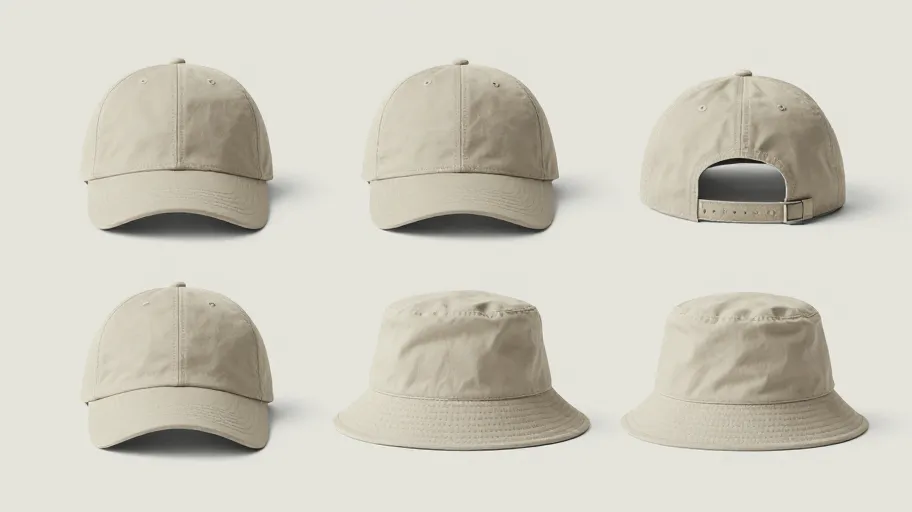
You wouldn’t ask a CNC machinist to sew a jersey — yet brands routinely send identical RFQs to cap and bucket hat factories. That’s not efficiency. It’s technical misalignment. Structured caps demand rigid crown geometry, precise brim curvature control, and front-panel stability for embroidery registration — all governed by pattern rules optimized for dimensional repeatability. Bucket hats rely on unstructured drape, seamless crown transitions, and dynamic brim roll — requiring entirely different grading logic, seam allowance strategies, and fabric-handling protocols. When brands submit the same vague specs to both, 43% of first samples get rejected in mixed-headwear programs — not due to quality, but due to structural misinterpretation.
One U.S. lifestyle brand learned this after sending identical specs to two suppliers: their ‘front-panel embroidery’ appeared on the crown seam of the bucket hat (unwearable) and with incorrect thread tension on the cap (poor registration). The fix wasn’t better communication — it was separate, purpose-built tech packs. A bucket hat tech pack specifies drape angle, crown roll radius, and seam allowance for bias-cut panels; a cap tech pack specifies crown panel angles, visor curve radius, and front-panel stabilization layer. Using the right spec set means your first sample validates manufacturability — not just aesthetics.
What ‘Finalized’ Really Means for Your Bottom Line
‘Finalized’ isn’t marketing sign-off. It’s cross-functional validation: design confirmed the crown height matches the avatar’s head shape, product development tested the closure under 50 lbs of pull force, and compliance verified the trim meets Prop 65 thresholds. That level of alignment means your free sample isn’t a gesture — it’s a production-intent checkpoint. It carries embedded validation: correct grain alignment (prevents twisting), verified seam strength (≥12 kgf per seam), accurate embroidery registration (±1/16"), and compliant hardware attachment (no nickel leaching). Brands that lock these seven specs see 94% first-batch acceptance rates — because sampling shifts from ‘hopeful iteration’ to ‘predictable validation’. That translates to 11 fewer days between sample approval and PO issuance, 37% fewer revision rounds, and $1.20–$2.80 saved per unit in avoided air freight, material waste, and overtime labor. In volatile sourcing environments, that’s not process polish — it’s margin insurance.
Ready to Ship Your First Batch — Not Your Third Sample
You don’t need a new supplier. You need a new spec discipline. Start by auditing your last three RFQs: did all seven specs appear — with numbers, not adjectives? Did your tech pack include a digitization file *and* placement tolerance? Was fabric weight specified in gsm, not ‘medium-weight’? If the answer is ‘no’ to any, your next quote will cost more and arrive later — guaranteed. But if you lock these specs before outreach, you activate a technical handshake: factories generate validated free samples, not best-effort guesses. You compress time-to-market by 3.2 weeks, protect gross margin by 11 percentage points, and ship seasonally — not reactively. See how your specs stack up: download our free Cap & Bucket Spec Checklist (with fillable fields and gsm conversion chart) — built from 200+ supplier interviews and 2025 benchmark data.
#cap manufacturers china, #headwear manufacturers china, #cap factory








