Shortlisting baseball cap manufacturers for a private-label project comes down to verifying eight things in order: proven manufacturing evidence, an auditable identity, genuine product engineering competence, physical samples you approve, engineering-level communication, clear accountability, complete documentation, and written commercial terms. Use a structured framework, score every candidate identically, and confirm each commercial term in writing before any deposit.
Why comparison frameworks beat gut feel
When overseas buyers evaluate factories from a distance, the biggest risk is not that a supplier lies. It is that every conversation drifts to a different set of questions, so three candidates end up impossible to compare. A written framework forces the same evidence from everyone, exposes vague answers, and creates a record you can return to when something goes wrong mid-project.
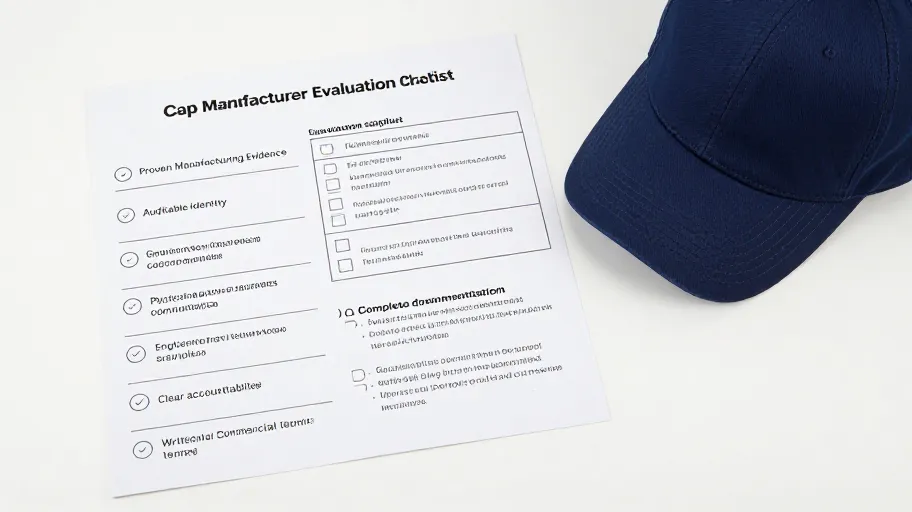
Below is the CAP-READY framework — eight evaluation dimensions designed for private-label headwear projects.
The CAP-READY framework
- C — Capacity evidence. Ask for verifiable output information: which production lines run headwear, what the current booking situation is, and how your volumes fit their schedule. Confirm current capacity for your order size directly; do not accept a brochure number as fact.
- A — Audit trail. Verify the legal entity behind the trading conversation. Ask for a business licence, factory address you can map or audit, and — if relevant to your market — which certifications they currently hold with evidence. If a document cannot be shown, treat the claim as unverified.
- P — Product engineering. A capable manufacturer can discuss construction choices: panel counts, closure types, sweatband materials, brim structure, embroidery versus woven patch versus silicone label, and how each affects the finished cap. A supplier who only forwards catalogue photos is a trading risk.
- E — Engineering communication. Test how the team responds to a technical drawing or a spec change request. Speed matters less than precision: do they ask clarifying questions, or guess? Guessing during quoting becomes rework during production.
- A — Accountability. Establish, in writing, who owns defects, delays and spec deviations, and what the correction process is. A supplier who resists documenting responsibility before the order is telling you how disputes will be handled after it.
- D — Documentation. Insist on a written spec sheet covering materials, colours (with reference standards), logo placement, sizing, packaging and labelling. This document is your reference for inspection.
- Y — Yield terms. MOQ, per-colour or per-size minimums, tooling or setup charges, payment structure, lead time and rework terms are all project-specific. Ask each manufacturer to quote them explicitly; compare the written answers, not verbal assurances.
Decision table: scoring candidate manufacturers
Score each criterion 0–2, then total. Use this table for every candidate so comparisons stay honest.
| CAP-READY criterion | Green (2 points) | Amber (1 point) | Red (0 points) |
|---|---|---|---|
| Capacity evidence | Provides verifiable, current production information for your volume | Gives ranges without sources | Vague or evasive |
| Audit trail | Licence, address and certifications evidenced on request | Partial documents, slow to produce | Refuses or delays verification |
| Product engineering | Discusses construction trade-offs unprompted | Answers only what you ask | Redirects to catalogue images |
| Real samples | Produces construction-matched samples with a written approval step | Samples differ from spec without explanation | Resists sampling before deposit |
| Engineering communication | Precise, clarifying responses | Mixed precision | Guesses or ignores spec details |
| Accountability | Accepts written defect and delay responsibility terms | Negotiates vaguely | Refuses written terms |
| Documentation | Issues a full spec sheet for sign-off | Partial spec sheet | Relies on chat history |
| Yield terms | All commercial terms quoted in writing | Some terms verbal | Terms appear only after deposit |
Interpretation is yours to define, but a practical rule: any zero in Audit trail, Real samples or Accountability disqualifies a candidate regardless of total score, because those three are hardest to fix after production starts.
Commercial terms to confirm in writing
Because no sample, cost, shipping or production policy was supplied for this article, treat every commercial term below as an open question for the supplier — never assume a figure or a norm:
- MOQ per style, per colour and per size run
- Tooling or setup charges for embroidery, patches or custom trims, and who owns the tooling afterwards
- Payment schedule and what each milestone unlocks
- Production lead time from deposit to ex-factory, and what happens if it slips
- Rework, replacement and dispute resolution terms for defects
- Inspection rights: whether you or a third party can inspect before shipment, and at what stage
- IP protection for your designs and logos, in writing
Approval questions to send your shortlist
Copy these into your first substantive email. The quality of the answers is itself an evaluation signal.
- "Can you describe the construction you'd recommend for our cap style — panels, closure, brim — and why?"
- "What current capacity can you confirm for our projected volumes, and when is your next available production slot?"
- "Which certifications do you currently hold, and can you share evidence?"
- "What is your process from approved sample to bulk production, and where are the written sign-off points?"
- "How do you document and correct deviations from the approved spec?"
- "Who is the named contact accountable if a shipment misses the approved spec?"
Sample-to-bulk control checklist
- Physical sample approved in writing with annotated photos
- Spec sheet signed by both parties, covering materials, colour references and logo placement
- Tolerance expectations for sizing and logo alignment documented by the supplier
- Pre-shipment inspection rights confirmed in the order terms
- Defect responsibility and correction process written into the order
- Commercial terms (MOQ, payment schedule, lead time) recorded in a quotation, not chat
- Escalation contact named before production begins
If a candidate clears the checklist and the decision table, you have a defensible basis for a private-label commitment — not just a good first impression.
FAQ
Should I work with a factory or a trading company for private-label caps? Both can succeed; the difference is accountability distance. If you work with a trading company, ask whether the underlying factory will be disclosed, whether audits are permitted, and who holds responsibility for spec compliance. Document the answers either way.
How many baseball cap manufacturers should I compare? Three to five scored candidates gives a meaningful spread without slowing your timeline. Score every candidate with the same framework so the comparison holds up internally.
What evidence should I request before paying a deposit? Approved physical sample, signed spec sheet, written quotation with all commercial terms, verifiable business identity, and documented accountability terms for defects and delays. If any of these are missing, ask why before proceeding.
How do I check a manufacturer's quality claims? Convert claims into evidence: request samples matched to your construction, ask for inspection rights before shipment, and define what a defect means in the order terms. Claims you cannot test are marketing; claims you can test are specifications.
Do I need an on-site audit? For larger or long-term programs, an audit — yours or a third party's — adds verification depth. For smaller first orders, documented sample approval, spec sheets and inspection rights provide a practical baseline. Decide based on your exposure, not the supplier's preference.
Compare every candidate on the same page
下载 Supplier Scorecard — a ready-to-use scoring sheet built around the CAP-READY framework, with columns for written terms, evidence received and approval gates, so your shortlist becomes a decision rather than a pile of chat histories.
Prefer to start smaller? Use the sample-to-bulk checklist above in your next supplier email — it costs nothing and immediately shows you which manufacturers welcome documentation and which resist it.
#cap manufacturers china, #headwear manufacturers china, #cap factory