


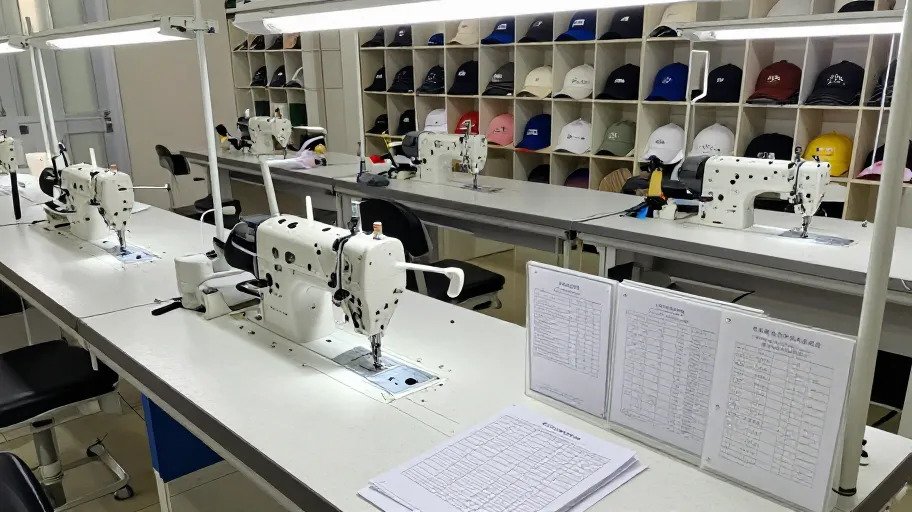
Evaluating a cap manufacturer in China comes down to three verifiable things: real manufacturing capability, accountability for your designs and compliance files, and documented process control from sample to bulk. Compare candidates on evidence you can request and inspect — not on claims. The framework below shows you what to ask for.
The CAP-Verify Framework
C — Capability. Confirm the supplier can physically make your product. A manufacturer should be able to explain, in specific terms, how it produces the constructions you need — six-panel structured caps, unstructured dad caps, five-panels, snapbacks, bucket hats, knit beanies — and what finishing methods it runs in-house versus subcontracting. Ask which steps (cutting, embroidery, printing, washing, packing) happen under its own roof and which do not. A supplier that cannot describe its own production flow clearly is a signal to slow down.
A — Accountability. For private-label work, your trademarks, artwork files and tech packs are core assets. Ask how design files are stored, who can access them, whether they will sign an NDA under your chosen jurisdiction, and what happens to files after production. Also request clarity on who is the legal exporting entity, who issues your commercial invoice, and who holds the certificates you may need for your destination market. Confirm every point in writing before approving any order.
P — Process control. Quality consistency is a process outcome. Ask how the supplier handles pre-production samples, inline inspection during production, and final random inspection. Request that your contract specify: approved sample as the binding reference, inspection stages, how discrepancies are documented, and what the correction route is when a check fails. Any of these figures — sample terms, timelines, defect thresholds — must be confirmed directly with the supplier; do not rely on assumptions from other buyers' experiences.
Decision table: comparing candidate cap manufacturers
| Evaluation dimension | What to request | What a strong answer looks like | Weight |
|---|---|---|---|
| Manufacturing status | Business licence, factory address, video or in-person walkthrough | Supplier identifies itself as manufacturer (or as a trading company — which can be acceptable if disclosed) and shows production space matching your product type | High |
| Product fit | Tech-pack review meeting; sample of your actual design | Supplier asks detailed questions about your spec before quoting | High |
| In-house vs subcontracted steps | Written list of in-house processes | Clear, honest breakdown; no vague "we handle everything" | High |
| IP and file control | NDA willingness, file-handling procedure | Written procedure; NDA accepted and returned signed | High |
| Quality process | Sample-approval and inspection workflow | Named stages, binding approved sample, documented inspection points | High |
| Export and compliance | Who exports, which documents and certificates they can provide | Direct, current answers — confirm each document for your market | Medium |
| Communication | Response quality during enquiry stage | Precise answers, willingness to say "we need to confirm" | Medium |
| References | Contactable buyers in your category (if the supplier can share them) | Verifiable, with the buyer's permission | Medium |
Use the table as a scorecard: score each dimension, then compare totals across candidates. Numbers force discipline; impressions do not.
Approval questions to send before you commit
Send these in writing and keep the replies attached to your project file:
- Are you a factory, a trading company, or both? Which production steps for caps are done in-house?
- What is your current minimum order quantity for this construction, and can you break it down by colour or size?
- What are your current sample terms — cost, timing, and whether any charge is credited against an order? (Confirm the current policy in writing; do not assume.)
- What is your current production lead time from approved sample, and what factors could change it?
- Which quality checks happen during production, and can my appointed third-party inspector visit?
- Will you sign our NDA, and how are artwork and tech-pack files stored and deleted?
- Which certificates or test reports can you provide for my destination market, and are they current?
- Who is the exporter of record, and what documentation do you provide with each shipment?
- How do you document and correct a failed inspection or a discrepancy against the approved sample?
- Can you provide two references from buyers in my product category, with their consent?
A supplier's willingness to answer question 10 — and the quality of questions 5 and 9 — tells you more about long-term reliability than any brochure.
Red flags that warrant a pause
- Refusing to identify in-house versus subcontracted processes
- Quoting before reading your tech pack
- Declining an NDA for private-label artwork
- Answers about compliance documents that shift between enquiries
- No named inspection stages, or resistance to third-party inspection
- Pressure to skip the pre-production sample approval
None of these alone ends a conversation, but each one deserves a written explanation before you approve anything.
Frequently asked questions
How do I verify a cap manufacturer in China is a real factory? Request the business licence, confirm the registered address matches the production address, and arrange a live video walkthrough or a third-party audit. Ask which processes run in-house and cross-check against what you see.
Should I work with a factory or a trading company for private-label caps? Both can work; the difference is accountability. A factory gives you direct process control; a trading company may offer broader product range and communication support. Whichever you choose, get the manufacturing status, export entity and quality process documented in your contract.
What documents should I collect before approving a supplier? Business licence, NDA, signed sample approval, the inspection workflow, agreed specification in the purchase contract, and any compliance documents relevant to your destination market. Confirm each is current before shipping.
How do I protect my brand designs when sourcing from China? Use an NDA signed before sharing artwork, limit file access to named contacts, watermark preliminary designs, and agree in writing on file storage and disposal after production. Legal enforceability depends on your jurisdiction — consult your own counsel.
Do I need to inspect the first production run? Documented inspection stages protect both sides. At minimum, approve a pre-production sample as the binding reference and define what happens if bulk goods diverge from it. Whether you attend in person or appoint a third-party inspector is your call — the key is that the check is contracted, not implied.
Evaluate candidates with structure, not impressions
Comparing cap manufacturers in China is a documentation exercise. The buyers who succeed are the ones who score candidates on the same dimensions, demand written answers, and approve against an approved sample — not against a promise.
[下载 Supplier Scorecard] — get the editable scoring template used in the decision table above and run your shortlist through it today.
Not ready to compare suppliers yet? Start smaller: copy the ten approval questions above into your own pre-approval checklist and send them to your current candidates. That single step will surface most of what you need to know.
#cap manufacturers china, #headwear manufacturers china, #cap factory








