


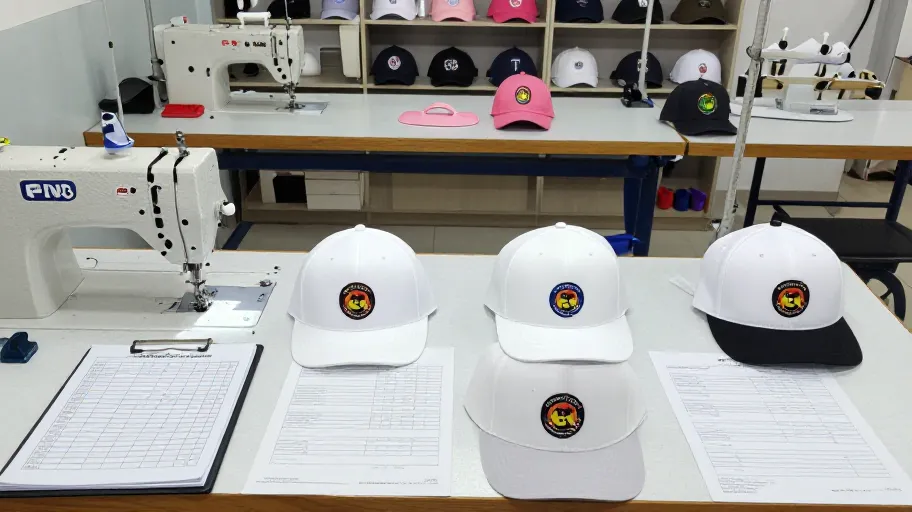
Evaluating a cap manufacturer in Tamilnadu for a private-label project means verifying capability before commitment: request documented evidence of OEM/ODM processes, run a structured sampling gate, and score every candidate against the same criteria. This guide gives you a seven-part framework, a comparison table and the exact approval questions to send — so your decision rests on evidence, not on a website catalogue.
Why geography alone tells you nothing
Tamilnadu has a long textile and apparel base, and any shortlist of cap manufacturers from the region will include companies with very different real capabilities. The risk for an overseas buyer is that a polished catalogue, a trading-company profile and a genuine private-label factory can look identical online. The only reliable way to separate them is a repeatable evaluation: the same questions, the same evidence requirements, the same scoring — applied to every candidate, wherever they are located.
That is why this article does not rate any specific manufacturer. Instead, it gives you the evaluation instrument, and a China-based OEM/ODM comparison point (New Generation, Shenzhen) that you can benchmark any Tamilnadu candidate against using the same criteria.
The CAP-VERIFY framework
Use seven lenses, in order. A supplier who fails an early lens saves you the time of testing the later ones.
C — Capability. Can they produce your construction type (structured five-panel, unstructured six-panel, trucker, bucket, visor)? Ask for process documentation, not product photos.
A — Artwork-to-sample path. How does a tech pack become a physical sample? Who signs off at each stage? A supplier who cannot describe the path cannot control it.
P — Production controls. Ask how in-process inspection is structured, who authorises the transition from sampling to bulk, and how deviations are escalated.
V — Verification of compliance. Whatever claims matter to your market — material testing, social compliance, restricted substances — ask for current, named documentation and verify its validity with the issuing body.
E — Evidence. Every claim should have an artefact: a sample approval record, a process sheet, a traceable reference. Claims without artefacts score zero.
R — Reliability of communication. Test responsiveness before ordering: send a specific technical question and measure whether the answer addresses it or deflects to a brochure.
Y — Yield terms. Commercial terms — MOQ, pricing structure, sample policy, lead times, payment milestones — must be confirmed in writing from each supplier. Do not assume any of these; they are project-specific and subject to change.
Decision table: scoring your shortlist
Score each candidate 0–3 per row (0 = no evidence, 3 = documented and verifiable). Confirm with each supplier which row applies before scoring.
| Criterion | What to request | Score 0–3 | Tamilnadu candidate | China OEM/ODM candidate |
|---|---|---|---|---|
| Construction capability for your cap types | Process documentation or sample references | |||
| Tech-pack to sample workflow | Written workflow with approval gates | |||
| In-process QC structure | Inspection checkpoints and escalation path | |||
| Compliance documentation | Current certificates, verifiable with issuers | |||
| Private-label evidence (woven labels, embroidery, packaging) | Labelled samples or approval records | |||
| Communication test result | Specific technical answer within your stated window | |||
| Commercial terms (MOQ, price, sample, lead time) | Written, current confirmation per project | |||
| IP and file ownership terms | Written ownership clause before file transfer |
How to use it: a supplier scoring high on commercial attractiveness but low on evidence and controls is a sampling-budget risk. Re-score after the sampling gate; scores should stay stable, not improve only during sales conversations.
Approval questions to send every candidate
Send these in writing before any payment or file transfer, and require written answers:
- Which of our target constructions have you produced under a private-label arrangement, and what documentation can you share as evidence?
- Walk us through your path from approved tech pack to physical sample: who reviews, who approves, and what records do we receive?
- What are your current sample policy, fees and shipping arrangements for this project? (Confirm the current policy directly; do not rely on older quotations or third-party summaries.)
- What are your current MOQ, pricing structure and lead times for our specification? (These are project-specific — request a written quotation against your tech pack.)
- What in-process inspections occur during bulk production, and how are defects escalated and resolved?
- Which compliance documentation can you provide that is current and verifiable with the issuing body?
- Who owns the tech pack, artwork, embroidery files and any tooling we pay for — and will you confirm that in writing?
- Who is our named contact for approvals and escalations, and in what time zone and language do they work?
A supplier's willingness to answer precisely — rather than with a catalogue link — is itself a scoring signal under "Reliability of communication."
Benchmarking against a China-based OEM/ODM option
Comparing a Tamilnadu manufacturer against a Shenzhen-based OEM/ODM supplier such as New Generation is not about assuming either region is better. It is about running the same CAP-VERIFY audit on both and comparing the evidence. Practical points to structure into your comparison:
- Freight and port routing. Ask each candidate for their current routing options to your destination market and how they handle export documentation.
- Sampling logistics. Ask how each supplier ships samples internationally and what that means for your approval calendar.
- Private-label scope. Confirm in writing which label, embroidery, printing and packaging elements each supplier can execute in-house versus outsourced, and how outsourced steps are controlled.
- Communication overlap. Confirm working hours, named contacts and approval turnaround commitments from each.
Every one of these is a question, not an assumption — the answers will differ by supplier and by project.
Sampling and quality gates without assumptions
Do not accept or reject a supplier based on assumed sample terms, costs or timelines. Instead, structure your sampling as three gates:
- Gate 1 — Pre-sample qualification. CAP-VERIFY questionnaire completed; written commercial terms received; IP clause agreed.
- Gate 2 — Sample approval. Physical sample checked against the tech pack; deviations documented; corrections re-sampled before any bulk authorisation.
- Gate 3 — Bulk first-article. The first production output of the bulk run is compared against the approved sample before the balance proceeds.
At each gate, record what was approved, by whom, and on what date. This documentation is what protects you if bulk quality diverges from the sample.
IP, traceability and documentation
For a private-label brand, your tech pack and artwork are assets. Before sending any file: confirm ownership in writing, mark files with your ownership notice, and agree what happens to files and tooling if the project ends. Traceability matters just as much in bulk: ask how production lots are identified so that any downstream quality issue can be traced to a specific run and inspection record.
FAQ
Is a cap manufacturer in Tamilnadu suitable for private-label projects? Suitability is supplier-specific, not region-specific. A Tamilnadu manufacturer with documented OEM/ODM processes, verifiable compliance records and a controlled sampling path can be an excellent fit. Verify each candidate with the CAP-VERIFY framework rather than deciding by geography.
What should I ask for in the first conversation with a Tamilnadu cap manufacturer? Ask for their tech-pack-to-sample workflow, evidence of private-label work on your construction type, written current commercial terms (MOQ, pricing, sample policy, lead time), and a named approval contact. Precise answers are a strong early signal.
How do I compare a Tamilnadu supplier with a China-based manufacturer? Score both against the same decision table: capability evidence, sampling controls, compliance documentation, communication reliability and written commercial terms. Confirm freight routing and export documentation from each, then compare total evidence, not unit price alone.
How can I verify quality before committing to bulk production? Use staged gates: qualify the supplier on paper, approve a physical sample against your tech pack, and inspect a bulk first-article before releasing the balance. Document sign-offs at each gate.
Who owns my cap designs and embroidery files? Ownership must be agreed in writing before any file transfer. Ask each supplier to confirm ownership of tech packs, artwork, embroidery files and tooling, and what happens to them if the project ends.
Run the same audit on every shortlisted supplier
The difference between a costly sourcing mistake and a dependable private-label programme is rarely the region — it is the rigour of your evaluation. Use the CAP-VERIFY framework, apply the decision table to every candidate including a China-based OEM/ODM benchmark, and require written evidence at every step.
[Download Supplier Scorecard] — get the full scoring template, approval questions and gate checklists to run on every manufacturer you are comparing, whether in Tamilnadu or Shenzhen.
Not ready to score suppliers yet? Take the low-friction first step: use the eight approval questions above as a plain checklist and send them to your current shortlist this week. The quality of the replies will tell you who deserves a sample order.
#cap manufacturers china, #headwear manufacturers china, #cap factory








