

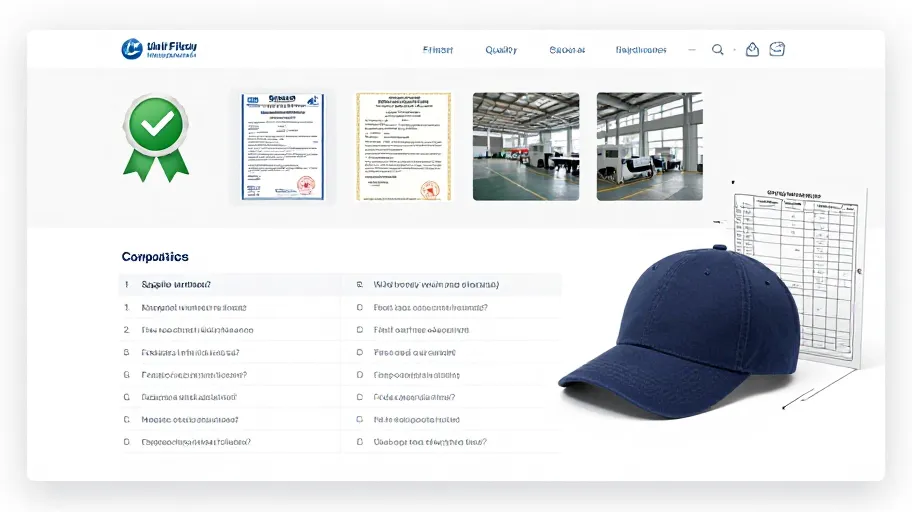
To evaluate a cap manufacturer online for a private-label project, run every candidate through four gates before discussing price: Verify the entity behind the listing, Evidence its production and quality documentation, Compare suppliers on identical written questions, and Approve only after a sample passes your spec sheet. Document each gate. A manufacturer you cannot verify, evidence and compare on equal terms is not yet a supplier — it is a listing.
Why online evaluation fails without a framework
Most sourcing problems in custom headwear are not caused by a bad factory. They are caused by an unstructured evaluation. A buyer browses several websites, exchanges a few emails, receives a sample that looks acceptable on screen, and commits — without ever documenting what was promised, by whom, or against which spec.
The result is familiar: the production run differs from the sample in ways nobody defined, the approval trail is a chat log, and neither side can point to an agreed standard. A named framework fixes this because it forces the same questions to every candidate and produces a written record you can compare and revisit.
The framework used throughout this article is VECA — Verify, Evidence, Compare, Approve. It works whether you are evaluating three suppliers or thirty, and it does not depend on any claim a manufacturer makes about itself online. That is the point: online claims are inputs to verify, not facts to trust.
Gate 1 — Verify: who is behind the listing?
Before you assess capability, establish the entity. Online, a cap manufacturer can present as a factory, a trading company, or a marketing page with no production role at all. None of these is inherently wrong — many importers work happily with trading companies — but you need to know which one you are talking to, because it determines who controls quality, who answers for defects, and how your spec travels into production.
Verification steps that cost you nothing but time:
- Match the company name on the website against its registered business entity, including the Chinese registered name if available.
- Ask directly: "Are you the manufacturing site, or do you coordinate production with partner factories?" Both answers can work; an unclear answer cannot.
- Check whether the address shown online corresponds to a plausible industrial location rather than a virtual office.
- Ask for the name and role of the person handling your project, so approvals have an owner.
If a manufacturer cannot or will not clarify its role in production at this stage, that itself is evaluation data. Log it and move on.
Gate 2 — Evidence: request documentation, not adjectives
Websites say "high quality", "professional", "advanced equipment". None of it is verifiable from a page. Evidence is. At this gate, request:
- Product specification sheets for the cap styles closest to your project, with construction, closure, sweatband and decoration methods identified.
- The quality-control workflow: inspection points, in-process checks, and what documentation you receive with a shipment.
- Decoration capability detail for your intended method — embroidery, printing, patches, laser, heat transfer — and who handles artwork approval.
- Any certifications or compliance documentation relevant to your destination market, framed as "please send current certificates for review" rather than assuming which ones exist.
- References or case examples the manufacturer is willing to share, which you can then weigh as claims to probe, not proof.
Read the responses as much for specificity as for content. A supplier that answers with concrete documents and named processes is demonstrating how it will communicate during production. A supplier that answers with brochures is demonstrating that too.
Gate 3 — Compare: same questions, written, side by side
Comparison only works on equal terms. Send every shortlisted cap manufacturer the identical written question set and score the answers in one table. Here is a decision table structure you can reuse:
| Evaluation criterion | What to request | What a strong answer looks like | Supplier A | Supplier B | Supplier C |
|---|---|---|---|---|---|
| Entity clarity | Confirmed manufacturing or trading role, registered name | Direct, unambiguous answer | |||
| Spec handling | Detailed spec sheet for your target cap style | Measurements, materials and construction named | |||
| Decoration method | Capability evidence for your decoration type | Process description, artwork approval step | |||
| MOQ & pricing | Written, project-specific quotation | Clear terms you can compare — confirm directly | |||
| Sampling | Current sample policy and cost | Stated in writing — confirm current policy | |||
| Lead time | Production timeline for your quantity | Written estimate tied to your spec | |||
| Quality control | Inspection points and shipment documentation | Defined process, not slogans | |||
| Communication | Named contact, response quality, language fit | Fast, precise, ownership | |||
| Compliance | Certificates relevant to your market | Documents sent for review |
Fill the scoring cells yourself; do not let suppliers fill them. The act of scoring forces you to notice gaps you would otherwise skim past.
Gate 4 — Approve: sample first, then stage gates
Approval is not a single moment. Structure it:
- Spec lock. A written spec sheet both sides sign off before sampling — style, construction, materials, decoration, colour references, labelling and packaging for your private-label branding.
- Sample approval. Evaluate the physical sample against the locked spec, not against your memory of a photo. Record every deviation in writing.
- Pre-production confirmation. Before bulk production, confirm how the approved sample and its spec will be held as the reference standard for the run.
- Final inspection terms. Agree in writing how the finished goods will be inspected and what documentation accompanies them, before any deposit moves.
Each gate is a point where you can stop the project at low cost. Skipping gates moves all your risk to the end.
Concrete approval questions to send any cap manufacturer online
Copy these into your first serious email. They are deliberately commercial-term-neutral: the answers must come from the supplier, in writing, for your specific project.
- Are you the manufacturing site for this product, or do you coordinate with partner factories? Please confirm the registered entity name.
- What is your minimum order quantity for this cap style with our decoration method? Please quote for our target quantity.
- What is the estimated production lead time for our quantity once the sample is approved?
- Which quality inspections occur during production, and what documentation do we receive with the shipment?
- What certifications or test documentation can you currently provide for our destination market?
- Who is our named contact, and what is the artwork approval workflow for our logo?
- What are your payment terms, and what triggers each payment stage?
A manufacturer's willingness to answer these precisely — before you have paid anything — is one of the most reliable signals you will get online.
Red flags and green flags checklist
Use this checklist for every candidate:
- Entity role (factory / trading / hybrid) confirmed in writing
- Registered company name verified
- Spec sheet received and matches your project style
- Decoration method capability evidenced, not asserted
- MOQ, price and lead time received as written, project-specific answers
- Current sample policy confirmed directly with the supplier
- Quality-control process described with inspection points
- Compliance documentation offered for review
- Named project contact assigned
- Sample approved against a signed spec sheet before any deposit
- Inspection and acceptance terms agreed in writing
A candidate missing two or more boxes after direct contact is a candidate to deprioritise — not because it is dishonest, but because you cannot document it, and undocumented suppliers cannot be compared.
Frequently asked questions
Is a trading company acceptable for a private-label cap project? It can be, provided you verify its role, understand who actually manufactures and inspects your goods, and confirm who is contractually responsible for quality. The VECA framework works the same way either way — verify first, then evidence.
How many cap manufacturers should I compare online? A practical shortlist is three to five candidates evaluated with the identical written question set. Comparing more adds noise; comparing fewer removes your negotiating position and your benchmark.
How do I judge quality from a website alone? You cannot — and neither can anyone else. A website can only tell you whether to open a conversation. Quality is judged from spec sheets, documentation, and a physical sample evaluated against a locked spec.
What should I confirm about sampling before ordering?
What matters most when comparing quotations? Comparability. A quotation is only meaningful when it responds to the same spec, quantity, decoration method and delivery terms as its competitors. Lock the spec first; then the numbers can actually be compared.
Run VECA on your shortlist
Turn this framework into a working document: a one-page scorecard with every VECA gate, every checklist item and a scoring column per supplier, ready for your next RFQ round.
[Download Supplier Scorecard]
Before that, if you want a lighter starting point: take the eight approval questions above, paste them into an email to your current shortlist, and see who answers precisely. That single step — free, fast, revealing — is the cheapest supplier filter you will ever run.
#cap manufacturers china, #headwear manufacturers china, #cap factory