
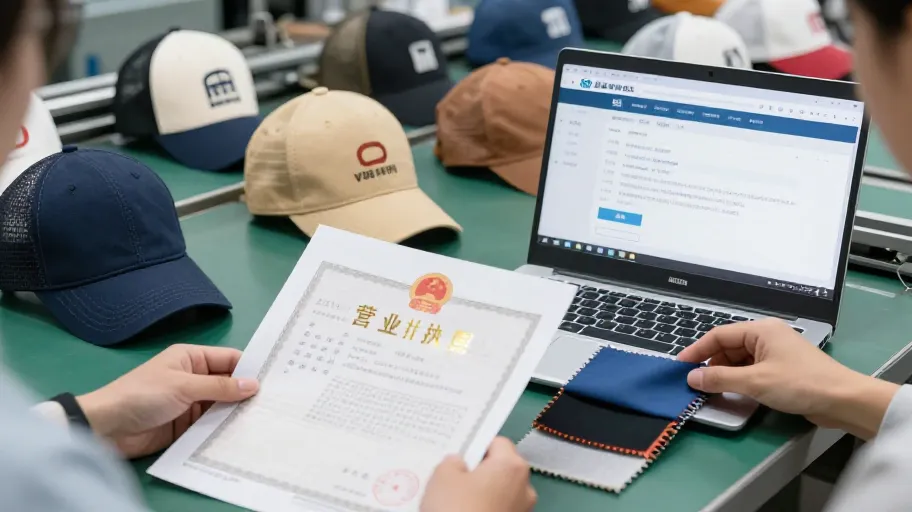
Comparing China hat manufacturers online works best when you separate verifiable evidence from marketing language. Use the VERIFY Framework — Verify identity, Evaluate communication, Review evidence, Inspect documentation, Factory-check, Yield a decision — to score every supplier against the same criteria, document answers in writing, and approve one only after its capabilities match your private-label specification.
The risk in online sourcing is not that a supplier list is hard to find. It is that every profile — factory, trading company, or outdated listing — reads much the same. The buyer who wins is the one who asks narrow, documentable questions and records the answers before any deposit moves.
Run identity and capability checks before anything else
Start by verifying who you are talking to. A business licence, export registration, and a consistent company name across the supplier's website, email domain and platform profiles are baseline evidence. Where the seller operates a storefront on a marketplace, check whether the listed entity matches the entity that would sign your contract.
Then ask capability questions tied to your specific project: which construction methods the supplier runs in-house for your cap style, whether embroidery or printing is done on-site or subcontracted, and which steps they would document for your order. Do not accept "we can do everything" — ask which processes they own, which they outsource, and who is accountable for each.
Test communication the way you would test production
Communication during evaluation predicts communication during production. Run a small, repeatable test in your first week of contact:
- Send one detailed technical question (a stitching method, a closure option, a panel construction) and note whether the answer is specific or generic.
- Request one document — a spec sheet template or an order-process outline — and see whether it arrives and whether it is coherent.
- Track response quality, not just speed: an answer that says "confirm with you after checking with the workshop" is more useful than an instant "no problem".
Score each supplier on the same test so the comparison is fair.
Demand documented evidence, not adjectives
Evidence means files you can keep. For a private-label project, ask for:
- A specification sheet template showing how they define materials, sizing and workmanship.
- Photos or files of construction options relevant to your style — not a generic catalogue, but items matched to your brief.
- Their proposed quality-control process for your order: what they check, at which stage, and what documentation you receive.
- Their minimum order quantity and production schedule for your specific design. These are project-specific figures the supplier must confirm, not numbers to estimate from other projects.
Decision table: score suppliers with VERIFY
| VERIFY dimension | What to check | Evidence to require | Red flag |
|---|---|---|---|
| Verify identity | Legal entity, export status, consistent naming | Business licence, matching domains | Entity differs across profiles |
| Evaluate communication | Specificity of technical answers | Written replies to your test questions | Vague, template-only answers |
| Review evidence | Capability for your exact cap style | Style-matched samples, spec templates | Generic catalogue only |
| Inspect documentation | QC process, order terms, IP terms | Written QC outline, contract draft | Verbal assurances, no documents |
| Factory-check | Physical or virtual audit readiness | Video walkthrough or third-party audit acceptance | Refusal of any verification |
| Yield a decision | Weighted score comparison | Completed scorecard per supplier | Decision made on price alone |
Score each dimension, weight what matters most for your project, and compare scorecards side by side rather than impressions.
Approval questions to put in writing
Before approving a supplier, get written answers to:
- Which entity signs the contract, and where is it registered?
- Which production steps for our design are in-house, and which are subcontracted?
- What is your current sample policy for this project — cost, shipping arrangement, and how fees are handled? (Confirm the current policy directly.)
- What is the minimum order quantity and production schedule for this exact specification?
- What inspection process applies to our order, and what documentation do we receive?
- Who owns our artwork, patterns and tooling, and what happens if we reorder elsewhere?
- What are the agreed remedies if goods fail inspection — rework, replacement, or another outcome you define together?
- Which certifications or test reports do you currently hold that are relevant to our destination market? Ask for documents, and confirm they are current and applicable to your product.
None of these should be answered from a listing. They should be answered in writing, by the supplier, for your project.
Pre-commitment evaluation checklist
Use this checklist before any deposit:
- Legal entity verified against licence and domain
- Communication test completed and scored
- Style-specific evidence reviewed (not generic catalogue)
- Sampling policy confirmed in writing for this project
- MOQ and schedule confirmed for this specification
- QC process and inspection documentation agreed
- IP and tooling ownership written into contract
- Rework and dispute remedies documented
- VERIFY scorecard completed for every shortlisted supplier
- Final approval recorded with reasons
FAQ
Can I trust a China hat manufacturer I have only found online? Trust should be built on documents, not profiles. Verify the legal entity, request style-specific evidence, and confirm policies in writing before any payment. A supplier that welcomes verification is easier to work with than one that resists it.
Should I choose a factory or a trading company for private-label headwear? Both can work, but you should know which you are dealing with, because it affects pricing structure and accountability. Ask directly which entity signs the contract and which processes are in-house, then record the answer.
What evidence should a supplier send before I order samples? A specification-sheet template, construction options matched to your cap style, a written description of their QC process for your order, and a written confirmation of the current sampling policy — including cost and shipping arrangement, which you must confirm directly.
How many manufacturers should I compare before deciding? Enough to make your criteria meaningful. Score at least two or three suppliers with the same VERIFY scorecard so you are comparing documented answers, not first impressions.
How do I protect my design when sourcing from China? Address ownership in writing before production: who holds the artwork, patterns and tooling, and what rights each party retains if the relationship ends. Have the supplier confirm, and keep the document.
Compare suppliers with the Supplier Scorecard
Shortlisting China hat manufacturers online is only half the job; the other half is scoring every candidate the same way. 下载 Supplier Scorecard and run your shortlist through the VERIFY Framework before your next sourcing decision.
Newer to structured sourcing? Start smaller: take the pre-commitment checklist above and answer it for one supplier this week. That single pass will show you exactly where you need more documentation.
#cap manufacturers china, #headwear manufacturers china, #cap factory