
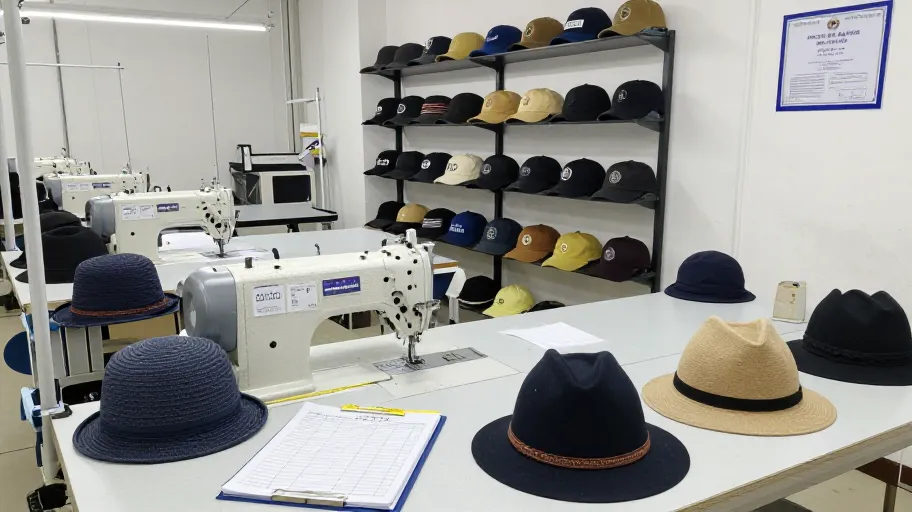
Shortlisting Chinese hat manufacturers is an evidence exercise, not a browsing exercise: verify factory status and capability directly, demand documented proof of quality systems, test the collaboration with a controlled sample run, and agree every commercial and IP term in writing before the first production order. A structured comparison beats a polished website every time.
Why supplier evaluation is a documentation problem
Most failed private-label headwear projects do not fail at the design stage. They fail because a claim that was made in a sales conversation was never written down, tested, or tied to an approval gate. When you evaluate Chinese hat manufacturers, your job is not to find a supplier who says the right things — it is to find a supplier who can prove the right things and accept them as written commitments.
The framework below, which we call V.E.T.A. — Verify, Evidence, Test, Agree — gives you four sequential gates. A supplier who stalls at any gate is telling you something. Your leverage is highest before the first payment, so use that window deliberately.
The V.E.T.A. framework
V — Verify the operation
Confirm who you are dealing with: a manufacturer, a trading company, or a hybrid. Neither is inherently wrong, but the difference shapes pricing transparency, quality control ownership and who is accountable when something goes wrong. Ask for:
- Business licence and manufacturing scope — does it cover headwear production?
- Confirmation of whether production happens in-house, at partner facilities, or both.
- Whether you can visit the facility or arrange a third-party audit, and on what terms.
Do not accept a factory claim at face value. A manufacturer with a genuine production base should be able to evidence it without friction — through a live video walkthrough, an audit report you commission, or a scheduled visit.
E — Evidence the capability claims
Capability in custom headwear sits in details: panel cutting accuracy, embroidery or print registration, sweatband attachment, closure and eyelet assembly, and finishing consistency across a full production run. For each claimed capability, ask for verifiable artefacts rather than descriptions:
- Photos and specs of relevant machinery for your product type (for example, embroidery heads if your design is heavy on stitched logos).
- Quality control documentation: what is inspected, at which stage, and how defects are recorded.
- References or case examples the supplier is authorised to share — and be specific that you want examples within your product category, not generic portfolio shots.
T — Test with a controlled sample
Before committing to production, run a sample process that mirrors how you will actually work together. Frame these as questions, because sample economics vary by supplier and project:
- What is your current sample policy — cost, timeline, and revision terms?
- If I approve a sample, how is that approved sample preserved and referenced during production?
- Can I request a pre-production sample from the actual production materials and batch?
- What is your process for a third-party inspection during or after production, and do you accept client-appointed inspectors?
The approved sample — sometimes called a golden sample — becomes your reference standard. Agree in writing that production will be judged against it.
A — Agree the terms before payment
Every commercial and legal question should be answered in a written document, not a chat message. At minimum, confirm:
- MOQ for your specific construction and decoration mix, per colourway.
- Pricing basis: what is included, what triggers price changes, and how reorders are priced.
- Lead time definitions: from what event does the clock start — deposit, artwork approval, or pre-production sample approval?
- Tooling, digitising and setup charges: who owns them and what happens on reorder.
- Defect and rework handling: how are disputes documented and remedied?
- IP protection: will the supplier sign an NDA covering your designs, and what is their policy on not producing your designs for other buyers?
- Shipping terms, packaging specification and labelling responsibilities.
If a supplier resists putting any of this in writing, treat that as evaluation data in itself.
Decision table: comparing shortlisted suppliers
Score each shortlisted Chinese hat manufacturer against the same criteria, using the same evidence standards:
| Evaluation criterion | What to demand | Evidence standard | Red flag |
|---|---|---|---|
| Factory status | Licence, production scope, audit access | Documented licence; audit offer in writing | Vague answers about where production happens |
| Product capability | Machines and processes matching your design | Category-specific samples, process photos | Only generic catalogue images |
| Sample process | Written policy on cost, timing, revisions | Clear, current written policy | Policy changes verbally mid-process |
| Quality control | Inspection stages and defect documentation | QC checklist or report format shared | “We check everything” with no artefacts |
| Pre-production approval | Golden-sample retention and batch matching | Written commitment to match approved sample | Refusal to define approval gates |
| IP protection | Signed NDA, exclusivity terms on request | Executed document | Reluctance to sign or vague exclusivity language |
| Commercial terms | MOQ, pricing basis, lead-time definition, remedies | Quotation and contract in writing | Terms only in chat history |
| Communication | Named contact, response discipline, technical fluency | Consistent performance through sampling | Different answers to the same question |
No supplier scores perfectly on every row. The purpose is to make trade-offs visible and documented, so your final choice is a reasoned decision your team can revisit and defend.
Concrete approval questions to send this week
Copy these into your next supplier email and log the answers:
- Please confirm in writing whether you manufacture in-house or subcontract, and which processes apply to my product.
- What is your current sample policy, including cost, timing and what happens if revisions are needed?
- How do you preserve my approved sample and ensure production matches it?
- What are your MOQ and pricing basis for my specific construction, decoration and colourway — and what would change them?
- What does your lead-time commitment cover, and from which milestone does it start?
- Will you sign an NDA covering my designs, and what exclusivity can you offer on my styles?
- How are defects identified, documented and remedied after delivery?
- Do you accept third-party inspections, and at which stages?
A supplier's written answers to these eight questions will tell you more than a month of browsing catalogues.
Supplier evaluation checklist
Use this checklist before any payment:
- Business licence and production scope verified
- In-house vs subcontracted processes confirmed in writing
- Category-specific samples received and assessed
- Sample policy (cost, timing, revisions) documented
- Golden-sample approval process agreed
- QC inspection stages and defect documentation reviewed
- MOQ and pricing basis confirmed for your exact specification
- Lead-time definition and starting milestone agreed
- NDA and IP terms signed
- Third-party inspection accepted in writing
- Defect and rework remedies documented
- Named contact and escalation path established
A note on evaluating New Generation
New Generation is a Shenzhen-based B2B OEM/ODM manufacturer of custom caps and headwear serving overseas brands, importers, wholesalers and corporate buyers. We state our business model plainly and encourage every buyer to apply the same V.E.T.A. scrutiny to us as to any other supplier: ask for our licences, our sample policy, our QC documentation and our written terms. We would rather be verified than believed.
FAQs
How can I tell a manufacturer from a trading company when sourcing caps from China? Ask for the business licence and its manufacturing scope, request a live facility walkthrough or audit access, and confirm in writing which processes are in-house. A genuine manufacturer can evidence production directly; a trading company will redirect the question. Neither is wrong — but you need to know which accountability structure you are buying into.
Should I visit the factory before placing my first order? A visit or a commissioned third-party audit is one of the strongest verification steps available, and the decision depends on order value and risk tolerance. If a visit is not practical, a scheduled live video walkthrough plus an independent inspection during sampling provides meaningful evidence. Confirm with each supplier what access they will support.
What documents should I have before paying a deposit? At minimum: a written quotation with pricing basis, a signed NDA if IP matters to you, an approved and retained golden sample, a lead-time definition with its starting milestone, and documented defect-and-remedy terms. Chat history is not a contract — convert agreements into documents before payment.
How do I compare several Chinese hat manufacturers fairly? Use the same criteria, the same evidence standards and the same scoring sheet for every supplier. The decision table above, or a structured supplier scorecard, prevents each supplier's strongest pitch from dominating your judgement and gives your team a shared record of why the final choice was made.
What if a supplier avoids answering policy questions directly?
Ready to run a structured comparison? [下载 Supplier Scorecard] — the same evaluation sheet format used above, ready for your shortlist of Chinese hat manufacturers.
If you are not ready for a scorecard yet, start smaller: send the eight approval questions above to your current shortlist and compare the written answers. That alone will narrow the field.
#cap manufacturers china, #headwear manufacturers china, #cap factory