


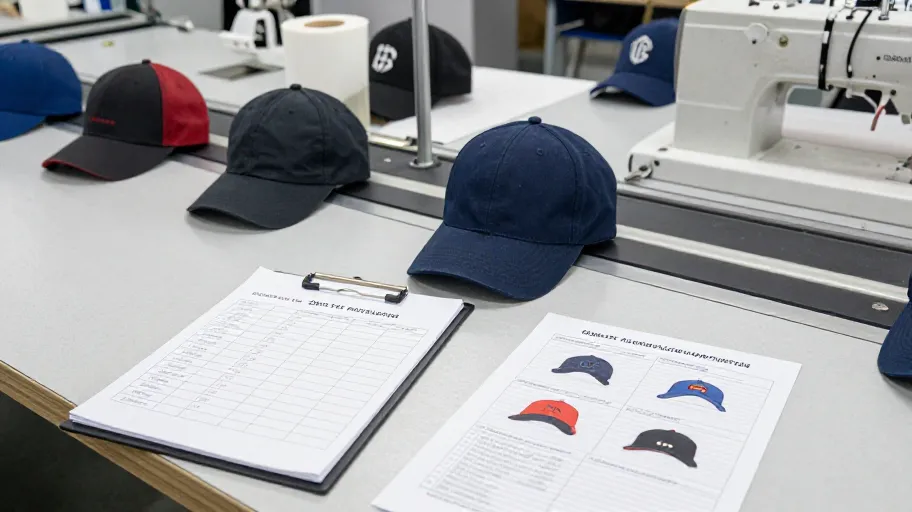
Evaluating headwear manufacturers for a private-label project comes down to three verifiable things: documented capacity, a written sample-approval process, and production controls you can inspect before mass production begins. Skip any one of these and you are comparing marketing claims instead of suppliers. A structured scorecard, not a hunch, should drive your shortlist.
Why this comparison needs structure, not gut feel
Many buyers start by searching for "headwear manufacturers usa" because a domestic-sounding supplier feels safer. That instinct is worth testing rather than trusting. Some suppliers marketing to US buyers own factories; others are trading companies, agents or brokers who subcontract. None of these models is inherently wrong — but each changes who controls your spec, your timeline and your remedies when something goes wrong.
The honest way to run the comparison is to hold every candidate, wherever they actually produce, to the same evidence standard. That is what the framework below is for.
The CAP-Headwear framework
Use three lenses, in order:
C — Capacity evidence. Ask for proof that the supplier can produce your category and volume: factory address you can verify, equipment lists, photos of relevant production lines, and named contacts on the production side. Capacity is project-specific — a manufacturer strong in embroidered snapbacks may not be the right fit for knitted beanies. Ask which of your exact constructions they have produced, and request project references you can contact.
A — Approval controls. Before mass production, you need a written pre-production sample process: how the sample is made, how revisions are handled, and what documentation confirms approval. Confirm current sample policy, costs and shipping arrangements directly with the supplier — these vary by project and are not something any article can state on a supplier's behalf.
P — Production documentation. Insist on a signed spec sheet covering materials, construction, colour references, sizing, labelling, packaging and brand markings. Define how defects will be handled and how quality will be inspected — including whether you or a third party will inspect, and at what stage.
Decision table: comparing supplier options
| Evaluation criterion | Questions to ask | What strong evidence looks like |
|---|---|---|
| Factory identity | Do you own the factory? Can I visit or video-audit it? | Verifiable address, named production contact, willingness to arrange audit |
| Category fit | Which of my exact constructions have you produced? | Project references, physical counter-samples in your category |
| Sample process | What is your current sample and approval policy? | Written process with defined revision and approval steps |
| Spec control | Will you sign a full spec sheet before production? | Signed technical pack, not verbal agreement |
| Quality inspection | Who inspects, when, and against what standard? | Named inspection method, agreed before deposit |
| IP protection | How are my artwork and designs protected? | Written confidentiality terms before file transfer |
| Communication | Who is my single point of contact? | One accountable person with production-side access |
Score each candidate, then compare totals. Suppliers who decline to answer documentation questions have told you something important.
Concrete approval questions to send every shortlisted manufacturer
- What is your current MOQ for my specific construction and decoration method?
- What is your current sample policy — process, cost and delivery — for a project like mine?
- What is your current lead time from approved pre-production sample to ex-factory?
- Which certifications or test reports can you provide for the materials in my spec, current as of today?
- Who conducts final inspection, at what stage, and against which written standard?
- How are defects, reworks and replacements handled contractually?
- What confidentiality or IP terms apply before I send artwork?
- What are your payment terms, and what triggers each payment milestone?
None of these answers belongs in an article — they change per supplier, per project and per season. Get them in writing, dated, from the person accountable for your order.
Where a Shenzhen OEM/ODM partner fits
New Generation is a Shenzhen-based OEM/ODM manufacturer of custom caps and headwear serving overseas brands, importers and wholesalers. For buyers comparing options against US-marketed suppliers, an OEM/ODM partner can be evaluated with exactly the framework above — capacity evidence, approval controls and production documentation.
What to verify with us, as with any manufacturer: current MOQs for your construction, current sampling policy, current lead times, material documentation for your spec, and inspection arrangements. We would rather you ask these questions before committing than discover gaps after a deposit. Every commercial detail is project-specific and confirmed during enquiry.
Pre-shipment approval checklist
Before you release any final payment or accept shipment, confirm:
- Signed spec sheet matches the approved pre-production sample
- Colour, material and labelling verified against approved references
- Brand markings and private-label details match signed artwork
- Packaging and carton marking instructions confirmed in writing
- Inspection completed at the agreed stage by the agreed party
- Defect handling documented before goods leave the factory
- Shipment terms, responsibilities and current policies confirmed directly
FAQ
Should I only work with manufacturers located in the USA? Not automatically. Location matters less than verifiable capability and controls. A supplier's real factory location, documentation quality and approval process should drive the decision — evaluate all candidates against the same evidence standard.
How do I know if a "manufacturer" is actually a factory? Ask directly, request a verifiable factory address, and propose a visit or live video audit. Trading companies can still be good partners, but you deserve to know which model you are buying from before negotiating.
What should a supplier confirm before I send private-label artwork? Written confidentiality or IP terms covering your files, plus a named contact responsible for them. Confirm the current policy directly — do not rely on a website statement alone.
How many manufacturers should I shortlist? Enough to compare meaningfully — score at least three candidates against the same criteria so your comparison is like-for-like rather than a single untested option.
Do I need third-party inspection? That depends on your risk tolerance, order value and internal resources. Decide who inspects, when and against what written standard before production starts, and document it in the order terms.
Download the Supplier Scorecard
Run every candidate — domestic-branded or China-based OEM/ODM — through the same scored evaluation before you commit. Download the Supplier Scorecard to compare capacity evidence, approval controls and production documentation side by side, and keep a written record of every answer you receive.
Prefer to start smaller? Use the pre-shipment approval checklist above as your first-pass filter: any supplier unwilling to answer those items in writing does not belong on your shortlist.
#cap manufacturers china, #headwear manufacturers china, #cap factory








