


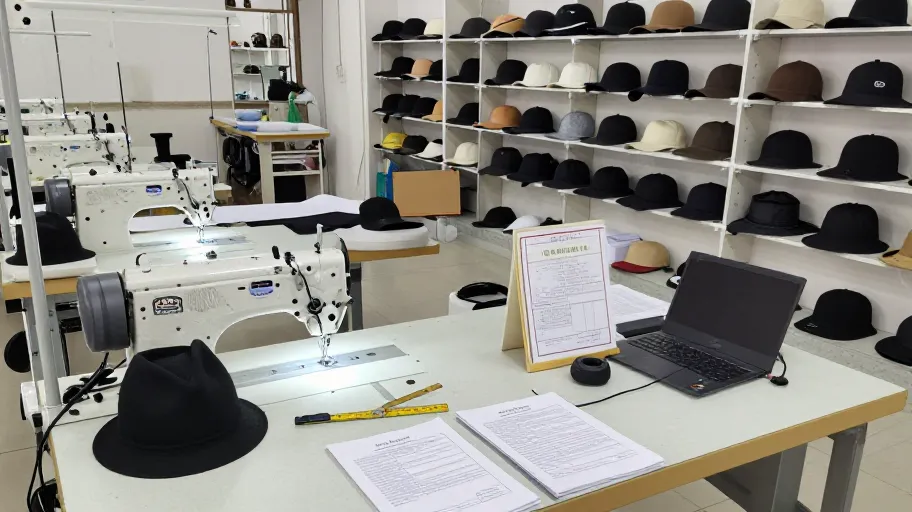
Evaluating men China hat manufacturers for a private-label project comes down to verifying six things in a fixed order: production capability, communication quality, quality control, compliance readiness, commercial terms and continuity. Buyers who run every candidate through the same six lenses — rather than comparing quotations in isolation — make faster, safer shortlist decisions and avoid the expensive surprises that surface after a deposit is paid.
Why price-first comparison fails
Most sourcing teams start with a spreadsheet of quotes. The problem is that a quotation is only an answer to a question you may not have fully asked. Two suppliers can quote the same six-panel cap at very different unit prices because they assumed different materials, construction methods, decoration techniques, packaging or inspection standards — or because one quotation is a factory's and the other a trading company's margin stacked on top.
A private-label project is a multi-month relationship, not a single transaction. What separates a workable supplier from a difficult one is rarely the headline price; it is how the supplier behaves when your specs change, when a bulk shipment differs from the approved sample, or when a shipment deadline moves. That behaviour cannot be read from a price list. It has to be tested with structured questions and documented answers.
The 6-Lens Supplier Scorecard
We recommend scoring every candidate manufacturer against the same six lenses before you request a quotation at all. Each lens produces a set of documented answers that become part of your project file — evidence you can return to if a dispute arises later.
| Lens | What to verify | Key questions to ask | Red flags |
|---|---|---|---|
| 1. Capability | Whether the supplier can actually produce your product type in-house | Do you manufacture this product category in your own facility, and which processes are outsourced? Can you share recent production examples of similar construction? | Vague answers about who makes what; refusal to describe the production flow |
| 2. Communication | Responsiveness, English capability, and whether one accountable contact exists | Who will own my project from sampling to shipment? What is your normal response window for technical questions? | Answers that change between emails; different people answering the same question inconsistently |
| 3. Quality control | In-process and final inspection practices | What inspection stages do you run, and may I appoint a third-party inspector before shipment? How do you handle a bulk shipment that deviates from the approved sample? | "Quality is guaranteed" without describing any process; resistance to third-party inspection |
| 4. Compliance readiness | Documentation your market may require | Which documents and test reports can you provide, and who arranges testing — you or the supplier? Confirm current requirements for my destination market. | Uncertainty about what paperwork exists; promises of documents without naming them |
| 5. Commercial terms | MOQ, payment structure, sample policy and tooling costs | What is the MOQ for this construction? What is the sample policy, including any fees and who covers shipping? What payment terms do you accept for a first order? | Terms quoted verbally only; reluctance to put MOQ and payment terms in writing |
| 6. Continuity | Whether the supplier can sustain the relationship | How do you handle repeat orders of the same style? Who keeps the approved samples and tooling between seasons? | No process for archiving approved samples; no answer on repeat-order handling |
Score each lens, document the answers, and compare suppliers on the full profile — not on one number.
Decision table: comparing your shortlist
Once you have answers from three or more candidates, lay them out side by side:
| Evaluation point | Supplier A | Supplier B | Supplier C |
|---|---|---|---|
| Confirmed in-house capability for this construction | |||
| Named project owner and response window | |||
| Documented QC stages and inspection access | |||
| Documents and reports they can provide | |||
| Written MOQ, sample policy and payment terms | |||
| Repeat-order and tooling retention process | |||
| Price for a fully specified product (same spec sheet) |
The final row should be filled in last, and only after every supplier has quoted against the identical tech pack. Only then is the price comparison meaningful.
Approval questions to send before any deposit
Before you approve a production order, send each shortlisted supplier this set of questions and require written answers. Treat the replies as part of your contract documentation.
- Specification confirmation. Please confirm in writing the exact materials, crown structure, brim stiffness, closure type, decoration method and stitching density you will use for bulk production.
- Golden sample. Will you produce a pre-production sample for my signed approval before mass production begins? Who retains the approved golden sample, and how will bulk production be checked against it?
- Inspection access. May I appoint my own third-party inspection company to inspect the finished goods before shipment, and at what stage?
- Documentation. Exactly which documents — commercial invoice, packing list, certificate of origin, and any test reports my market requires — will you supply, and who is responsible for arranging each one?
- Deviation procedure. If bulk production cannot match an agreed input material or component, what is your procedure for notifying me and obtaining my approval before proceeding?
- Terms in writing. Please restate the MOQ, unit price, sample policy, payment schedule and delivery term (e.g. FOB port) in writing, so both parties reference the same document.
A supplier's willingness to answer these in writing is itself a signal. Evasiveness at the approval stage tends to reappear at the shipping stage.
Evaluating samples: check, don't assume
Sampling is where most private-label projects are won or lost, and it is also where assumptions cause the most damage. When you receive samples, evaluate them against a written checklist rather than a general impression:
- Construction: crown shape, panel alignment, embroidery or print placement and density, closure function, sweatband and lining finish.
- Materials: does the fabric, brim board and hardware match the specification you sent, not just the sample photo?
- Label and branding: is your woven label, heat transfer or embroidered logo correct in artwork, position and thread colour?
- Consistency: if the supplier sent multiple samples, do they match each other? Sample-to-sample variance is a data point about process control.
Confirm directly with the supplier what the current sample policy is — including any fees, shipping arrangements and timelines — for your specific project, and get it in writing before you request samples. Do not rely on assumptions or on what another supplier offered; policies differ between manufacturers and can change between projects.
FAQ
How do I tell a real hat factory from a trading company? Ask directly which production processes are performed in their own facility and which are outsourced, and request evidence such as a business licence scope, a facility video walk-through or an invitation to audit. Then check whether their answers to technical construction questions are consistent and specific. Verify rather than assume — some excellent sourcing partners are trading companies, but you should know which kind of partner you are dealing with before you set expectations on price and control.
What MOQ should I expect for custom men's caps? MOQ depends on construction complexity, decoration method, material sourcing and the supplier's own order book, so it cannot be stated as a fixed number here. Ask each shortlisted supplier for a written MOQ against your specific tech pack, and ask how the MOQ changes if you vary colours or styles within one order.
How long does sampling and bulk production take? Timelines depend on the supplier's schedule, your design complexity and the decoration method, so treat any figure you read online as unverified. Ask each supplier to quote a written timeline for your specific project, including sample production, your approval window, bulk production and any inspection buffer, and build your launch plan from the supplier's own committed dates.
Should I hire a third-party inspection company? For most private-label buyers, independent pre-shipment inspection is a low-cost way to verify that bulk goods match the approved sample before they leave the factory. Ask the supplier whether they permit third-party inspection and at which stage. A supplier's response to this question — not just the answer itself — tells you a great deal about how they expect the relationship to work.
What documents do I need for importing headwear into my market? Requirements vary by destination market and product classification, so confirm the current requirements with your customs broker or freight forwarder first. Then ask each supplier exactly which documents and test reports they can provide and who arranges each one. Put the division of responsibility in writing before production starts.
Download the Supplier Scorecard
Run every candidate through the same six lenses and compare documented answers, not quotations. 下载 Supplier Scorecard to get the full 6-Lens evaluation template, including the pre-deposit approval question set and the sample evaluation checklist.
Quick-start checklist — before you request a single quote:
- Write a complete tech pack: materials, construction, decoration, labels, packaging
- Shortlist at least three suppliers and send each the identical spec
- Ask the six-lens questions and file written answers
- Confirm each supplier's current sample policy in writing for your project
- Require a pre-production golden sample with your signed approval
- Agree inspection access and the document list before the deposit
- Compare prices only after all suppliers have quoted the same spec
#cap manufacturers china, #headwear manufacturers china, #cap factory








