


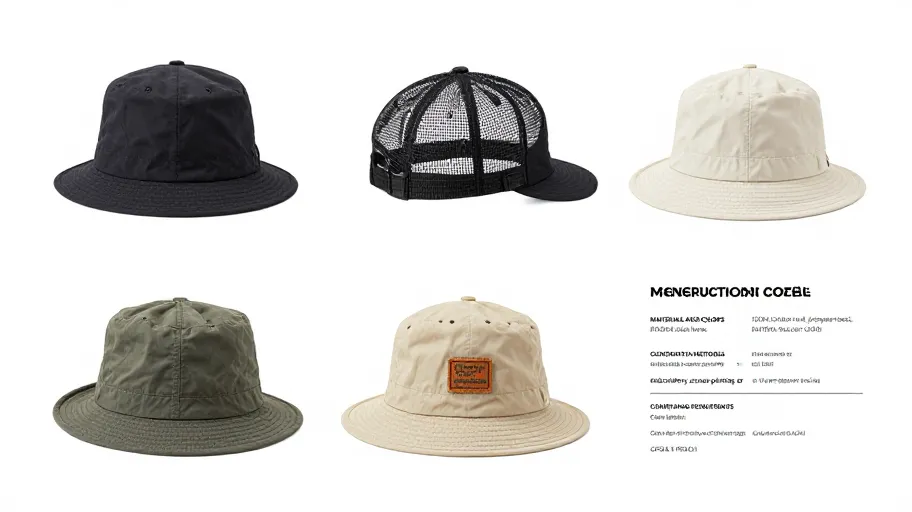
Before you request a quotation for custom men's headwear, your men hat tech pack should specify five blocks: style and dimensions, materials and colours, construction details, decoration methods, and compliance or labelling requirements. A supplier can only price what you document. Every undefined detail becomes an assumption in the quote — and assumptions are where quotations and production runs start to diverge.
Why vague briefs produce unreliable quotes
When a manufacturer receives a short email with a photo and the words "how much for 500 pieces," the response is not really a quotation. It is a range built on guesses: guesses about fabric, guesses about panel count, guesses about decoration, guesses about packing. Compare three such ranges from three factories and you are comparing three sets of guesses, not three offers.
The purpose of a tech pack is not paperwork for its own sake. It exists to make every quotation answer the same question, so that when you compare suppliers you are comparing like with like. It also protects you later: if the approved sample and the tech pack agree, and the bulk run matches neither, you have a documented basis for resolution.
None of this requires you to know how to manufacture a hat. It requires you to decide what you want, state it precisely, and mark clearly which points you want the supplier to propose options for.
The 5-BLOCK QUOTE-READY framework
Use this framework to assemble your brief before your first RFQ email.
Block 1 — Style and dimensions
State the base silhouette: six-panel baseball cap, five-panel, dad cap, trucker, flat cap, beanie, bucket — with a reference image or a labelled drawing where possible. Then specify the measurements you care about, such as crown height, brim length and circumference range, in writing. Avoid a single naked measurement; give the measurement, the method, and where it was taken (e.g. "brim length, measured from stitching line to outer edge").
Do not state numeric tolerances you have not agreed with the supplier. Instead, ask: "What dimensional tolerance can you commit to in writing for each measurement in this brief?"
Block 2 — Materials and colours
Specify shell fabric, lining, sweatband material, closure type, button and eyelet treatment. For colours, reference a physical standard you can send or a named colour system reference — but confirm with the supplier how they match colour and what approval step exists before bulk dyeing or bulk cutting.
Open questions to put in the brief rather than assume: "Which material options do you propose at different quality levels for this style?" and "What is your process for colour approval before production?"
Block 3 — Construction details
This is the block first-time buyers most leave blank — and it changes cost and look considerably. Document:
- Panel count and seam placement
- Structured vs unstructured crown, and the interlining type if structured
- Sweatband style (sewn-through, tucked, or another construction)
- Stitching expectations: seam type, stitching density, contrast thread
- Brim finish and whether the brim is pre-curved
- Ventilation: eyelets, mesh back, or none
For each point you are unsure about, convert your uncertainty into a question: "Please propose two sweatband construction options with photos of previous work and explain the difference in finish."
Block 4 — Decoration methods
State logo placement with a placement diagram, logo artwork in vector format, finished logo dimensions, and the decoration method: embroidery, 3D embroidery, puff print, screen print, patch, woven label, heat transfer, or laser. If you want the supplier to recommend, say so explicitly and ask for samples of each method they propose on your actual fabric.
Ask: "What artwork format and minimum line detail do you need for this decoration method?" — rather than discovering after sampling that the logo cannot reproduce at your specified size.
Block 5 — Compliance, labelling and packing
Specify care labels, country-of-origin labelling, hangtags, inner branding, and any regulatory requirement applicable in your destination market — and ask the supplier to confirm in writing what they can support and what documentation they can provide. Do not assume any certification exists; request evidence for any claim relevant to your order.
Packing belongs in the quote too: folding method, polybag, inner carton, carton marking. Ask the supplier for their packing options and to price each, since packing is a real cost line buyers forget to brief.
Decision table: what you specify vs what you ask the supplier to propose
| Element | Buyer specifies | Ask supplier to propose | Why it matters for the quote |
|---|---|---|---|
| Silhouette and reference style | Yes | Alternatives if style is custom | Fixes the tooling and pattern baseline |
| Shell fabric | Preferred option | Two alternates with price impact | Material drives the largest cost share |
| Crown height, brim length | Target measurements | Achievable tolerance in writing | Prevents post-quote disputes |
| Structured vs unstructured | Yes | Interlining options | Affects look, cost and packing |
| Decoration method | Preferred method | Feasibility check on your artwork | Method mismatch invalidates the quote |
| Colour standard | Reference standard | Matching process and approval step | Avoids unapproved bulk dyeing |
| Labels and compliance | Destination requirements | What they can document and support | Compliance gaps surface late and expensively |
| Packing | Expectations | Options with per-unit price | Packing omitted from briefs is omitted from quotes |
| Sample policy | — | Current policy, confirmed directly | Must be confirmed before you rely on it |
Approval questions to document before sign-off
Before you approve a quotation or a sample, get written answers to these and keep them with your tech pack:
- "Does this quotation cover every line in the attached tech pack? Please list any items not included."
- "Which measurements can you commit to in writing, and with what tolerance?"
- "What is the sample-to-bulk approval sequence, and what must I approve before bulk production starts?"
- "What is your current sample policy, including any fees and shipping arrangements? Please confirm directly."
- "What is your current production scheduling and dispatch process for an order of this specification? Please confirm current timelines directly."
- "What documentation can you provide for any compliance claim relevant to my destination market?"
- "If the bulk run differs from the approved sample, what is your resolution process?"
These questions are deliberately supplier-neutral. You are not asking the factory to promise an outcome; you are asking them to state their current position in writing so you can compare suppliers on evidence.
FAQ
Do I need a tech pack for a simple embroidered cap? Yes — a simple style still involves material, crown construction, decoration placement and packing decisions. A one-page tech pack for a simple cap is better than a paragraph email, because it removes the assumptions from the quotation.
Can the supplier help me build the tech pack? An OEM/ODM partner can propose options, but the brief should start with your decisions: style, target market, decoration intent and compliance requirements. Ask the supplier which points they can recommend on, and mark those clearly as "supplier to propose" so their suggestions are quoted, not assumed.
Should I send the same tech pack to multiple suppliers? Yes. Sending an identical brief to each supplier is the only way to make quotations comparable. Note in each brief which line items you have asked that supplier to propose, so you can evaluate the quality of their proposals, not just the price.
How detailed do dimensions need to be? Give each measurement, the measuring method and the reference point, and ask the supplier to state the tolerance they can commit to. A measurement without a method invites two different readings — one of which will be yours.
What happens if I change the tech pack after quoting? Any change after quotation — material swap, decoration change, packing change — should be re-quoted in writing as an amendment. Keep a version number on the document so the approved sample, the tech pack and the production order all reference the same version.
Before you send the first RFQ
A men hat tech pack is not a formality between you and a factory; it is the instrument that makes every subsequent decision — supplier comparison, sample approval, bulk inspection — auditable. Invest an afternoon in the brief and you save weeks of clarification later.
[Download Tech Pack Checklist] — get the complete pre-quote checklist covering all five blocks, the approval questions, and the supplier-confirmation items in one fillable document.
[Get the one-page version] — if you just need the quick checklist to review your current brief before your next RFQ email, grab the condensed one-pager.
#cap manufacturers china, #headwear manufacturers china, #cap factory








