
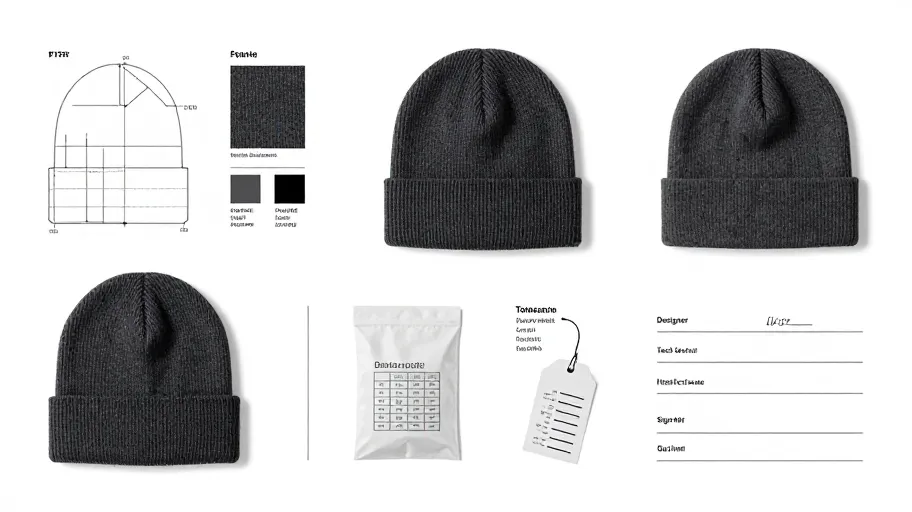
A beanie tech pack is the written contract between your approved sample and the bulk production run. It records every attribute the factory must hold — materials, knit construction, colour references, dimensions, label placement, packaging — plus the tolerances and sign-off rules that decide when a production unit matches the sample. Approving a sample is only half the job; the tech pack is what makes that approval enforceable at scale.
Why a great sample is not enough
Most sourcing disputes trace back to the same gap: the buyer approved a physical sample, but the factory received only a purchase order and a photo. Everything not written down becomes an open decision at the production line, and open decisions get resolved by whoever is closest to the machine — not by whoever approved the sample.
A beanie tech pack closes that gap. It does not need to be engineering-grade documentation; it needs to be complete, unambiguous and signed off by both sides before any yarn is committed.
The A-P-P-R-O-V-E framework for beanie tech packs
Use this framework to structure your hand-off document so nothing approved in the sample stage is lost on the way to production.
A — Artwork and branding. Record every logo, embroidery, patch, jacquard pattern, woven label and print placement exactly as executed on the approved sample. Include artwork files, colour separations, position measurements taken from the sample itself, and the approved reference sample number. If a patch changed size during sampling, the tech pack must record the final approved version, not the original artwork.
P — Parameters. List the measurable attributes: finished dimensions, weight per unit, gauge, yarn composition, lining type, cuff style and closure details. For every parameter, state the target as measured on the approved sample. Numerical tolerances are project-specific — agree them with your manufacturer in writing rather than assuming any figure, and record what you agreed.
O — Off-spec actions. Decide in advance what happens when a production unit doesn't match. Which attributes are hard requirements, and which are preferences? What is the inspection method, sampling approach and acceptance rule? Who signs the release? These questions belong in the tech pack, agreed calmly before production, not negotiated after goods are knitted.
V — Verification. Define the checkpoints: first-article or first-production-piece review, inline checks, and final inspection before shipment. State what evidence you require at each checkpoint — photos, measurements, video call — and who on your side reviews it. Confirm the current inspection and sampling policy directly with your supplier.
E — Expectations. Cover packaging, labelling, carton marking, documentation and any compliance requirements specific to your market. MOQ, price, lead time, capacity and certification are project-specific claims — confirm each one directly and in writing with your manufacturer rather than carrying assumptions from the sampling conversation. Confirm the current policy directly for any sample, fee or shipping question that arises during hand-off.
Specify, confirm, or leave open: a decision table
Not every detail needs the same level of documentation. Use this table to allocate each item.
| Item | How to handle it | Why |
|---|---|---|
| Yarn composition and knit structure | Specify in writing | Drives cost, hand-feel and appearance; impossible to fix later |
| Colour reference per colourway | Specify in writing | Verbal colour descriptions ("navy-ish") invite drift |
| Dimensions and weight | Specify target + written tolerance agreed with supplier | Defines fit and perceived quality |
| Logo placement and method | Specify in writing, annotated to sample photos | Most visible attribute to your end customer |
| Golden sample retention | Confirm with supplier | Both sides need an agreed physical referee |
| Inspection and acceptance rules | Negotiate and document before release | Prevents post-production disputes |
| MOQ, price, lead time | Confirm current policy directly | Project-specific; must be verified each order |
| Sample, fee and shipping terms during hand-off | Confirm current policy directly | Terms vary and must be in writing per project |
| Minor trim substitutions | Leave open only with a named approver | Open items without owners drift silently |
The rule of thumb: if a detail would upset you if it changed, it belongs in writing with an agreed acceptance rule. If you genuinely don't care, say so explicitly — "supplier's choice" is a valid spec entry and removes ambiguity.
Approval questions to close before production release
Run this question set with your manufacturer and keep the written answers inside the tech pack:
- Does this tech pack describe the approved sample in full, or are there attributes of the sample not yet documented?
- Which parameters have written tolerances, and who agreed them?
- Who holds the golden sample, and how will production units be compared to it?
- What happens if a first-article piece deviates — who reviews it, and what is the decision path?
- What evidence (photos, measurements, reports) will be provided at each checkpoint, and when?
- Are packaging, labelling and required documentation fully specified?
- Which items remain open, who owns each one, and what is the deadline to close them?
Nothing enters production until every line item is either specified or explicitly closed. That single discipline prevents most hand-off failures.
Pre-hand-off checklist
- Every branded element documented with final approved artwork and placement
- Materials, construction and dimensions recorded as measured on the approved sample
- Written tolerances agreed with the manufacturer for each measurable parameter
- Colour references attached for every colourway
- Golden sample identified, and retention agreed with the supplier
- Inspection checkpoints, methods and acceptance rules documented
- Packaging, labelling and destination-market documentation specified
- All commercial terms — quantity, price, timeline — confirmed directly and in writing
- Open items listed with named owners and closure dates
- Both parties have signed off on the final tech pack version
FAQ
How detailed does a beanie tech pack need to be? Detailed enough that someone who has never seen your sample could check a production unit against the document and reach the same pass/fail conclusion as you would. That means measurable targets, references, and acceptance rules — not necessarily a long document.
Do I need a tech pack if the sample is already approved? Yes — the sample is evidence of what you approved; the tech pack is the instruction for reproducing it. Without it, the approved sample has no written counterpart to enforce during production.
What if my supplier says the tech pack isn't necessary? Ask them to confirm in writing which attributes they will hold from the sample alone, and who decides when a production unit matches. That conversation converts an informal promise into documentation — and documents what happens if the promise isn't kept.
Who owns the tolerances — me or the manufacturer? Tolerances are negotiated. Propose targets based on what your end customer will notice, ask the manufacturer what they can hold consistently, and record the agreed figure. A tolerance neither side discussed is a dispute waiting to happen.
How do I handle multiple colourways? Document the construction once, then create a colourway table: one row per colour with its colour reference, yarn details and any colour-specific trims. Approve one golden sample per colourway where feasible.
Get the template
If you're preparing a beanie hand-off now, 获取 Beanie Brief — our beanie specification brief template walks you through the A-P-P-R-O-V-E structure with prompts for every attribute, tolerance and approval question covered above.
Not ready for the full template? Start with the pre-hand-off checklist in this article and work through it line by line — it's the fastest way to see which decisions are still open before you commit to production.
#cap manufacturers china, #headwear manufacturers china, #cap factory