


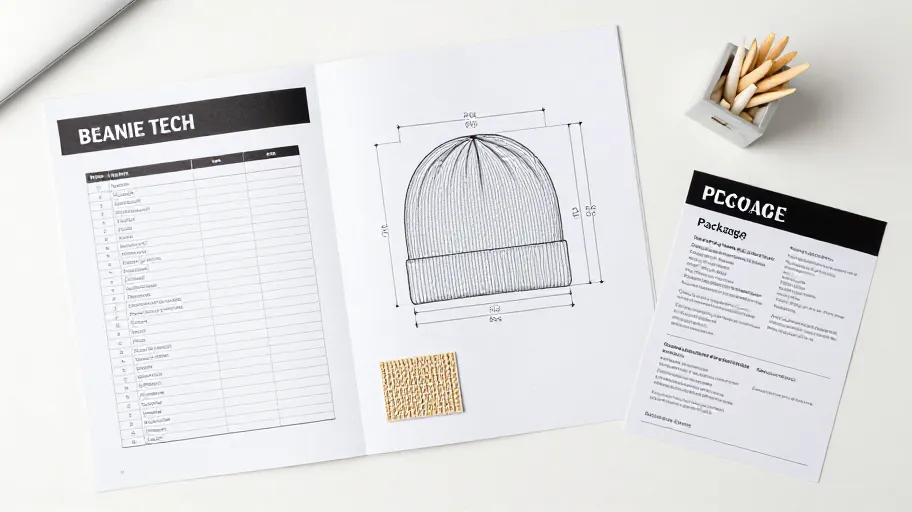
A beanie tech pack is the technical document that tells a manufacturer exactly what to make: yarn or fabric specification, knit construction, panels, dimensions, label and packaging details, and the tolerance band for every measurement. Without one, a supplier fills the gaps with assumptions, and the quote you receive reflects those assumptions rather than your product. A complete tech pack is therefore the single most effective way to obtain an accurate, comparable quote on your first enquiry.
Why quote accuracy starts with your documentation
When a manufacturer receives an enquiry, they price what they can see. If the knit gauge, cuff construction, label placement or packing method is undefined, the commercial team either quotes wide to cover the unknowns or asks for clarification — and each round of clarification pushes your timeline back.
A beanie tech pack removes that ambiguity. It is not a marketing document. It is a specification: precise enough that two different suppliers reading it would price the same product. That is also what makes it a comparison tool. If you send the same pack to several manufacturers, the variance in their responses tells you something real about their engineering understanding, their communication quality and their willingness to document decisions.
The SPEC-IT framework for beanie tech packs
To structure your pack, work through six elements. Together they cover everything a manufacturer needs to price and sample without guessing.
| Letter | Element | What it covers | Why it changes the quote |
|---|---|---|---|
| S | Specifications | Yarn or fabric content, weight, gauge, colour references (e.g., Pantone), finish | Material choice is a primary cost and lead-time variable |
| P | Panels & shape | Crown construction, fold/cuff design, pom or brim, seams | Construction complexity drives machine time and labour |
| E | Extras | Labels, hangtags, embroidery, woven patches, printing, packaging | Each add-on is a separate process with its own cost |
| C | Construction detail | Stitch type, seam method, lining, edge finishing | Affects both sampling and unit economics |
| I | Iterations | Which prototype rounds you expect, and approval gates | Defines the sampling phase of the project |
| T | Tolerances | Acceptable measurement variance per dimension, and inspection criteria | Sets the quality bar the quote must be built to meet |
Work through SPEC-IT in order. A decision you make in one element — say, a heavier yarn — changes what is realistic in construction and what tolerance band is achievable. Suppliers can advise on these interactions, but only if the rest of the pack pins down the variables.
What to send now versus what to confirm
Not every decision has to be final before your first enquiry. The table below separates what belongs in your tech pack from day one, and what should be raised as an explicit question to the supplier.
| Item | Put in the tech pack | Confirm with the supplier |
|---|---|---|
| Yarn/fibre content and weight | Yes, even if provisional | Availability of the specified material |
| Colour reference system | Yes | Match capability and dye-lot control process |
| Measurement chart (labelled diagram + dimensions) | Yes | Achievable tolerance band per dimension |
| Construction method | Yes, if known; otherwise describe intent | Recommended alternative if your method is impractical |
| Label and packaging spec | Yes | Compliance marking requirements for your destination market |
| Prototype rounds and approvals | Outline your expectation | Sampling policy, costs and current terms |
| Order quantity | State your target range | Minimum order quantity for this specific build |
| Delivery timeline | State your deadline | Feasibility, production schedule and shipping options |
The right-hand column matters as much as the left. Every item there is a project-specific variable that no article, template or assumption can answer for you — it depends on the supplier's current capacity, material availability and policies, all of which change over time and must be verified in writing before you commit.
Approval questions to ask before accepting a quote
Before you approve any quotation, ask the supplier to confirm the following in writing:
- Which assumptions, if any, did you make where our tech pack was silent?
- What tolerance band can you commit to for each measurement, and how is it inspected?
- What material substitutions, if any, are you proposing, and why?
- What does your sampling process include, how many rounds are quoted, and what are the current terms?
- What is your minimum order quantity for this specific construction and decoration combination?
- Which documentation can you provide for the destination market's labelling and product-safety requirements?
- At what points in the process do we approve (sample, pre-production, shipment), and what does each approval lock in?
A supplier's willingness to answer these questions precisely — and to document the answers — is itself a signal worth weighting in your evaluation.
Where quotes drift, and how to close the gaps
Quote drift happens when the enquiry and the quote are built on different assumptions. Three areas deserve particular attention with knitted headwear:
Gauge and weight. A beanie described only as "knitted, one size" leaves the gauge, yarn weight and stretch behaviour undefined. Specify what you can, then ask the supplier to confirm what is achievable for the fit you want.
Decoration. Embroidery on a stretch knit behaves differently than on a woven cap panel. State the logo size, position and method in the pack, and ask the supplier to confirm feasibility before the quote is final.
Label and packaging. Neck labels, care labels, hangtags, polybags and carton marking each carry cost and compliance implications. List them all, and confirm current requirements for your market with the supplier and your own compliance adviser.
None of these points implies any particular supplier behaviour. They are simply the places where your documentation and the manufacturer's assumptions are most likely to diverge — and each one is closed with a written question, not an assumption.
FAQ
What is a beanie tech pack?
It is the specification document a brand sends to a manufacturer describing the product to be made: materials, construction, dimensions, tolerances, decoration, labelling and packaging. It is the basis for sampling, quoting and production approval.
Can I get a quote without a complete tech pack?
You can, but the quote will be built on the supplier's assumptions. A more reliable path is to complete what you can, mark open items clearly, and ask the supplier to quote conditionally with those assumptions listed — then compare suppliers on both price and the quality of their assumptions.
How detailed should the measurement chart be?
Detailed enough that every dimension has a labelled diagram reference, a target value and an accepted variance you and the supplier have agreed in writing. The exact tolerance band is a project-specific decision to confirm with the manufacturer, not a number to assume.
Do I need a tech pack for a small first order?
A tech pack protects you at any order size, because it defines what "correct" looks like. For a first order it is arguably more important: you are establishing whether this supplier can execute to a documented standard before you scale.
What if I don't know which construction to specify?
Describe the intended fit, feel and visual reference instead. An OEM/ODM supplier's engineering team can propose constructions that meet your brief — but document the final choice back into the tech pack and approve a sample against it before production.
Get the Beanie Brief
Preparing a beanie enquiry from scratch is slower than starting from a structured template. 获取 Beanie Brief — our beanie-specific enquiry template built around the SPEC-IT framework — and send your first technical enquiry with every variable defined. You will get back quotes you can actually compare.
Before you go: download the pre-enquiry checklist and run it against your draft. Every item you tick is one fewer assumption in your supplier's quote.
#cap manufacturers china, #headwear manufacturers china, #cap factory








