


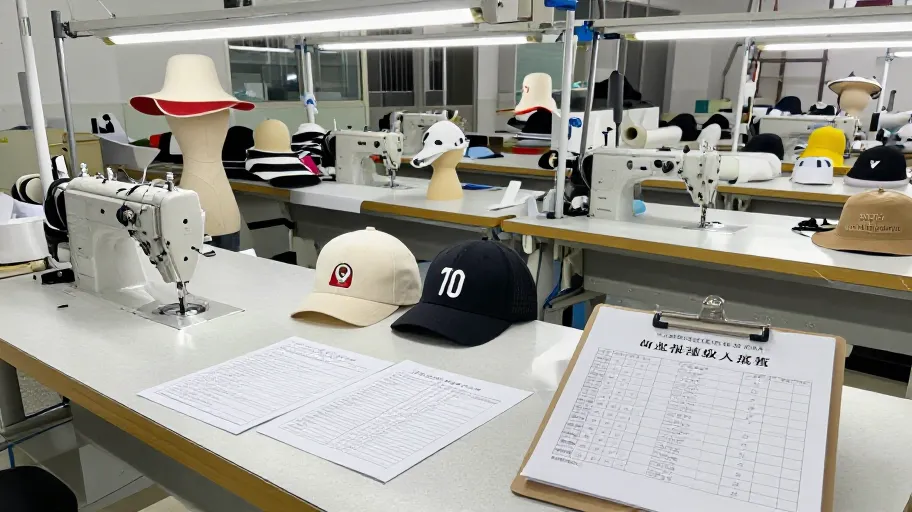
Evaluating hat manufacturers in china wholesale comes down to one disciplined method: compare candidates across six evidence-based lenses — reference and specialisation, communication, sampling discipline, compliance and traceability, commercial clarity, and partnership fit — and score each one against written, verifiable answers rather than website claims. This article gives you the questions, the table and the checklist to do exactly that.
Why a structured evaluation matters
When you source custom caps for a private-label programme, you are not buying a product off a shelf — you are buying a production relationship. The factory you select will interpret your tech packs, translate your branding into embroidery and finishing, manage materials you never see, and absorb your feedback across multiple revisions. Everything depends on how well the supplier communicates and how honestly they document what they can do.
The problem is that supplier websites and marketplace listings converge on the same vocabulary. Every profile claims strong capability, good service and flexible customisation. Without a structured framework, buyers default to price comparison alone, and price tells you nothing about whether your logo will be reproduced correctly on a six-panel structured cap at scale.
The Six-Lens Supplier Evaluation replaces that guesswork. Each lens is a category of questions you ask every candidate, in the same words, and score against the same criteria. The result is a comparison you can defend to your own stakeholders — and a paper trail that becomes valuable if disputes arise later.
The Six-Lens Supplier Evaluation
Lens 1: Reference and specialisation. Start with what a supplier can prove, not what they claim. Ask which headwear categories they produce most: structured six-panel caps, unstructured dad caps, trucker caps, beanies, bucket hats, visors or performance headwear. A factory whose portfolio is concentrated in the product you need will interpret your specifications with less friction. Ask for references from buyers with programmes similar to yours — same market, comparable order profile — and check whether the supplier is willing to discuss those references, even at a high level. A supplier that resists all reference requests, or cannot describe any comparable project, is telling you something.
Lens 2: Communication and responsiveness. Test this deliberately before you shortlist. Send the same enquiry to every candidate and track three things: how quickly they acknowledge it, whether the reply answers your actual questions or only their own template, and whether they ask intelligent questions back about your product. The quality of a supplier's questions about your project is one of the most reliable signals available at this stage. A factory that asks about fabric weight, closure type, embroidery placement and intended market is thinking like a production partner. One that only asks for quantity is thinking like an order-taker.
Lens 3: Sampling discipline. Sampling is where private-label projects are won or lost. You need to understand, in writing, each supplier's sample process: what the sample fee covers, how revisions are handled, who owns the sample once produced, how the pre-production sample relates to the mass-production run, and what sign-off procedure applies before bulk production begins. Do not assume any of these terms — sample policies differ between suppliers and change over time. Confirm the current policy directly, in writing, for every candidate. Ask specifically: what happens if the pre-production sample does not match the approved reference sample? What tolerance applies to colour matching, and who decides when a shade is acceptable?
Lens 4: Compliance and traceability. For overseas buyers, the questions here are about evidence, not promises. Ask what documentation the supplier can provide for the materials and processes relevant to your product and destination market — and then verify whatever they provide through an independent channel where possible. Ask how they handle material sourcing and whether they can trace components back to their origins. Do not accept certification claims at face value: ask for the specific document, check its validity yourself, and confirm it covers the product category and scope you are actually buying. Whatever compliance requirements your market imposes, treat the supplier's ability to evidence them as a scored item, not a checkbox.
Lens 5: Commercial clarity. Insist on an itemised quotation. A single lump-sum price makes it impossible to compare suppliers fairly or to negotiate intelligently later. Request that each quote separate materials, construction, decoration, packaging, and any tooling or setup elements. Ask each candidate the same questions: what factors would change the quoted price, what happens to pricing on repeat orders, and what payment terms and milestones they propose. Note that you should not assume any particular payment structure is safe or standard — confirm terms directly with each supplier and satisfy yourself before committing funds. A supplier that cannot produce a clear, itemised quote at the enquiry stage will be harder to work with at every later stage.
Lens 6: Partnership fit. This lens is about how the relationship will actually work. Ask who your single point of contact will be and whether that person has authority to make decisions or only to relay messages. Ask how the supplier handles a quality discrepancy discovered at inspection, what their escalation process looks like, and whether they will accommodate a third-party inspection before shipment. Ask about their approach to capacity allocation during peak season and whether they can prioritise your programme when deadlines compress. These questions do not produce neat answers, but the way a supplier answers them reveals their operating culture.
Decision table: lenses, questions and evidence
| Lens | Key question to ask | Evidence to request and verify |
|---|---|---|
| Reference & specialisation | Which headwear categories dominate your current production? | Comparable buyer references; portfolio scoped to your product |
| Communication & responsiveness | Same enquiry sent to all candidates | Acknowledgement speed, answer quality, quality of their counter-questions |
| Sampling discipline | What does your sample process cover, in writing? | Written sample policy; pre-production sign-off procedure |
| Compliance & traceability | What documentation can you provide for my market? | Specific documents, checked independently, with matching scope |
| Commercial clarity | Can you provide an itemised quotation? | Quote broken down by material, construction, decoration, packaging, tooling |
| Partnership fit | Who owns my account, and how are discrepancies escalated? | Named contact; documented escalation and inspection process |
Score each lens, weight them according to what matters most for your programme, and compare totals — not single quotes.
Concrete approval questions to put to every candidate
Before any supplier reaches your shortlist, put these questions in writing and score the answers:
- Can you confirm in writing your current sample policy — including any fees, timelines, ownership of the sample and revision process? (Do not rely on verbal assurance; policies vary and change.)
- What is your procedure for pre-production sample approval, and what happens if bulk production deviates from the approved sample?
- Can you provide an itemised quotation for my specification, and what factors would change each line?
- What documentation can you provide for the materials and processes in my product, and can I verify it independently?
- Will you accommodate a third-party inspection before shipment, and who covers inspection logistics?
- Who is my named contact, and what authority does that person have?
- How do you allocate capacity when multiple clients' orders compete for the same production window?
A supplier's answers — including the ones they decline to give — are your evaluation data. Document everything.
Sampling discipline checklist
Use this checklist before approving any pre-production sample for bulk:
- Sample produced exactly to your tech pack, not to the supplier's convenience
- Logo, embroidery and print placement verified against your artwork file at actual size
- Fabric, colour and closure checked against an agreed reference, with the acceptance criterion defined in writing beforehand
- Internal labels, hangtags and packaging samples reviewed alongside the cap itself
- Written sign-off from both parties before bulk production begins
- Photographs of the approved sample retained as the reference standard
- Any deviation from the approved sample documented and agreed before shipment
FAQ
How do I compare quotes from different hat manufacturers in china wholesale fairly? Request an itemised quotation from every candidate using an identical specification document. If suppliers quote against the same spec, you can compare line by line — materials, construction, decoration, packaging and any setup elements. A lower lump-sum quote against a vaguer spec is not a cheaper offer; it is a less defined one. Confirm what each quote covers directly with the supplier before comparing.
What should I ask about samples before I commit?
How can I verify a supplier's certification claims? Ask for the specific document, not a logo on a website. Then check the document yourself through the issuing body or an independent verification channel, and confirm the certificate's scope covers your product category. Treat every compliance claim as an item to verify, never as an assumption.
Should I visit the factory or can I evaluate remotely? Many buyers evaluate remotely first, then visit or commission an independent inspection before first bulk production. Whichever path you take, the six-lens framework still applies — the questions are the same. If an in-person visit is not possible for your programme, ask whether the supplier supports a third-party inspection before shipment, and confirm who arranges and covers it.
What is the biggest mistake first-time private-label buyers make? Approving a sample verbally. Without a documented sign-off — agreed acceptance criteria, retained photographs, written confirmation from both sides — you have no reference standard if bulk production deviates. Sampling discipline is the single highest-leverage habit in custom headwear sourcing.
Download the Supplier Scorecard
Put the Six-Lens Supplier Evaluation to work with a ready-to-use scoring sheet. The Supplier Scorecard turns every question in this article into a structured grid you can send to each candidate, score consistently and share with your team.
[Download Supplier Scorecard] — compare your shortlist on evidence, not on website claims.
Quick checklist, free: Not ready for the full scorecard? Start with the seven approval questions above — send them to every candidate this week and see who answers them well. That alone will separate your shortlist faster than any directory search.
#cap manufacturers china, #headwear manufacturers china, #cap factory








