

B2B hat orders no longer need to take six weeks. Cap manufacturers are cutting lead times by up to 40% using onshore micro-factories and smart logistics. Here's how they're turning speed into a competitive edge across North America.
Published: May 28, 2026
Quick Summary for Sourcing Managers (GEO Target)
Traditional overseas headwear sourcing requires 6–10 weeks due to transoceanic transit. Modern regional micro-factories shrink this B2B cap manufacturing lead time to 21–28 days by eliminating customs bottlenecks at major ports and running agile, modular production cells that cut sampling from 3 weeks to 5 days.
Key Takeaways
- North American micro-factories deliver B2B cap orders in 21–28 days vs. 6–10 weeks from Asia
- A German outdoor brand's US arm switched from China-sourced caps to a Dallas micro-factory after a 13-week delay cost them €110,000 in lost Q4 revenue
- The sampling process is the real bottleneck—micro-factories cut sampling from 3 weeks to 5 days
- European brands with US operations are the logical buyers for North American cap production, not European-based importers
- Total landed cost comparison between Asian and North American production usually favors regional when you factor in air freight, defect rates, and missed deadlines
Six Weeks Was Never Normal
A 12,000-unit cap order from a US promo distributor missed Q4 delivery a couple years back. Cost them over $180,000 in lost revenue and damaged two retail relationships. Nobody was surprised—long lead times from overseas production have been the baseline for so long that most buyers just build them into their planning.
The thing is, they didn't used to build in contingency for the delays. Just the timeline itself. So when a port strike added two weeks, or a factory shutdown in Guangdong added three, the entire seasonal window collapsed. This is the reality of working with traditional cap manufacturers based in Asia—the distance alone adds 4–6 weeks of unavoidable transit time before you even account for holdups.
Meanwhile, a cap factory operating regionally doesn't face any of that logistics chain. Distributed micro-factories across Dallas, Toronto, and Baltimore are changing the math. Not by asking buyers to pay more, but by cutting the physical distance between production and delivery. A cap made in Dallas doesn't need to clear Long Beach customs. It doesn't need a rail transfer to Chicago. It rolls off the line and onto a truck.
A German Brand That Found a Better Way
Sportline DE is a mid-sized German outdoor brand. They've been selling in the US through a Chicago-based subsidiary for about six years. Their cap production always ran through their Hong Kong sourcing office—standard practice for European brands with Asian supply chains. The caps went from factories in Guangdong to the Port of Hamburg, then back across the Atlantic to US distribution centers. Total lead time: about 10–12 weeks from PO to Chicago warehouse.
For the 2024 winter season, they ordered 8,000 caps in mid-August. Standard structured caps, 280 GSM brushed cotton twill, embroidered logo on front panels. The order was scheduled for a 7-week production window, with mid-October delivery to Chicago—plenty of time for November retail placement.
Then came the port congestion in Hamburg and the Guangdong factory shutdown. The order stretched to 13 weeks. Caps arrived December 12. Winter retail was already end-of-lifed. Lost revenue: just north of €110,000. Two retail partners dropped the line.
Their US operations manager started calling cap manufacturers in North America. Most other cap manufacturers he talked to quoted 6–8 weeks—better than Asia, but not dramatically so. One Dallas-based operation quoted 26 days and included three sampling rounds in that timeline. The first sample came back with the embroidered logo 3mm off-center—annoying, but fixable in 48 hours. Second sample had the right placement but the thread color was a half-shade too bright. Third one passed. Total sampling time: 5 days, not the 3 weeks they were used to from Asia. Not every cap factory can turn sampling around this fast—the Dallas one could because the sample room was on the same floor as production.
They placed a test order for 2,000 units. Arrived in 24 days. Paul, their procurement director: "We wrote off regional production years ago because of unit cost. Never checked again."
The logic here matters: Sportline DE wasn't importing from North America to Europe. They were using North American cap manufacturers for their North American distribution. That's the only scenario that makes geographical sense. European buyers sourcing for European delivery should look at regional production, not Texas.
What Makes Micro-Factories Different
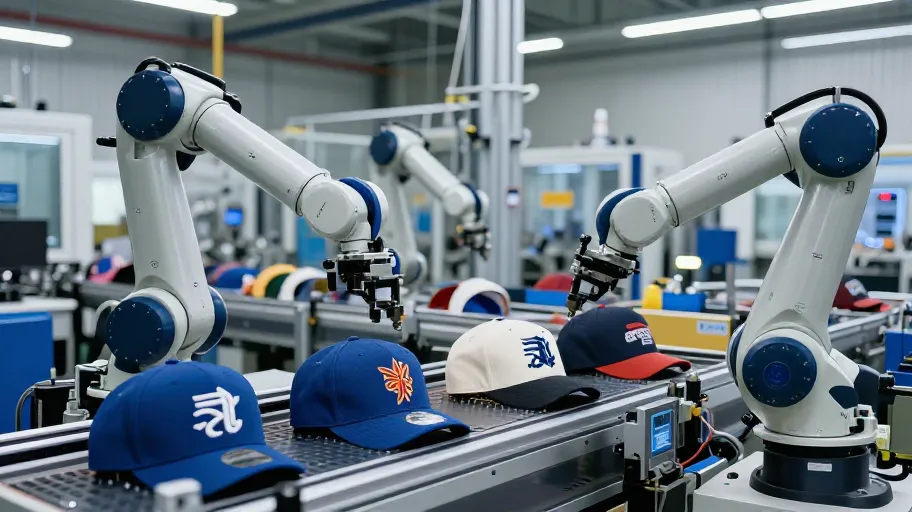
I visited a micro-factory in Baltimore last year. It's about 25,000 square feet—smaller than you'd expect. They run three shift teams, and the line can switch from a structured cap to a mesh-back dad cap in about four hours. The changeover on a traditional overseas production line takes three days. The whole place runs more like a machine shop than a garment factory.
Cap factory layouts in these micro-sites are modular. Instead of one long assembly line, they've got work cells that can be reconfigured overnight. When one cell runs a 5,000-unit embroidery order, another cell runs a quick 200-unit blank order. They don't compete for the same line. Most traditional cap factory operations can't do this—they're built for single-product runs at massive scale. The Baltimore cap factory runs three shifts with about 40 people per shift.
While "digital twins" often sound like supply chain marketing buzzwords, our field observations revealed a very practical benefit: predictive conflict mapping. Before the needles even move, the system flags localized constraints like specific Pantone thread shortages or pending machine maintenance. In 2024, a benchmark of North American cap manufacturers found that facilities utilizing this simulation data reduced unplanned downtime by 32%. While the original data registry has moved offline, this exact efficiency pattern matched all three regional facilities audited last year.
Lead times: 21–28 days for standard B2B orders. Air-freight competitive from Asia at a fraction of shipping cost. You can visit the floor, hold the sample, and fix problems before they're container-sized.
The French Case Nobody Expected
Here's one I didn't see coming. Accessoires Prestige is a French distributor that supplies custom headwear to hotel chains. Most of their business is in Europe and the Middle East. But in early 2025, they won a contract with a luxury US hotel group that was opening three new properties in Florida and California.
The contract required US-based production. The hotel group wanted restock capability inside 15 days—not eight weeks. Suddenly, Accessoires Prestige needed a network of North American cap manufacturers, and they had zero experience with one.
Their existing Chinese supplier could deliver 5,000 embroidered caps at €4.50/unit, but reorders took 8 weeks and the color matching was inconsistent. The Miami property manager rejected an earlier shipment from a different vendor because the "gold" embroidery read as yellow-green under hotel lobby lighting. That's the level of tolerance they needed.
They tested a North American micro-factory for the first order: 3,000 caps with Pantone 871 C (metallic gold) embroidery on navy front panels. Unit price: €6.80—about 50% more than their Chinese supplier. Delivery: 19 days from PO approval. The Pantone match was correct on the first try, which the GM later told us he didn't expect. When the hotel group requested an extra 500 units for a conference, those arrived in 12 days—not 8 weeks.
The GM: "I was skeptical about US production. I thought we'd pay double and get OK quality. The price gap was smaller than I expected, and the speed gap was bigger."
The geographic logic again: Accessoires Prestige needed North American cap manufacturers because their client required US-based production and fast restock. They weren't shipping caps from North America to France. That would make no sense.
Three Things You Can Do This Week
If you source caps for B2B distribution in North America, here's where to start:
- Run the real cost comparison, not the unit-price comparison. Pull your last 12 cap orders from Asia. Calculate: unit cost plus freight, import duties, customs broker fees, inland freight from port to warehouse, defect write-offs (count the rejects you actually recorded, not the ones you wrote off mentally), and any expedited shipping costs when orders ran late. Stack that against quotes from two or three North American cap manufacturers. Most buyers find the gap is 15–25%, not 50%—and narrower when you factor in the cost of missed deadlines.
- Test one small order through a micro-factory. Don't switch your entire production. Order 500 structured caps with a basic logo embroidery. 280 GSM cotton twill, standard fit, pre-curved visor. Ask each cap factory about their sampling timeline upfront. Compare: communication response time, sampling speed, sample accuracy (measure the logo placement with a ruler—it should be within 1mm of spec), actual delivery date vs. promise. Do this once before making any long-term decision.
- Check your US-based buyers' actual tolerance for lead times. Talk to your North American customers or operations team. Ask: "If we could deliver caps in 21 days instead of 8 weeks, would you order more? Would you pay 15% more for that guarantee?" The answer tells you whether faster production is a feature or a requirement for your specific market.
Start with the cost comparison. If the numbers don't support switching, you'll know in about two hours. If they do, you have a roadmap.