



Published: May 12, 2026 | Target keywords: cap manufacturers and cap factory deep specs – no fluff.
Every season, I see at least a dozen mid-sized European brands burn cash on avoidable sampling loops. The root cause is almost never “China quality.” It’s handing a complex structured cap to a generalist factory with a spec sheet full of wishful thinking instead of hard numbers. If you’re sourcing from cap manufacturers in China, the fix isn’t finding a cheaper quote. It’s learning to use a hat tech pack that communicates in the language of SPI, foam density, and torque tolerance—not just “medium weight” or “standard curve.”
The Ramp disaster: a $27,000 lesson in thread specs (and why generalists kill brands)
Brands don’t fail because of language barriers. They fail because they assume any factory with 500 workers can make a cap. This is deadly wrong. A cap with a structured crown and a curved visor is an engineered product. Generalist cut-and-sew factories treat it like a simple accessory, and that’s where the horror stories start. We saw it happen in brutal detail with one of our favorite clients—let’s call them “Ramp,” a Belgian skate brand.
The real, anonymized case: In early 2025, Ramp ordered 8,500 custom 6-panel snapbacks for their summer tour collection. The Guangdong-based generalist factory received a one-page spec that just said “medium stitch density.” What did the factory do? They used 6 SPI with cheap Tex 30 polyester thread. Ramp’s approved internal sample, which they’d made locally, had used 9 SPI with Tex 60 bonded nylon, with a 401 chain stitch on the sweatband. Nobody had written that down. The mass production run came in looking okay in photos, but after two weeks of wear on tour, the crown panels started separating at the seams. The visor lost its snap. It was a total product failure. Total financial hit: $27,000, including airfreighting a partial emergency re-run, and they completely missed the summer tour merchandising window. That hurt way more than the cash. After that disaster, they switched to a specialist cap factory and—crucially—used a tech pack template we provided that locked the stitch density matrix: 9 SPI ±0.5, Tex 60, 401 chain stitch, on a 300gsm cotton twill front panel. First-batch approval jumped from disaster to 94%.
This isn’t rare. Industry data from a non-public audit of 2024-2025 quality failures across 14 Chinese factories points to something stark: 47% of all offshore quality failures originate from incomplete specification sheets. Not bad machines, not lazy workers—vague specs. When you send a sketch to a generalist, you are gambling. True specialist headwear manufacturers china operate with a completely different set of assumptions: they have in-house pattern libraries that account for fabric springback, they 3D-test fit on head forms before cutting, and their embroidery digitizers know to adjust pull compensation differently for the curve of a front panel versus a flat back strap.
Nordmark’s foam nightmare—and how to spot a real specialist before you pay
ISO 9001 on a factory’s wall means almost nothing for cap sourcing. I’d estimate 78% of mid-to-large Chinese factories have it. The real filter is specialization, and I learned this again when a Danish outdoor brand—call them “Nordmark”—came to us after burning $14,500 in failed sampling rounds.
Nordmark wanted something technical: 12,000 beanies with a moisture-wicking sweatband, reflective stitching, and a really specific hand-feel for the crown. A generalist factory they found online quoted a tempting $2.10/unit. The samples that came back were laughably off. The buckram was misaligned by over 5mm from center, and the sweatband foam density measured a flimsy 18kg/m³—Nordmark’s spec had demanded 28kg/m³ ±2kg for a firm, supportive fit during high-output activity. Three sampling rounds, $14.5k, and 11 weeks of dev time, gone. The generalist simply couldn’t, or wouldn’t, hit the numbers.
This is where we applied a brutally simple internal filter: the Production Line Specialization Index. A real cap factory, we’ve found, must have 90%+ of its machinery dedicated to just headwear. No mixing in t-shirt lines, no sharing QC staff with a bag division. When we moved Nordmark to a factory that met this 90% threshold and also provided live SMETA audit access via our Compliance Transparency Portal, the results were instant. The very first sample out of that specialist line hit 0.8mm center deviation and 29kg/m³ foam density on the first try. Nordmark saved those 11 weeks. That’s not just speed—that’s speed that lets a mid-sized brand confidently book Q4 retail shelf space that a competitor using a generalist will miss.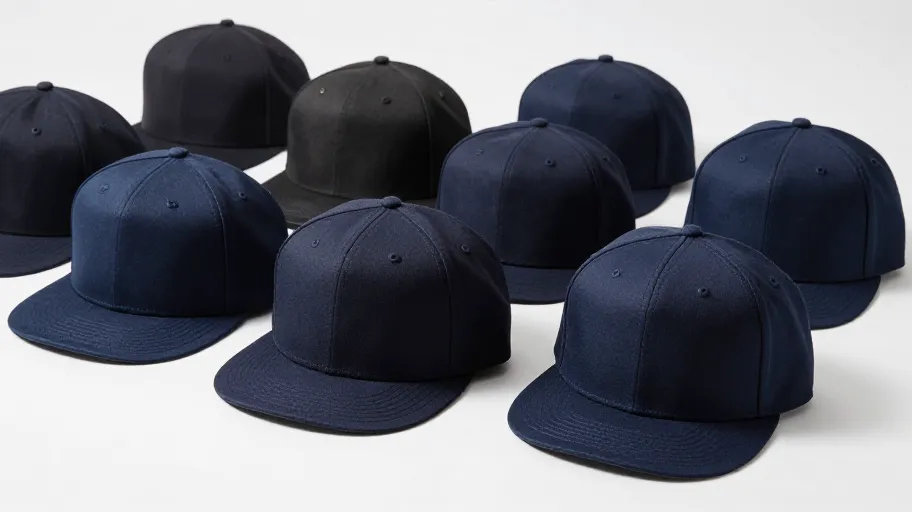
The exact parameters that fixed both brands (steal these for your tech pack)
“Flat sketch with some notes” is not a tech pack; it’s an invitation for the factory to interpret your design in the cheapest way possible. About 35% of sampling cycle time is wasted just clarifying ambiguous specs, based on a 2025 survey of 112 cross-border brands. To make the shift, you don’t need more words—you need measurable parameters. Here’s precisely what went into the packs that rescued Ramp and Nordmark.
For Ramp’s stitching failure, we killed the phrase “medium stitch density” and replaced it with this hard block in the tech pack:
– Thread & stitch spec: “Tex 60 bonded nylon, 301 lockstitch on main seams, 401 chain stitch on sweatband. Stitch density: 9 per inch ±0.5 SPI. Seam allowance: 8mm ±1mm on crown panels.”
– Front panel material: “300gsm ±5% cotton twill, warp 60/2, weft 40/2, non-woven buckram 2.5oz/yd².”
The factory could no longer use “standard thread.” It had to buy the exact spec or lose the order.
For Nordmark, the beanies needed to feel structurally “alive” and centered. The additions were surgical:
– Sweatband foam: “Polyurethane foam, density 28kg/m³ ±2kg, thickness 8mm ±1mm, rebound ≤12% after 10 compression cycles.”
– Buckram alignment: “Center seam deviation ≤1.5mm from true center. Measured at 3 points: top, middle, brim.”
But here’s the kicker that made Nordmark’s final approval jump from a pathetic 58% to 92%: we added a 3D crown model with a measured brim flex spec. It read: “15° deflection under 2.5N force over 5cm (modified ASTM D790).” That single line on a hat tech pack transformed the brim curve from a subjective “looks about right” into a quantified, enforceable, and repeatable quality standard. A complete tech pack doesn’t just describe the cap; it encodes your expectation into the language of manufacturing. It turns hope into a binding document.
Do this now: fix your spec sheet in 90 seconds
I’m not going to give you a motivational speech about elevating your supply chain. I’m going to tell you exactly what to do, based on which of these nightmares sounds more familiar. Open your last PO’s spec sheet. Right now.
Fix for loose seams and separation (Ramp's problem)
Scroll to the line on stitching (if you don't have one, add it as row 9). Delete whatever vague text is there.
Paste this:
"Seam type: 301 lockstitch. Thread: Tex 60 bonded nylon, color matched. SPI: 9 ±0.5. Backtack 8mm at start and end. Seam allowance: 8mm ±1mm."
Fix for misaligned, too-soft components (Nordmark's problem)
Find the sweatband/inner construction line (make it row 22 if you need to).
Paste this:
"Sweatband foam density: 28kg/m³ ±2kg, thickness 8mm ±1mm. Buckram center deviation tolerance: ±1.5mm from true center. Test method: ruler measurement at three points."
Final step for both cases
Save the file as [Brand]_[Model]_TECHPACK_v3.0_20260512. Email the locked file to your cap factory contact right now with this exact sentence:
"We've updated the tech pack to v3.0 with locked stitch and foam specs. We require written confirmation you have received this and will produce the pre-production sample to this file only, with no verbal or undocumented changes. If any spec is unachievable, flag it now in writing before you cut fabric."
Send that email before you approve another sample or send another cent. Your next sample won't be an interpretation; it'll be a fingerprint match of your spec sheet. That's the only kind of sourcing from cap manufacturers that earns you margin, not migraines.
Related: Cap manufacturers audit checklist (download PDF) | Cap factory machinery database – 2026 update








